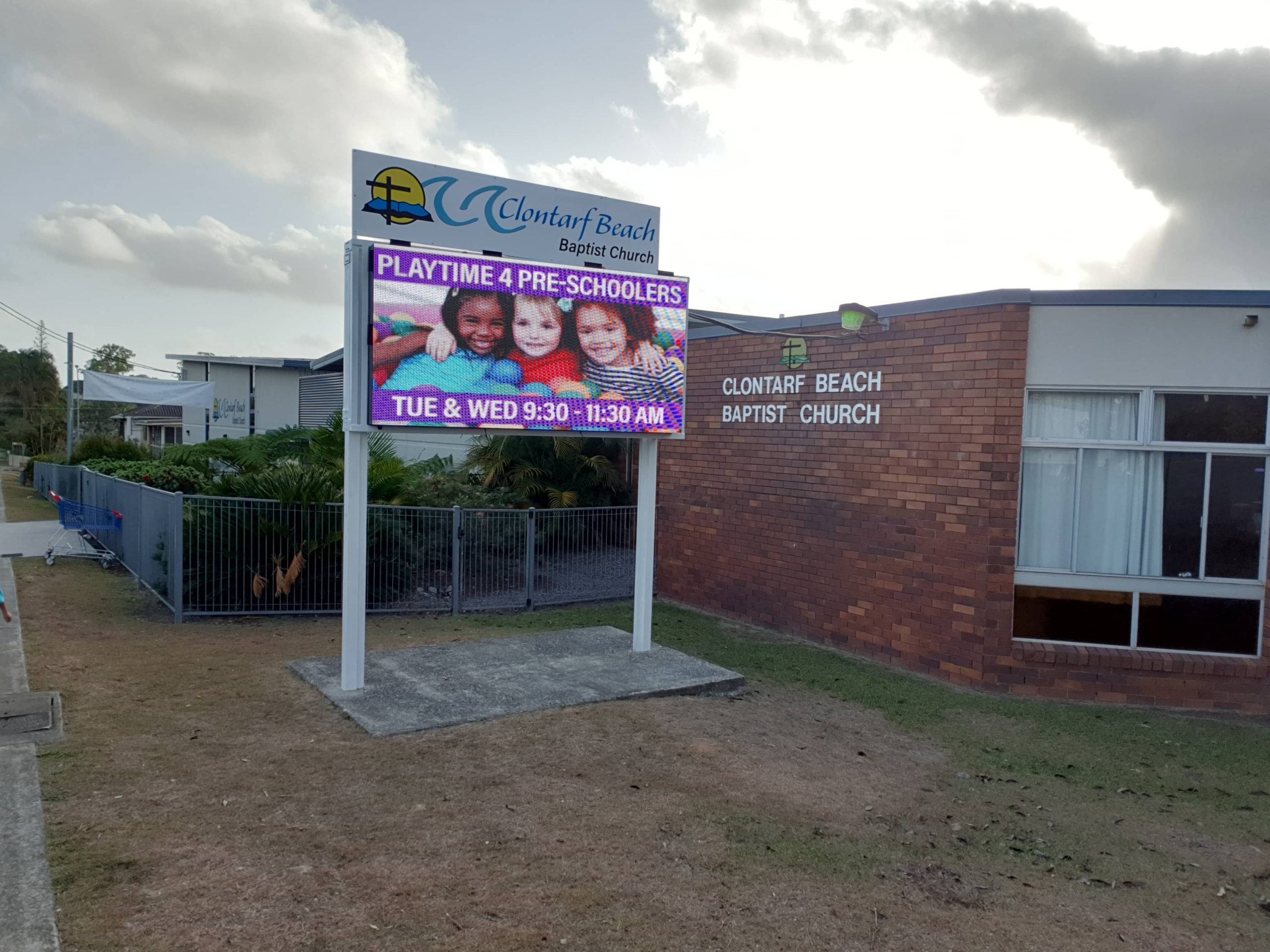
A church LED sign can do much more than tell people what time Sunday worship starts. That is often the first use churches imagine, and it is certainly an important one, but it is only the beginning. A well-used sign does not just post service times. It welcomes first-time visitors before they step out of the car. It reminds regular attenders what is happening this week. It helps the wider community understand that the church is active, open and engaged. It creates visibility for youth programs, support groups, family events, outreach drives and seasonal services. It gives practical guidance when people need it, and encouragement when they least expect it. Blink Digital’s own church LED signs page already points to this broader role, describing church LED signs as a way to share worship schedules, inspirational messages and community announcements through bright, energy-efficient displays suitable for indoor and outdoor use. The same page also positions Blink Digital as a Brisbane-based provider with more than 22 years of experience helping churches across Australia communicate more clearly with durable, easy-to-update signage.
That wider communication role matters because most churches are not only trying to inform their existing congregation. They are trying to care for people, welcome newcomers, strengthen participation, and remain visible in the life of the local community throughout the week. Church communication has become more fragmented over time. Bulletins are still useful, but many people skim them. Emails are missed. Social posts disappear in crowded feeds. Verbal announcements work for those already in the room, but not for the person driving past on a Wednesday evening or the family trying to work out where to go on their first visit. Several church signage resources make the same practical point: digital signs work because they communicate in places people are already physically present, such as entrance areas, lobbies and shared spaces, without asking them to open an app or read a long message elsewhere.
This is where the strategic value of LED signs for churches Australia really begins. A church sign is not just a modern replacement for a plastic-letter noticeboard. It is a communication surface that can be used to reduce friction, increase warmth, and extend the church’s voice beyond one service window each week. Blink Digital is well placed to help churches make that shift because the company already offers church LED signs specifically designed for clear, engaging indoor and outdoor communication. What many churches need next is not another explanation of what an LED sign is, but a practical guide to what they should actually display on it, how that content should change through the week, and how to keep every message warm, readable and aligned with the mission of the church.
A church sign should feel like ministry, not clutter
The strongest church signs do not feel like digital clutter. They feel like hospitality. They answer simple questions. They reassure people that they are in the right place. They make it easier to understand what the church does, what is happening this week, and how someone can take a next step. That is why the most effective church message board content starts with purpose rather than volume.
One of the biggest mistakes churches make is trying to use the sign as a compressed version of every announcement they have. A special service, a roster reminder, youth group, a food drive, a verse, a prayer night, a volunteer thank-you, a fundraising update, a Bible study time, a men’s breakfast date and a children’s ministry prompt all rotate through the screen in one long loop. Technically, the sign is “full of information”, but practically, much of that information goes unread. People driving past or entering the property do not have the time to process a crowded queue of messages. The sign becomes background rather than guidance.
A better approach is to think of the sign as a ministry touchpoint. Each message should serve one of a few clear purposes. It can welcome. It can guide. It can invite. It can encourage. It can remind. It can reassure. Once churches begin making those distinctions, content decisions become clearer. Disign’s church digital signage guidance supports this way of thinking by framing church screens as tools that welcome, guide and connect the community, rather than just dump announcements onto a display. It also points out that churches benefit when screens reduce confusion for guests, support clearer next steps, and keep messaging consistent across spaces and ministries.
That is why the best signs rarely feel overloaded. They feel intentional. A visitor sees a warm welcome and service time. A family notices where children’s check-in is. A regular attendee sees a reminder about a youth event or food drive. A neighbour driving past sees that the church is active and approachable. That is not a small shift. It changes the sign from a passive board into an active part of community-building.
Beyond Sunday: why weekday messaging matters
Many churches still treat the sign as if it only matters in the hour before worship begins. But church life is not confined to Sunday morning. The real work of connection often happens between services. Midweek gatherings, support programs, youth nights, prayer groups, counselling, food relief, volunteer coordination, community meals and seasonal outreach all happen across the rest of the week. If the sign only ever reinforces service times, it misses most of the church’s visible public life.
That is especially important in local neighbourhoods where people may not know what the church actually does. A church can be deeply engaged in practical care, youth support, community meals and local partnerships, but if the sign only displays “Sunday 9 am” and “Sunday 5 pm”, much of that ministry stays invisible. By contrast, a sign that occasionally surfaces messages about community support, school holiday programs, family events or outreach activities communicates that the church is present and active beyond the sanctuary doors.
Resources focused on church digital signage repeatedly make this point in slightly different ways. ScreenLoom’s practical guide notes that churches use screens for far more than worship schedules, highlighting service announcements, youth programs, volunteer sign-ups, mission updates and holiday schedules as part of the wider communication load churches already carry. Disign similarly positions church digital signage as a way to display event reminders, next steps, wayfinding, ministry updates and giving prompts across the week, not just during worship.
For Blink Digital clients, this opens up a more strategic conversation. Instead of asking, “What should be on our church sign?”, the more useful question is, “What does our community most need to know this week, and what kind of message will help them notice it?” Sometimes the answer is a clear Sunday time. Sometimes it is a welcome for first-time guests. Sometimes it is a practical reminder about the youth night, food drive or Christmas service. Churches that use signs this way tend to feel more alive in the public eye because their message reflects the real rhythm of church life.
What first-time visitors need to see before they arrive
For a church, one of the most important audiences is the person who has never visited before. That person often arrives with a mix of curiosity and uncertainty. They may not know where to park, whether the service is formal or relaxed, whether children’s programs run at the same time, or whether they will feel out of place. The sign cannot answer every one of those concerns in detail, but it can lower anxiety before the person even steps onto the property.
This is where warm, direct messaging matters. A sign that simply lists times is useful, but a sign that says “You’re Welcome Here – Sunday 9 am & 5 pm” sends a very different signal. If the church has a children’s check-in point, accessible parking, a café after the service, or a newcomers’ area, the sign may not list all of it at once, but it can rotate welcoming messages that build confidence ahead of arrival. One church signage source points out that digital signs can help first-time visitors by offering clear, gentle information about where to go for parking, nursery or guest check-in, and argues that this kind of practical welcome can be the difference between someone driving in and someone driving on.
There is also a readability issue here. Churches sometimes assume that a welcoming tone means writing long, expressive messages. It usually works better to do the opposite. Keep the wording short. Keep the tone warm. Use one clear idea at a time. “Join us this Sunday.” “All welcome.” “New here? You’re invited.” “Kids program available.” These are simple, but they work because they are immediately understood. Blink Digital can help churches balance warmth and readability so the screen does not become sentimental or generic. The best welcome messages still feel specific to the church’s identity, but they remain easy to absorb at a glance.
Balancing inspiration with practicality
One of the distinctive strengths of church signage is that it can carry both practical information and spiritual encouragement. That is part of what makes church LED sign ideas different from most other business signage conversations. Churches are not only sharing operational messages. They are also trying to reflect faith, mission and care. The challenge is getting the balance right.
Scripture and inspirational messages absolutely have a place. Visual Electro-Matic’s examples highlight the way Bible verses and uplifting messages can create a sense of connection beyond Sunday, with the possibility that passersby may even start looking forward to what appears on the sign each week. That kind of content can help a church become a familiar source of encouragement in its local area.
But if every message is generic inspiration, the sign can lose practical usefulness. People still need to know what is happening and how to engage. That is why the strongest churches treat inspiration and practicality as partners, not competitors. A service-time slide may run alongside a warm invitation. A Christmas event promotion may sit alongside a short seasonal scripture. A community pantry message may be paired with a phrase of encouragement. The key is intentional rotation, not muddle. A church does not need to choose between being useful and being uplifting. It does need to decide what should lead in each moment.
For example, in the days leading up to Easter, practical invitations to service times and Good Friday gatherings may need priority. In quieter weeks, a thoughtful scripture or short encouragement may be exactly right. In times of local hardship, a message about support services, prayer availability or community meals may matter more than either. Blink Digital can help churches think in these content layers so the sign always feels mission-aligned rather than mechanically repetitive.
Planning a weekly rhythm for church digital signage content
One of the easiest ways to improve church digital signage content is to stop updating it randomly and start giving it a weekly rhythm. Churches do not need a complicated broadcast schedule. They just need a consistent structure that reflects how people interact with the church across the week.
Early in the week, content often works best when it reflects on what has just happened and points gently toward what is next. If Sunday included baptisms, a special guest or a successful outreach event, the sign can acknowledge that with gratitude and warmth. This is also a good time to surface reminders about recurring midweek programs, prayer gatherings, support groups or community services.
By midweek, the sign can shift further into practical invitation mode. Youth nights, Bible studies, playgroups, food pantry sessions, community meals, volunteer rosters and local partnerships are often the kinds of things happening between Sundays. These messages help regular attenders remember and help neighbours understand that the church is active in many different ways.
Later in the week, the sign can start turning back toward Sunday. Service times, sermon series prompts, kids ministry notes, parking or check-in guidance, and warm welcome messaging become more important as attendance approaches. If there is something special on the weekend — communion, baptisms, a guest speaker, a family event, a shared lunch — that content can become more prominent.
This kind of rhythm works because it respects the reality of attention. People notice what is timely. Messages that feel obviously connected to what is happening now are more likely to be read and remembered. It also helps the church staff or volunteer team avoid last-minute panic. Rather than asking “What should go on the sign today?”, they work from a rhythm that already makes sense.
Seasonal planning: Easter, Christmas and the moments people are most ready to respond
If churches want their sign to matter more, they should pay close attention to the calendar. Some seasons create far more openness than others. Easter and Christmas, in particular, are moments when many people are more receptive to an invitation, more likely to notice local messaging, and more inclined to return to church spaces even if they are not regular attenders.
This is where content planning matters. A sign should not switch to Christmas Eve messaging two days before the event. Seasonal communication works best when it unfolds in stages. First comes awareness. Then invitation. Then practical details. Then welcome. Then follow-up. An LED sign is well suited to this because it can change through each stage without the cost or delay of reprinting.
For Easter, that might mean beginning with a simple seasonal theme and service awareness, then moving into clearer invitations, then displaying final practical details closer to the weekend. For Christmas, the rhythm may be longer. The sign can first acknowledge the season, then promote community carols, toy drives or support initiatives, then move into service times and family invitations as the date approaches. Visual Electro-Matic highlights holiday programming as a strong use case for church LED signs because programmable signs make it easier to build visibility in the lead-up to major annual events.
The important thing is not to let the sign become a last-minute afterthought. Seasonal church messaging is most effective when it feels intentional and aligned with the broader ministry calendar. Blink Digital can support churches not only with the physical sign, but with a more strategic approach to what gets shown and when, so major moments like Easter and Christmas feel clear, inviting and well prepared.
Youth, families and ministry-specific communication
Churches often communicate as if everyone needs the same message at the same time. In practice, different parts of the church community respond to different invitations. Families want to know what is happening for children. Teenagers notice youth nights and camps. Young adults may respond to social events, studies or service opportunities. Older members may be more focused on pastoral care, weekday gatherings or community support.
A church LED sign cannot carry every message all the time, but it can make room for the ministries that form the rhythm of church life. This matters because one of the strengths of digital signage is flexibility. It allows churches to surface the right ministry at the right time without printing new banners for every short campaign. Disign’s church digital signage page explicitly mentions ministry-specific messaging and the ability to tailor announcements for different ministries, spaces or campuses while keeping branding consistent.
That opens up useful possibilities. A sign can support youth ministry visibility during the week, especially if the youth gathering happens on-site in the evening and local families pass the building around that time. It can highlight children’s check-in or family-friendly service notes ahead of Sundays. It can remind people about support groups, holiday clubs or community-facing family events. The sign does not need to become hyper-segmented to be effective. It just needs to make sure the ministries most central to the week are not invisible.
The key is to keep these messages specific and warm. “Youth Friday 7 pm” is a start, but “Youth Friday 7 pm – All teens welcome” does more relational work. “Kids church during both services” tells families something practical and reassuring at the same time. Blink Digital can help churches present these messages clearly so they support ministry rather than just filling the screen.
Outreach, support and local involvement deserve visible space
A church sign should not only talk about what happens inside the building. It should also make visible the church’s involvement in the wider community. That may include food relief, support groups, counselling, chaplaincy, school partnerships, local fundraising, volunteer drives, community meals or neighbourhood events. These are not side notes. They are often some of the clearest public expressions of the church’s mission.
This is one of the areas where church communication signage can build trust beyond the congregation. A neighbour may never attend a service, but they may notice a free community meal, counselling availability, a food drive or a support group meeting. They may not remember the exact wording, but the pattern matters: the church appears active, caring and present. Mega Sign’s church LED guidance specifically points to community outreach, youth activities, support services and local events as high-value content categories because they increase awareness of the church’s practical work in the neighbourhood.
The message structure here needs care. Outreach content should not sound like generic promotion. It should feel welcoming and grounded. “Community Pantry Thursday 10 am.” “Need prayer? We’re here.” “Christmas hamper donations welcome.” “Free family movie night.” These are clearer and more human than abstract slogans. Churches that use signs this way often discover that the screen becomes part of their local witness, not just their internal communications.
Fundraising and giving without sounding transactional
Fundraising and giving prompts can be awkward if they are handled poorly, but they do not need to be. Churches often have legitimate reasons to use signage for generosity campaigns: mission projects, building appeals, local support drives, Christmas hampers, youth camp sponsorship, school supply collections, or practical community aid. The key is tone.
If a sign reduces giving to a blunt demand, it can feel transactional. If it frames generosity around purpose, participation and community impact, it becomes much more aligned with church life. A giving-related message is often strongest when it tells people what the contribution supports. “Support our winter food drive.” “Help send students to camp.” “Toy donations welcome this week.” These kinds of prompts are specific, understandable and anchored in visible action.
Disign includes giving prompts among the practical uses of church digital signage, but it places them alongside welcome messaging, event updates, next steps and ministry communication rather than as a standalone financial ask. That is a useful balance.
Blink Digital can help churches design these messages so they feel consistent with the rest of the church’s communication style. Generosity messaging should fit naturally within the broader flow of the sign rather than looking like a separate, commercial campaign dropped awkwardly into a ministry context.
Readability matters more than creativity
Churches often want signs to feel warm, expressive and visually engaging. That is understandable. But there is a point where creativity begins to work against readability. Decorative fonts, overly long quotes, weak contrast, crowded backgrounds and too many slides can all reduce the practical usefulness of the sign.
If the sign is outdoors, especially near a road, readability becomes even more important. People may only have a few seconds to process the message. Blink Digital’s own church page already emphasises that church LED signs are designed for visibility in bright daylight as well as evening conditions. That hardware advantage only reaches its full potential when the content is designed clearly.
In practice, churches should use:
- short lines
- large, plain fonts
- strong contrast
- one main idea per slide
- clear timing for slide changes
- images only when they support the message, not crowd it
This does not make the sign boring. It makes it usable. A simple, warm message is far more effective than a beautiful but unreadable one. Blink Digital can help churches strike that balance so every message feels approachable, visible and mission-aligned.
Keep the sign consistent with the rest of the church’s communication
The sign should not feel like it belongs to a different church than the website, bulletin, social media or foyer screens. It should carry the same tone, style and identity. That does not mean every channel is identical, but they should all feel connected.
If the church is warm and community-focused online, the sign should not suddenly sound formal and distant. If the church uses a clear visual identity in other materials, the sign should follow that pattern. Consistency builds recognition and trust, and it also makes content easier to prepare. Churches that create a few standard templates for welcome messages, event notices, seasonal promotions, scripture slides and practical reminders tend to communicate more clearly because the structure is already in place.
This is especially important for churches with more than one campus or several internal screens. Disign emphasises the value of consistent branding and centrally managed updates across multiple screens and locations, which helps avoid mismatched messaging between ministries or campuses.
Blink Digital can support this by helping churches think not only about the sign itself, but also about the visual and communication system around it.
The sign should serve the mission, not distract from it
This may be the most important principle of all. A church LED sign is a tool. It should serve the mission of the church. It should help people feel welcomed, informed, invited and encouraged. It should reduce confusion and increase clarity. It should make practical information easier to see and important moments easier to promote. It should support ministry, not become a distraction from it.
That means churches do not need to use the sign for everything. They need to use it well. They need to know when to lead with service details, when to display scripture, when to promote a community event, when to celebrate, when to guide, and when to stay simple. A sign that tries to do every job at once usually does none of them particularly well. A sign that understands its role can become one of the most useful communication tools a church has.
Blink Digital already offers church LED signage built for exactly this kind of communication: bright, easy-to-update displays for worship schedules, community announcements and inspirational messaging, with indoor and outdoor suitability and Australian support. The next step is helping churches use that capability more strategically across the full week.
Final thoughts: what to display beyond service times
If a church sign only ever shows service times, it is useful. But it is not yet doing everything it could. It could be welcoming first-time visitors more warmly. It could be making ministries more visible. It could be supporting safer and clearer weekly communication. It could be inviting the neighbourhood into Easter and Christmas events more effectively. It could be encouraging people with timely scripture and practical next steps. It could be reminding families about youth nights, support programs, pantry drives, prayer gatherings and outreach opportunities. It could be showing, in a simple but visible way, that the church is active all week, not just for one hour on Sunday.
That is where stronger church LED sign ideas begin — not with more content, but with better purpose. A church sign works best when it reflects the life of the church as it actually happens: worship, welcome, care, invitation, service and community. When it does that, it becomes much more than a schedule board. It becomes part of how the church builds connection.
Contact Blink Digital for church LED signs that support stronger communication
If your church wants signage that does more than list service times, Blink Digital can help.
From practical advice on church digital signage content and warm, readable church message board content, to choosing the right LED signs for churches Australia and planning clearer church communication signage, Blink Digital can help your church create a sign strategy that welcomes, informs and connects people all week long.
Contact Blink Digital today for more information, a quote, or help planning a church LED sign approach that feels clear, mission-aligned and genuinely useful to your congregation and community.