Why real estate agency LED signs matter in a portal-first market
Australia’s property search journey is overwhelmingly digital, with realestate.com.au reporting a record audience of 13.05 million Australians in October 2025 and more than 60 per cent of the adult online population using the platform that month. That matters because it changes the role of the physical agency office. A shopfront no longer needs to replace the portals. It needs to do something the portals cannot do as well: create immediate local presence, reinforce trust in a suburb specialist, and turn passing traffic into warm enquiries. That is exactly where real estate LED signs and well-planned digital signage become commercially useful rather than decorative.
Blink Digital’s real estate page already positions LED signage as a way to turn an office frontage into a 24/7 property showcase and to keep listings, inspections, auctions and sold results current with bright digital displays visible day and night. Blink Digital also presents itself as a Brisbane-based supplier with installation, consulting, maintenance and design capability, which makes the company a logical fit for agencies that want more than a screen dropped into a window. For a real estate office, that combination matters because the sign is not only a marketing asset. It is part of the branch’s daily communication system.
That is why the best digital signage for real estate agencies does not behave like a looping slide deck someone forgot to update last Thursday. It should behave like a living extension of the campaign calendar. When a listing launches, the screen should help create urgency. When an open home approaches, the screen should make the time impossible to miss. When an auction is coming, the display should build anticipation without confusing buyers. When nothing major is launching, the same screen should keep the agency credible with sold results, suburb knowledge, agent branding and appraisal messaging. Blink Digital can help agencies plan that content rhythm so the screen stays active, useful and brand-safe rather than random.
For local search as well, this matters. Prospects looking for LED signs Brisbane, digital signage Brisbane, or more general led signs and digital signage are rarely searching out of idle curiosity. They are often comparing suppliers, planning an upgrade, or asking what format will actually work for their window, wall, awning or roadside exposure. A strong agency-focused article can meet that search intent while also showing how Blink Digital can help real estate businesses move from static print cycles to a more responsive and higher-impact display strategy.
What to show on property display LED signs across the sales cycle
The biggest mistake agencies make with property display LED signs is assuming that “property content” is one thing. It is not. The message that works on the first day of a new campaign is different from the message that works on Saturday morning before inspections. It is different again from the message that works on Monday after a strong auction result. Good real estate LED signs follow the campaign cycle. Great ones also know what to do in the gaps between campaigns, because those are the moments when a shopfront can easily look stale if nobody has planned ahead. Blink Digital can help agencies build templates for each campaign phase so updates stay fast and controlled.
When a new property launches, the screen should do three jobs very quickly. First, it should announce that something fresh has hit the market. Secondly, it should tell viewers what kind of property it is and where it is. Thirdly, it should give them one clear next step, such as scan a QR code, call the office, or visit the next inspection. This is not the moment to dump every available photo, paragraph and feature list onto the screen. For launch messaging, stronger results usually come from a hero image, a suburb or street identifier, a simple label such as “Just Listed”, and one action prompt. That approach aligns with Blink Digital’s own positioning of LED signage as high-impact, bright property promotion designed to keep listings current and visually prominent.
As the first inspection approaches, the sign should shift from awareness to scheduling. Blink Digital’s real estate page specifically highlights promoting inspections and time-based messaging, which is important because open homes are time-sensitive events. If your agency displays “Open Saturday” all week without the time, the message is weak. If your screen says “Open 10:00–10:30 am Saturday” on Friday evening and Saturday morning, the message becomes actionable. A practical screen strategy is to change the weighting of content as the inspection gets closer: broad property awareness early in the week, then clear date-and-time promotion in the final 24 to 36 hours.
Auction campaigns need a different tone again. This is where digital signage can outperform static posters because countdown-style messaging, rotating reminders and automatic schedule changes are far easier to manage digitally than through reprinting. Blink Digital already promotes LED signs as a way to run scheduled inspection and auction messaging and then switch campaigns without manual swaps. That makes auction content especially powerful in agency windows, because the same screen can show “Auction This Saturday”, then “Auction Today”, then “Sold Under the Hammer” in sequence as the campaign progresses. The operational benefit is just as important as the visual benefit: agency staff are not stuck physically replacing materials every time the campaign status changes.
There is also a trust angle here. Regulators and governments continue to scrutinise misleading property advertising and underquoting, and New South Wales announced reforms in 2026 that would require sellers to publish price guides across all listings as part of a crackdown on underquoting. Even if an agency is not operating in NSW, the broader lesson carries across Australia: if a screen displays pricing guidance, auction timing, offer status or campaign claims, the information needs to be current and supportable. In practice, that means your screen content should be treated with the same care as your portal listings and social campaigns. Blink Digital can help with the display system, but the agency still needs a disciplined approval process for what goes on it.
After a sale, many agencies rush on to the next campaign and forget how valuable sold content is. That is a missed opportunity. Blink Digital’s real estate page explicitly calls out sold results as a core use case, and for good reason. Sold screens do not just celebrate a transaction. They provide social proof, reinforce suburb expertise, and reassure future vendors that the office is active in the local market. An LED window filled only with current properties can look transactional. A window that also features recent sold outcomes can look established, trusted and in demand.
The strongest sold-result content is specific enough to feel real without becoming cluttered. “Just Sold in New Farm”, “Another Auction Result in Paddington”, or “Sold by the Blink Digital client team in Ashgrove” style frameworks work well because they are legible at a glance and still locally meaningful. If the agency has permission and it fits the brand, a sold price or “multiple bidders” message can add more substance. If not, the combination of suburb, property image and agent branding is often enough. The important thing is consistency. A screen that shows solid, frequent sold activity can do as much for vendor confidence as it does for buyer interest.
Between listing launches, open homes and auction pushes, many agencies wonder what should fill the gaps. This is where real estate LED signs can become a true business-development asset. Instead of leaving old campaigns up too long, agencies can rotate suburb market snapshots, “Thinking of selling?” prompts, appraisal calls to action, property management messages, buyer database calls, finance partner mentions where appropriate, and agent introduction panels. Blink Digital’s broader services pages present digital signage as a flexible communication tool backed by consulting, design and custom screen solutions, which supports that wider strategic use. The screen should not go dark just because there is no auction on Saturday.
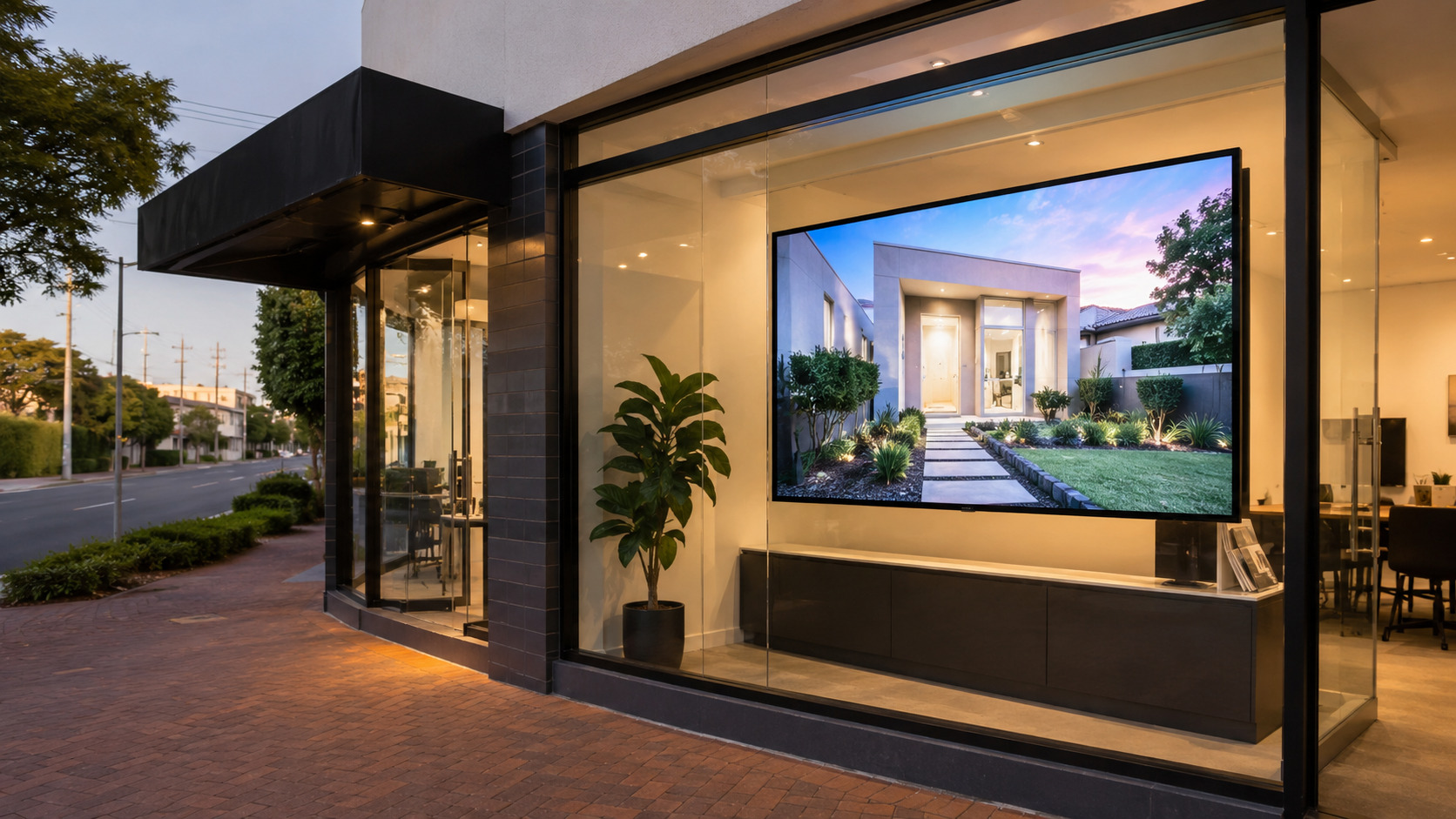
After hours, the logic becomes even stronger. Blink Digital directly markets its real estate signage as a way to turn the shopfront into a 24/7 property showcase. That is significant because one of the main advantages of a streetfront agency over a pure online brand is the physical presence of the office itself. A lit, current, premium-looking window after hours keeps the branch visible when the doors are shut. People walking a dog, heading to dinner, or driving through the suburb at night can still see active listings, sold proof and agency branding. That is not just decorative exposure. It is part of how a local office stays present in the suburb outside trading hours.
How digital signage for real estate agencies should change for passing traffic and window browsers
Not every viewer sees the screen in the same way, so not every message should be designed the same way either. Some viewers will glance at the display while driving past. Some will notice it while walking by. Others will stop and browse the screen from only a few metres away. The content strategy should reflect those different behaviours. A sign that tries to serve all three audiences with the same dense layout usually ends up serving none of them particularly well. Blink Digital’s custom-design and placement services are useful here because the best message structure depends on where the sign sits, how far viewers stand from it, and whether the agency gets more vehicle traffic, foot traffic or both.
For passing traffic, simplicity wins. Guidance for roadside electronic signs from the US Federal Highway Administration emphasises that messages should be simple, direct, brief, legible and clear. While that guidance is written for traffic information rather than real estate marketing, the viewing logic still applies: people moving past a sign quickly do not have long to decode it. For a suburban real estate office on a busy road, the best roadside-facing screen messages are usually short, high-contrast and singular. Think “Open Sat 11 am”, “Auction This Weekend”, “Just Listed in Bulimba” or “Sold in Seven Days”, not five competing headlines stacked into one frame.
For pedestrians and deliberate window browsers, you can afford more detail, but “more detail” should not turn into visual noise. A shopper or buyer standing outside the office can process property images, suburb names, bed-bath-car icons, inspection times and QR codes far more easily than someone passing in a car. This is where property display LED signs can do useful layered communication. The first frame can capture attention with the hero image and suburb. The second can provide the next inspection. The third can show a call to enquiry. Because the viewer is stationary or slow-moving, the screen can communicate in sequence rather than cramming everything into one slide.
The physical display specification matters too. Blink Digital’s outdoor LED guidance explains that pixel pitch affects clarity and that smaller pixel pitch supports higher resolution and closer viewing. That is especially relevant for real estate offices because many agency windows are designed for near-range browsing, not just long-distance roadside visibility. If buyers routinely stand outside the window to inspect details, the content and the hardware both need to support close viewing. If the sign is primarily aimed at traffic further away, the design emphasis shifts toward larger type, larger photographs and fewer words. Blink Digital can help match the format to the real viewing distance rather than choosing a one-size-fits-all screen.
This is also why agencies should think in zones. An outward-facing hero display may be best used for suburb-level messages, campaign headlines and single-property teasers. A second internal or window-facing display can handle more detailed browsing content for people who stop. In some offices, the right answer is not “one screen that does everything” but a mix of formats doing different jobs. Blink Digital’s custom screen, installation and consulting services make that sort of planned setup more realistic, especially for agencies wanting to balance street impact with in-window property presentation.
Keeping real estate LED signs fresh, accurate and on brand
One reason some agency screens underperform is not the hardware. It is content discipline. A new LED display often looks fantastic for the first few weeks, then slowly slides into a pattern of old listings, repeated stock images and inconsistent branding. That is avoidable. Blink Digital’s real estate and services pages both highlight remote content control, scheduling, programming and ongoing support. Those features matter because the real advantage of LED signage is not merely brightness. It is the ability to keep content current without reprinting, re-installing or manually rebuilding the window every few days.
The cleanest way to manage digital signage for real estate agencies is to build a content framework before the sign goes live. That means deciding in advance what categories will appear on the screen, what proportion of airtime each category receives, and who inside the business is responsible for approvals. A practical starting point might include launches, inspections, auctions, sold results, appraisal messages and suburb-brand content. The exact ratio will vary by office. A high-volume sales agency may emphasise sold proof. A newer branch may need more agent-brand and appraisal content. A mixed sales and property-management office may also want leasing and PM recruitment messages in quieter sales periods. Blink Digital can help with the screen strategy, but the agency benefits most when it also defines this content logic internally.
Templates make that possible at scale. If each listing requires a fresh graphic build from scratch, the screen will quickly become a burden. If the office has approved templates for “Just Listed”, “Open Home”, “Auction”, “Just Sold”, “Suburb Snapshot” and “Book an Appraisal”, updates become faster and more consistent. That is particularly useful for multi-agent offices where campaigns move quickly and compliance risk rises when too many people are improvising. Blink Digital’s consulting, design and programming offer is well suited to helping agencies create a template-based system rather than a collection of disconnected slides.
Freshness also needs scheduling, not just new files. Inspection reminders should intensify close to the event. Auction messages should change as the campaign matures. After-hours content can lean more heavily towards brand presence, sold proof and enquiry prompts. Morning content may give inspections more weight, while weekday daytime content may focus on listings and appraisals. Because Blink Digital discusses remote programming and content control across its pages, agencies are not locked into one static loop. They can run smarter daypart-style content if they plan for it.
Accuracy is the other half of freshness. The Office of Fair Trading in Queensland oversees property industry regulation, and Australian governments continue to sharpen the focus on fair and transparent property advertising. In practical terms, an agency should treat on-screen campaign information as live advertising, not casual decoration. Inspection times, auction dates, sold labels, price guides and offer-status language all need clear internal ownership. If a property is under offer, the screen should change promptly. If an inspection is cancelled or moved, the display should not mislead people for another two days. A bright digital screen magnifies both good operations and sloppy ones.
Brand control matters just as much. Real estate windows can become overwhelming very quickly because every listing competes for attention. The strongest screens do not try to make every property look louder than the last one. They use a stable visual hierarchy: consistent fonts, restrained motion, brand-aligned colours, clear labels, and repeatable layouts. That makes the office look organised and premium. Blink Digital’s emphasis on customised design and professionally installed digital signage is relevant here, because the best result comes when the screen is treated as part of the branch identity rather than as a generic rectangle playing whatever file was available.
Choosing digital signage Brisbane and LED signs Brisbane for local agencies
For agencies searching digital signage Brisbane or LED signs Brisbane, the supplier question is not only about screen size or headline price. It is also about fit, support and longevity. Blink Digital is based in Brendale and presents itself as servicing Brisbane, the Sunshine Coast, the Gold Coast and other Australian locations, with local installation, maintenance and design capability. Its services pages also say many LED displays can be viewed at the Brendale factory and that the business maintains an eight-year supply of parts for each LED sign. For an agency office, that kind of local support matters because a shopfront display is most valuable when it is reliable, readable and easy to keep live over the long term.
Hardware decisions should start with placement. Will the sign sit behind glass, on the façade, under an awning, or freestanding outside the office? Will the main audience be vehicles, foot traffic, or deliberate window browsers? Blink Digital’s product range spans outdoor LED signs, indoor LED signs, underawning formats, poster signs, round signs and custom screens, which means an agency is not forced into a generic answer. A busy suburban corner office may need an outward-facing hero screen and a separate browsing display. A compact high-street office may benefit most from a close-view window setup. A larger franchise branch might even combine multiple formats for different communication zones.
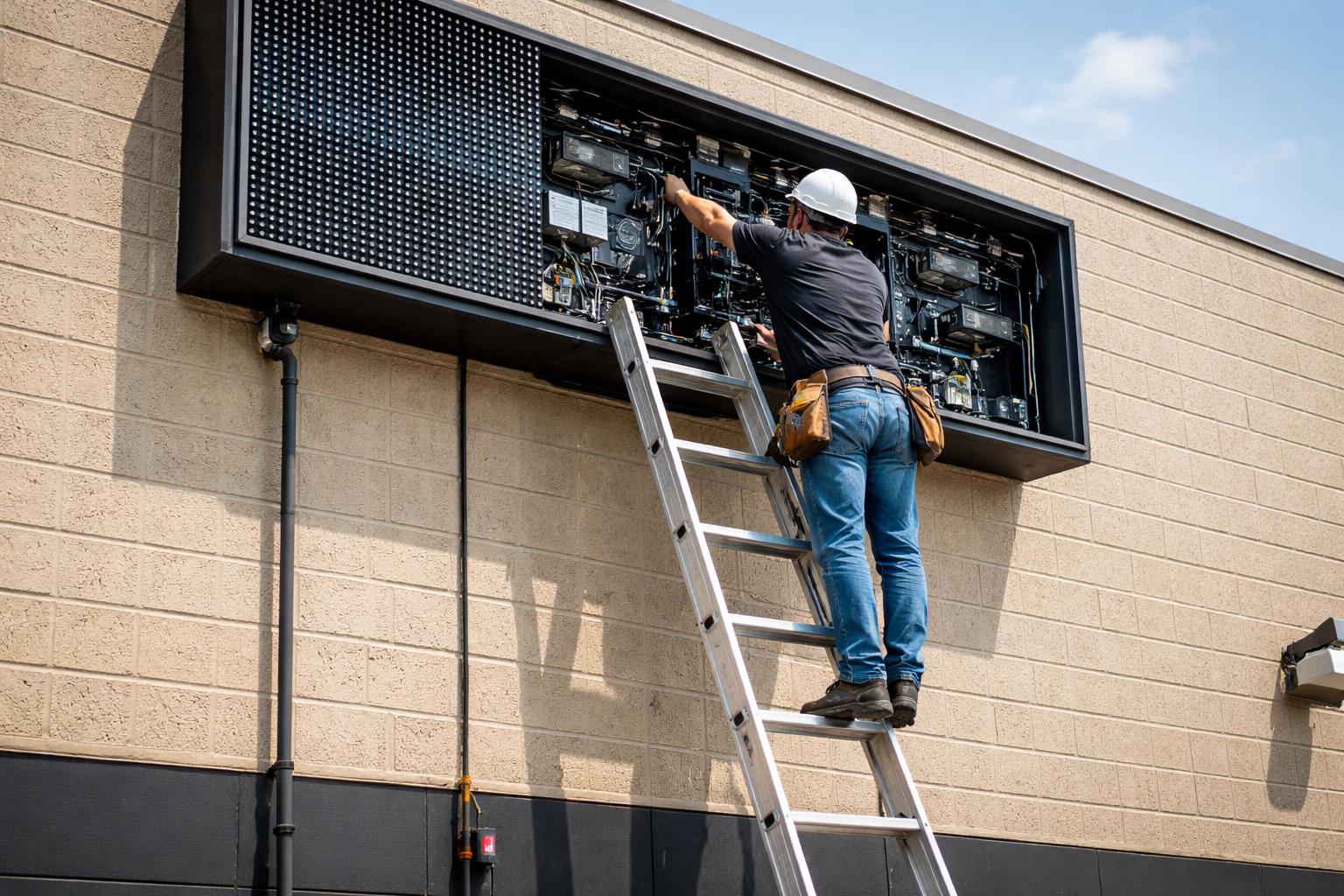
Brightness and durability still matter even when content strategy is excellent. Blink Digital describes its outdoor LED products as ultra-bright and designed for visibility day or night, while the real estate page refers to weather-resistant hardware and aluminium cabinet options built for Australian conditions. For agencies with glass-heavy frontages or bright daytime exposure, that is more than a technical detail. An unreadable screen in a sunny window is not a branding asset. It is an expensive compromise. Likewise, if the office needs an exterior installation, weather resistance and service access should be considered from the start rather than after installation.
There is also a workflow question that should be asked before buying. Who will update the content? How often? From where? Blink Digital’s pages talk about remote control, programming, installation and support, which suggests a more complete service model than simply selling hardware. Agencies should look for that. The right supplier should be able to discuss not only which sign to install, but how the system will actually function inside a branch environment where campaigns change constantly and staff already have enough to manage. That is one of the clearest reasons to work with Blink Digital on led signs brisbane or broader digital signage brisbane requirements: the value sits in the operating model as much as in the screen itself.
For SEO and lead generation, that local angle is important too. Prospects searching for led signs, digital signage, digital signage Brisbane, or led signs Brisbane are usually trying to answer a practical buying question, not a theoretical one. They want to know what to install, where it should go, what it should show and who can support it properly. A real estate office is a perfect example of that intent in action, because the display has to serve both marketing and branch operations. This is where Blink Digital can stand out: not by promising that any screen will do everything, but by helping agencies choose a setup that matches how buyers and vendors actually interact with a real estate shopfront.
What a strong agency screen strategy looks like in practice
A well-run agency screen strategy usually looks less dramatic than people expect. It is not constant motion, flashy transitions or a hundred listings spinning by in an endless blur. It is controlled, current and useful. During a normal week, the screen gives priority to fresh listings and imminent inspections. As the weekend approaches, it shifts more airtime to open-home schedules and auction reminders. After the weekend, it pivots quickly to sold proof, new campaign launches and appraisal prompts. When there is no major event, it reinforces local credibility with suburb-level messaging and polished brand storytelling. Blink Digital already frames LED signage as a modern communication tool for high-impact visibility, remote updates and long-term business use, and real estate is one of the clearest sectors where that logic becomes commercially actionable.
In practical terms, that means the screen should answer a few simple questions for each audience. For buyers: what is new, what is open, and what has just sold? For sellers: is this office active in my area, do they look current, and do they seem like the kind of agency that markets property well? For the everyday passer-by: what does this agency stand for, and why should I remember the name? The screen does not need to answer those questions in one frame. It just needs to answer them clearly across the loop. When that happens, the office frontage starts working harder than a static poster wall ever could.
That is ultimately why real estate LED signs work best when they are treated as part of the agency’s sales system, not as afterthought décor. They can support launch campaigns, make open-home times more visible, build auction momentum, extend after-hours presence, reduce the reprint cycle, and provide the sold proof that helps win future vendors. Blink Digital’s mix of custom screens, installation, maintenance, programming and local support gives agencies a pathway to build that kind of system properly rather than improvising it piece by piece.
Talk to Blink Digital about real estate LED signs
If your agency wants a shopfront that does more than hold static posters, Blink Digital can help you plan a smarter real estate display strategy. Whether you need real estate LED signs, property display LED signs, or a broader digital signage for real estate agencies solution, Blink Digital offers custom screen design, installation, maintenance, consulting and ongoing support from its Queensland base. The company’s real estate, outdoor signage and services pages make clear that the goal is not simply to supply a screen, but to deliver a durable, high-visibility system designed around your frontage, audience and campaign needs.
Contact Blink Digital for more information and assistance with a real estate LED signage solution tailored to your office, your local market and the way your agency actually promotes listings, open homes, auctions and sold results.