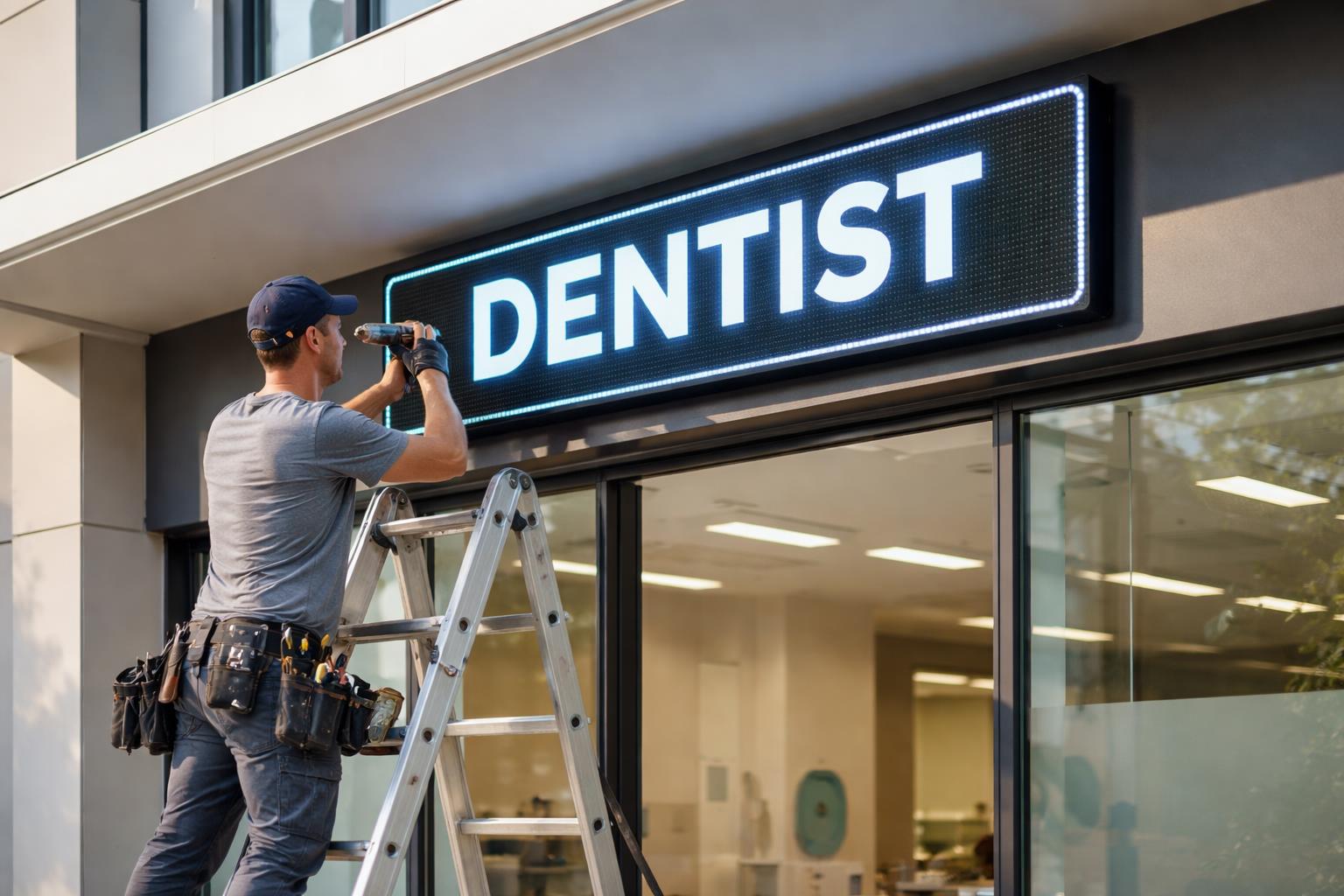
The Moment Where Signage Either Works — or Fails
Every business relies on signage, whether consciously or not. From the moment a potential customer walks past your shopfront, drives into your car park, or steps through your entrance, signage begins doing its job — or failing silently.
The reality is simple: people do not read signage carefully. They scan. They glance. They make quick decisions based on what they can process in seconds.
If your signage is clear, they move forward confidently.
If your signage is confusing, they hesitate.
If they hesitate, you lose momentum — and often, you lose the sale.
Accessible signage exists to remove that hesitation.
It is not about compliance checklists or niche design standards. It is about making sure your signage works for real people, in real environments, under real conditions — including poor lighting, distractions, time pressure, and unfamiliar surroundings.
At Blink Digital, we see this pattern constantly. Businesses invest in signage to increase visibility, but the real gains come when signage improves usability — when customers can find, understand, and act without needing help.
This article explores how to design signage that does exactly that.
Understanding Accessibility in Everyday Business Contexts
When people hear the term “accessible signage”, they often think about specialised environments — hospitals, government buildings, or compliance-driven spaces. But in reality, accessibility applies to every business that serves the public.
Accessible signage means your signs are easy to read, easy to understand, and easy to follow for as many people as possible.
This includes:
-
Customers with low vision
-
Older customers who need clearer text and stronger contrast
-
Neurodivergent individuals who benefit from simplified layouts
-
First-time visitors unfamiliar with your space
-
Customers who are distracted, rushed, or making decisions quickly
In other words, accessible signage is not just about inclusion — it is about efficiency.
When signage is easier to use, customers move faster, make decisions more confidently, and require less assistance from staff. The result is a smoother experience for everyone involved.
The Business Impact of Readability and Clarity
It is easy to underestimate how much signage influences behaviour. Because it operates in the background, its impact is often invisible — until it is improved.
When signage lacks clarity, several things begin to happen.
Customers pause longer than they should. They look around for confirmation. They ask staff questions that signage should already answer. In some cases, they abandon the process entirely.
In retail and hospitality environments, this can mean fewer walk-ins, slower ordering, and reduced average transaction value.
In service-based businesses, it can mean confusion at reception, missed appointments, or a less professional impression overall.
By contrast, clear and accessible signage creates flow.
Customers understand what you offer before they enter. They know where to go once inside. They can quickly interpret menus, services, or pricing. They move from entry to action with minimal friction.
Blink Digital works with businesses to achieve this outcome — not by adding more signage, but by improving how signage communicates.
Designing for Real Human Behaviour
One of the biggest mistakes in signage design is assuming that people will take the time to read carefully.
They won’t.
Most customers are processing information while walking, talking, or thinking about something else. Their attention is limited, and their tolerance for confusion is low.
This means your signage needs to work instantly.
Readable signage is not about adding more detail — it is about reducing effort.
Clear hierarchy, strong contrast, and simple messaging allow people to understand information without stopping. This is especially important in environments where speed matters, such as cafés, retail stores, gyms, or medical practices.
Blink Digital approaches signage with this principle in mind: if a customer needs to think about what a sign means, it is already too complex.
The Role of Contrast in Visibility
Contrast is one of the most important — and most overlooked — elements of accessible signage.
In practical terms, contrast determines whether text stands out clearly or blends into the background.
High contrast combinations make reading effortless. Low contrast combinations force the eye to work harder, reducing comprehension speed and increasing fatigue.
This becomes even more important in real-world conditions.
Outdoor signage is exposed to sunlight, shadows, and reflections. Indoor signage may be affected by artificial lighting or glare from nearby surfaces. In both cases, poor contrast can make otherwise well-designed signage unreadable.
Blink Digital prioritises contrast in every signage project because it directly impacts performance. A visually appealing design means very little if it cannot be read quickly and clearly.
Typography and the Speed of Understanding
Fonts are often chosen for style, but in signage, function must come first.
Readable typography is defined by simplicity. Clean, well-spaced letters are easier to recognise at a glance, especially from a distance.
Decorative fonts, script styles, or overly stylised lettering may look distinctive, but they slow down reading and increase the risk of misinterpretation.
Consistency also plays a key role. When the same font is used across multiple signs, customers become familiar with its appearance, allowing them to process information more quickly.
At Blink Digital, font selection is always guided by readability and real-world performance, ensuring that signage communicates effectively in any environment.
The Importance of Scale and Distance
A common issue in signage design is the mismatch between text size and viewing distance.
Designs created on a screen often appear clear and balanced, but once printed and installed, they may become difficult to read from the intended distance.
Customers rarely stand directly in front of signage. They approach from a distance, often at an angle, and may only have a few seconds to interpret the message.
This makes scale critical.
Larger text improves readability, reduces hesitation, and ensures that key messages are visible even in motion. Smaller text should be reserved for secondary information, not primary communication.
Blink Digital works with clients to ensure that signage is designed for its actual viewing conditions — not just its digital preview.
Simplifying Language for Faster Decisions
Complex language slows people down.
In signage, every extra word adds friction. The goal is to communicate meaning as directly as possible.
Short phrases, familiar terms, and clear instructions are more effective than detailed explanations.
For example, directional signage should prioritise clarity over formality. A simple arrow paired with a short label is far more effective than a sentence.
This approach benefits all customers, including those who may be unfamiliar with the environment or processing information quickly.
Blink Digital helps businesses refine messaging so that signage supports action, not confusion.
Designing for Real Environments, Not Ideal Conditions
Signage does not exist in a controlled setting. It exists in dynamic, often unpredictable environments.
Lighting conditions change throughout the day. Shadows move. Reflections appear on glass surfaces. People approach from different directions and at different speeds.
All of these factors influence how signage is perceived.
Effective signage design takes these variables into account from the beginning. Placement, angle, material choice, and finish all play a role in ensuring visibility.
At Blink Digital, signage is designed with its final environment in mind, ensuring that it performs consistently in real-world conditions.
Creating a Seamless Customer Journey Through Signage
Accessible signage is most effective when it is treated as a system rather than a collection of individual signs.
Each sign should connect logically to the next, guiding customers through a clear and intuitive journey.
From the moment someone notices your business to the moment they complete a transaction, signage should support each step.
This includes:
-
Entrance signage that clearly communicates what you offer
-
Window signage that reinforces key messages
-
Directional signage that guides movement
-
Menu or service boards that support decision-making
-
Counter signage that encourages final actions
When these elements are aligned, customers move through your space with confidence and ease.
Blink Digital specialises in creating cohesive signage systems that improve flow and usability across entire environments.
Seeing Your Business Through a Customer’s Eyes: A Real-World Walkthrough of Signage in Action
One of the most effective ways to improve signage accessibility is to stop thinking like a business owner or designer, and start thinking like a first-time visitor. Not someone who already understands your layout, your services, or your terminology — but someone arriving for the very first time, with no context, no guidance, and no patience for confusion.
Imagine a customer approaching your business from the street. They may be driving, walking, or passing by quickly. At this stage, your signage has only a few seconds to answer a simple but critical question: Is this relevant to me? If your shopfront messaging is cluttered, unclear, or difficult to read at a distance, that opportunity is lost before it even begins. Accessible signage at this point is not about saying everything — it is about saying the right thing, clearly and instantly.
As the customer moves closer, their focus shifts from awareness to understanding. They are no longer asking whether your business exists, but what exactly you offer and whether it matches their needs. This is where window signage, decals, and entry messaging play a crucial role. If the information is layered properly — with a clear headline, followed by supporting details — the customer can build confidence without needing to stop and analyse. If not, hesitation begins.
That hesitation is where many businesses lose momentum. It might only last a few seconds, but in a busy environment, those seconds matter. A customer who pauses too long often decides to keep moving, especially if there are alternative options nearby. Accessible signage removes that pause by guiding the customer forward naturally, without requiring effort.
Once inside, the experience shifts again. The customer is now navigating your space, often while processing multiple inputs at once — other people, sounds, products, and internal decisions about what they want. This is where directional signage becomes essential. Clear, well-placed signs should confirm that the customer is in the right place and guide them to the next step without uncertainty.
If the layout is intuitive and signage supports that layout, customers move smoothly. If not, they begin scanning the environment for clues, looking at other people for cues, or asking staff for help. None of these are ideal outcomes. They introduce friction into what should be a straightforward process.
At this stage, consistency becomes critical. If one sign says “Order Here” and another says “Service Counter”, the customer has to interpret whether those mean the same thing. Even small inconsistencies create doubt. Accessible signage avoids this by using the same language, the same visual style, and the same structure throughout the space. The result is familiarity — and familiarity reduces effort.
As the customer reaches the decision point — whether that is a menu board, service list, or product display — clarity becomes even more important. This is where poor signage has a direct impact on revenue. If options are difficult to scan, if text is too small, or if contrast is weak, customers take longer to decide. In fast-paced environments, this not only slows down service but can also lead to simpler, lower-value choices or even decision avoidance.
Accessible signage supports decision-making by organising information in a way that feels natural. Categories are clearly separated, key items are easy to spot, and the overall layout allows the customer to process options quickly. Instead of feeling overwhelmed, the customer feels guided.
This moment is often underestimated. Businesses focus heavily on attracting customers, but the ability to convert that attention into action depends heavily on how information is presented at the point of decision. Blink Digital often works with clients to refine this stage, ensuring that signage does not just look professional, but actively supports faster and more confident choices.
After the decision is made, the customer’s focus shifts again — this time to completing the interaction. Where do they pay? Where do they wait? Where do they collect their order? These steps should be obvious, but in many environments, they are not. Confusion at this stage creates unnecessary stress and can disrupt the entire experience.
Clear counter signage, pickup indicators, and simple instructions ensure that the final steps are just as smooth as the first. This consistency reinforces confidence and leaves a positive impression.
Even after the transaction is complete, signage continues to play a role. Exit signage, amenity indicators, and follow-up prompts all contribute to the overall experience. A customer who can leave easily, find what they need, and navigate the space without frustration is far more likely to return.
What becomes clear through this walkthrough is that accessible signage is not a single element — it is a continuous system. Each sign builds on the one before it, creating a chain of communication that guides the customer from start to finish.
When that chain is strong, the experience feels effortless. Customers may not consciously notice the signage, but they benefit from it. They move with confidence, make decisions quickly, and engage more positively with the business.
When that chain is weak, the opposite happens. Customers feel uncertain, distracted, or overwhelmed. They rely on guesswork or assistance, and their overall perception of the business is affected.
This is why accessible signage should always be approached as a journey, not a collection of individual signs. It requires stepping back and looking at the entire environment from the customer’s perspective — identifying where confusion might occur and addressing it before it becomes a problem.
At Blink Digital, this is a core part of how signage solutions are developed. It is not just about producing individual signs, but about understanding how those signs work together in real space. By focusing on flow, clarity, and consistency, businesses can create environments that feel intuitive rather than overwhelming.
Ultimately, accessible signage is about respect for the customer’s time and attention. It acknowledges that people want to move quickly, understand easily, and make decisions without unnecessary effort. When signage supports those needs, it becomes one of the most powerful tools a business can use — not just for visibility, but for usability, efficiency, and long-term success.
Reducing Cognitive Load Through Design
Cognitive load refers to the mental effort required to process information.
In busy environments, customers are already managing multiple inputs — conversations, movement, noise, and decisions. If signage adds to that load, it becomes a barrier rather than a support.
Accessible signage reduces cognitive load by simplifying visual information.
Clear hierarchy, consistent layout, and minimal clutter allow customers to focus on what matters. This is particularly important for neurodivergent individuals, but it benefits all users.
By reducing complexity, signage becomes easier to understand and faster to act upon.
The Role of Materials in Accessibility
Material choice has a direct impact on readability.
Glossy finishes can create reflections that obscure text, while matte finishes reduce glare and improve clarity. Durable materials maintain their appearance over time, ensuring that contrast and visibility remain consistent.
Surface quality also matters. Smooth, clean surfaces produce sharper visuals, while worn or damaged materials can distort text and reduce legibility.
Blink Digital helps businesses select materials that support both durability and readability, ensuring long-term performance.
Maintaining Signage for Ongoing Accessibility
Even well-designed signage can lose effectiveness if it is not maintained.
Dust, dirt, and environmental exposure can reduce contrast and clarity. Sunlight can cause fading, while wear and tear can lead to peeling or cracking.
Regular maintenance ensures that signage continues to perform as intended.
This includes cleaning, inspecting for damage, and updating content when necessary. Outdated or poorly maintained signage creates confusion and undermines trust.
Blink Digital supports businesses with ongoing signage updates and replacements, helping maintain consistency and clarity over time.
Consistency as a Foundation for Usability
Consistency is one of the most powerful tools in accessible signage.
When fonts, colours, terminology, and layout are consistent across all signage, customers can quickly recognise patterns and understand information without reinterpreting each sign.
Inconsistent signage, on the other hand, forces customers to think harder, slowing them down and increasing the risk of confusion.
A consistent signage system builds familiarity, which in turn improves usability and efficiency.
Accessible Signage as a Business Advantage
Accessible signage is not just a design improvement — it is a business advantage.
By making your signage easier to read and use, you create a more efficient environment for both customers and staff.
Customers move through your space more smoothly. They make decisions more quickly. They require less assistance.
Staff can focus on service rather than answering basic questions.
The result is a better experience, stronger engagement, and improved overall performance.
How Blink Digital Helps Businesses Get It Right
Blink Digital works with businesses across Australia to create signage that performs in real-world conditions.
Our approach focuses on clarity, usability, and consistency. We help businesses design signage that not only looks professional, but also works effectively in practice.
From initial design through to production and installation, our team ensures that every element supports a seamless customer experience.
Whether you are updating existing signage or planning a complete rollout, Blink Digital provides practical guidance and reliable execution.
Making Signage Work for Everyone
Accessible signage is about more than compliance or aesthetics. It is about communication.
When signage is clear, consistent, and easy to use, it removes barriers and creates confidence. Customers can navigate your space without hesitation, understand your offering without effort, and make decisions quickly.
This leads to a better experience for everyone — and better outcomes for your business.
If you want signage that is not only visually strong but genuinely easy to read, follow, and use, Blink Digital can help.
Contact our team today to discuss how we can design, produce, and install signage that improves clarity, flow, and customer experience across your business.