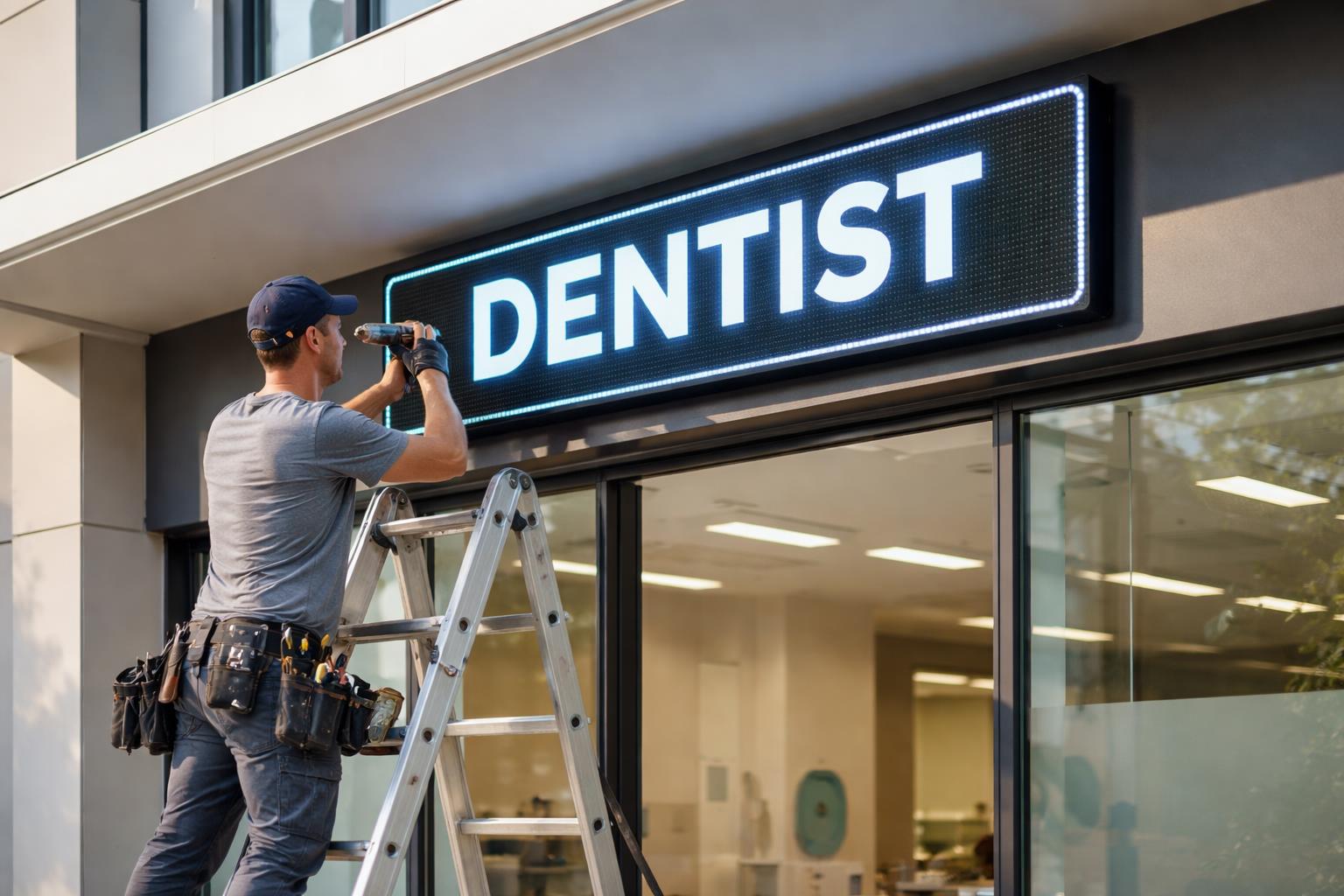
Ordering signage can feel straightforward: choose a format, approve the artwork, print, install, done. In reality, shopfront signage approval and placement rules can make the difference between a smooth rollout and a costly reprint. The most common (and expensive) mistake is locking in a design before confirming whether the sign is allowed at that site and in that location—especially when councils, landlords or shopping centre management are involved.
This guide is a practical retail signage approval guide for Australian businesses, written in Australian English and tailored to the real-world signage mix Blink Digital supplies—A-frames, banners, banner flags, window decals, cut vinyl, corflute, aluminium signs and large format prints. Blink Digital can help you avoid ordering the wrong sign for the wrong site by checking the likely compliance triggers early, then designing, printing and installing a signage package that fits your site rules and your brand.
This article is general information, not legal advice. Local laws and planning controls are different in every council area, and tenancy rules vary by landlord and centre. Still, there are predictable “gotchas” across Australia, and you can reduce risk dramatically by following a consistent signage permit checklist before you press print.
How signage approvals work in Australia
Before we get into specific sign types, it helps to understand the approval landscape. “Signage compliance” in Australia is usually a combination of three buckets: council rules, landlord/tenancy rules, and (sometimes) state road authority rules. Depending on your sign, you might need one approval, several approvals, or none—if your sign meets “self-assessable” criteria in your local area.
Some councils make a clear distinction between signage that can be displayed without council approval (“self-assessable” or permitted signs) and signage that needs a licence or assessment. For example, Brisbane City Council notes that small businesses in business areas can “typically display self-assessable signs” and that you don’t need Council approval if you meet the requirements—but if you don’t comply, you must apply for full assessment and licensing.
Even within a single council area, “self-assessable” can come with exclusions. Brisbane’s guidance explicitly flags exclusions such as Queen Street or Valley Malls and certain overlays (e.g., Heritage or Commercial character overlay) as reasons a business may not be able to rely on self-assessable provisions.
Across Victoria, signage is often regulated through planning scheme controls. The Victorian planning system describes a planning permit as a legal document that allows a certain use or development to proceed on land, with conditions and time limits. In practical signage terms, you might need a planning permit depending on sign type, site controls (like heritage overlays), and the nature of illumination or animation.
“Council rules” are not limited to planning. In Queensland, a council fact sheet emphasises that permanent advertising may require a mix of approvals—such as building approval, local law approval, or planning scheme approval—while temporary advertising devices may be classed as permitted signs if they comply with prescribed requirements.
Landlord and shopping centre controls are separate again. Tenancy and lease guidance from Australian law firms commonly notes that leases often require landlord or lessor consent for signage, and that signage should be discussed and agreed before the lease is signed. In shopping centres, you may also have a design manual that dictates sign types, sizes, finishes and placement, independent of local council requirements.
Finally, some locations trigger state road requirements. In Queensland, the Queensland Department of Transport and Main Roads maintains a Roadside Advertising Manual to help evaluate roadside advertising proposals around state-controlled roads, including technical criteria and approval processes. This matters if your sign is near, on, or visible from a state-controlled road corridor where additional rules may apply.
The takeaway is simple: before you print, confirm which bucket(s) apply to your site. Blink Digital can help you do that quickly by asking the right early questions and, where needed, working with your site stakeholders (centre managers, landlords, council requirements) before you commit to manufacturing.
Common sign types and the approval triggers businesses miss
Most businesses don’t get stuck because they chose the “wrong” sign. They get stuck because they didn’t realise a sign’s placement, size, illumination, or location category changes the approval pathway. A practical way to avoid surprises is to review sign types the way councils and landlords do: “what is it, where is it, and how is it mounted or displayed?”
Shopfront, fascia and under-awning signs
Shopfront signage is high impact, but it’s also the most likely to be constrained by landlord rules and (sometimes) planning/building controls. Brisbane’s guidance includes “awning fascia signs” and sets self-assessable conditions such as fitting within the fascia outline and not exceeding a height limit. For under-awning signs, it includes clearances and dimensional limits (for example, requirements around clearance from the footway and spacing from other signs).
In shopping centres, fitout guides often go further than councils. One centre fitout guide notes that shopfront signage is a “critical element” of the shopfront design and includes conditions such as limiting signage to the store name and/or logo, and restricting additional banners or placards beyond approved shopfront signage. It also references structural engineer certification for certain signage support requirements.
If you’re changing shopfront glazing or modifying the shopfront structure, landlords can require approval and alignment with adjacent shopfront standards. A shopping centre fitout guide may require shopfront amendments to be subject to landlord and local authority approval and specify design constraints like concealed channels and prohibited fixing styles.
What to check before printing shopfront signs
- Is the sign in the centre’s approved “signage zone” (some centres specify an entry setback or a defined zone)?
- Is illumination allowed, and if so, what type (internal illumination, halo-lit, lightbox)?
- Are there fascia height limits, clearance limits, or sign spacing rules?
- Does your lease require written landlord consent before any signage is installed?
- Will the installation require structural certification (e.g., engineer sign-off) because of load, suspension, or fixing method?
Blink Digital can help by checking the site type (street-facing tenancy vs centre-managed tenancy), confirming how the sign will be mounted, and recommending sign types (and fixing methods) that match your constraints before you spend money on fabrication.
Window signage and “how much glass you can cover”
Window graphics are one of the fastest ways to refresh a shopfront, but they often trigger “window signage council rules” around glass coverage and size—especially in CBD zones, heritage areas, or places where councils regulate visual clutter.
Brisbane provides a clear example: it defines a window sign as an advertisement displayed on or through a display window and states that, to be self-assessable, it must cover no more than 25% of the glass area and be no larger than 2m². It also notes that illuminated or electronic window signs must meet additional technical standards.
The same Brisbane page highlights that small businesses can typically use self-assessable signs only if they are not in restricted areas (e.g., Queen Street or Valley Malls) and do not have certain overlays, such as Heritage overlays. In Victoria, councils similarly warn that if a property is in a Heritage Overlay, almost all signs will need a planning permit.
Blink Digital’s window signage range includes vinyl window signs, window clings, frosted lettering and perforated one-way vision options, and it explicitly notes you can choose one-way vision solutions that allow you to see out while limiting visibility in. That’s useful because one-way vision may allow you to deliver bold branding while keeping the interior usable, but you still need to confirm coverage limits, positioning, and any building/centre restrictions before printing full window wraps.
What to check before printing window decals
- Is your site subject to window coverage limits or size limits for self-assessable signage?
- Is the property in a heritage overlay or special character zone that changes the planning rules?
- Is there a centre/landlord rule limiting external-facing window signage or requiring approvals?
- Does the glass have tinting, frosting, or safety film that affects adhesion and readability? (This can be checked on site before print.)
- Do you need an “interim” solution (e.g., partial coverage or panels) while approvals are in progress?
Blink Digital can advise on the right window film type, measure properly, and help you design coverage that stays within typical council/centre rules while still delivering strong visibility.
A-frames and footway signs on public paths
A-frames are one of the most common “I’ll just put it out front” sign types—and this is exactly why they’re heavily regulated. These are the classic A-frame sign regulations area: height limits, trading zones, clear pedestrian corridors, corner exclusions, trading hours, and sometimes permit requirements.
Brisbane defines a footway sign (A-frame/sandwich board) and states self-assessable conditions such as maximum dimensions, a minimum setback from the kerb, a required pedestrian corridor, maximum distance from the property boundary, and requirements not to block or clutter landscaping and street furniture. It also notes you can have up to two footway signs per shop (in qualifying areas).
NSW councils often take a similar approach. Bayside Council lists A-frame criteria including being portable and stable, freestanding (not fixed to infrastructure), and windproof, and it specifies display conditions such as placement in the trading zone (not the pedestrian zone) and removal at close of business.
Sutherland Shire Council provides example permit conditions including display hours, a limit on number of A-frames per shopfront, and placement conditions such as immediate placement against the storefront and a kerb setback.
Even where a council allows A-frames generally, specific precincts can require a separate permit. Brisbane’s Valley Malls example explicitly states you need a permit to display an A-frame sign in that precinct and lists supporting documents including a site plan, sign design copy, and public liability insurance to $20 million.
Blink Digital supplies A-frame signage and outlines their portability and flexibility for sidewalk use, including for customers walking or driving past. The compliance challenge is not the product—it’s your site and placement. Blink Digital can help you choose an A-frame size and placement approach that fits local rules and avoids pedestrian issues (and the risk of a council complaint).
Flags, banners and temporary promotional signs
Flags and banners are highly visible, but temporary signage is often regulated by time limits, size limits and location rules. Brisbane includes self-assessable conditions for commercial flags (e.g., maximum area and height limits) and for business promotion signs (temporary sale/auction/promotion signs), including time limits and an explicit restriction on electronic displays for those temporary signs.
Other councils similarly regulate temporary event and promotion signage. For example, Toowoomba Regional Council describes a “site community organisation sign” for an event and includes a rule that it must not be displayed longer than 30 days prior to the event and must be removed within 1 day of the event.
Banners also interact with structural and wind-load rules. Toowoomba’s guidance includes requirements such as affixing the advertising device to a structure that will accommodate wind loadings and not placing the sign beyond the street front boundary. It also notes an authorised person may request engineer certification for a dedicated support structure.
Blink Digital’s banner products are described as durable, light, and easy to install, transport and store, and Blink Digital also offers associated services like mounting and laminating. Blink Digital’s banner flags are described as attention-grabbing through height and movement and designed to withstand the weather—useful for trade shows, retail yards, and outdoor display.
What to check before printing banners/flags
- Are there size, height, and time limits for temporary signs in your council area?
- Will the sign be exposed to high wind loads, requiring a more robust mounting method or mesh/banner specification?
- Is the sign inside a centre that restricts “extra” signage (placards, banners) beyond approved shopfront sign types?
- Is the flag/banner placed so it doesn’t create hazards to pedestrians and vehicles or block sightlines?
Blink Digital can recommend the right banner or flag format, and if the site has strict rules, Blink Digital can shift your strategy toward compliant alternatives (for example, internal flags, window panels, or approved under-awning signage) without losing visibility.
Footpath, sightlines and public safety compliance
Footpath and public land signage is the area where businesses are most likely to trigger compliance issues quickly, because it affects public access and safety. It’s also where councils are more likely to enforce rules, because obstacles can impair accessibility and movement.
Keep pedestrian corridors clear and continuous
Many councils define “trading zones” and “pedestrian zones”, and they require that footpath trading items stay within the trading zone with adequate clearance. Bayside Council explains that footpaths are for everyone and that footway trading zones must provide a clear, continuous, and safe access for pedestrians.
Brisbane’s footway sign criteria for self-assessable signs explicitly references a 2m pedestrian corridor requirement between the sign and the property boundary, in addition to a setback from the kerb.
Victorian footpath permits also frequently emphasise removal at close of trading and safety in wind conditions. Latrobe City Council states that signs and other items associated with outdoor dining must be constructed so they don’t cause injury or become a hazard (including being moved by wind), that no item may be fixed to the footpath, and that items must be removed at the close of trading.
A Bass Coast permit conditions document explicitly notes that minimum widths of zones are determined with consideration to the Disability Discrimination Act 1992 and Pedestrian Council recommendations, and that trading is only permissible in the trading zone. This is a useful reminder: clearance is not purely aesthetic—it’s accessibility and safety.
Protect motorist sightlines and road safety
Compliance isn’t just about pedestrians. Footpath items can block driveways, corners, and lines of sight for drivers. A City of Sydney policy states that displays should not obstruct a motorist’s line of sight to regulatory signage, driveways, traffic control signals or other critical road infrastructure.
That same policy also reinforces that pedestrians should not be forced onto the road by displays or non-permanent items, and that improvements are not to be fixed structures and should be stored away at close of business.
These are practical design and placement checks you can do on-site:
- Stand at the driveway exit: can drivers still see both directions?
- Check the corner: is the A-frame too close to an intersection or arcade?
- Check the road edge: is the sign far enough from the kerb to avoid bump risk?
- Check the pedestrian pinch points: is the clear walking path still continuous?
Blink Digital can help by recommending A-frame placement, providing compliant sizes, and advising on safer alternatives if the footpath is too narrow.
Understand insurance and documentation for public land
Many councils require public liability insurance for signage or trading on public land, and some precincts make this explicit in permit documents. Brisbane’s Valley Malls permit process lists a Certificate of Currency for public liability insurance to the value of $20 million as a required document for an A-frame permit.
The City of Sydney local approvals policy includes a requirement that owners/operators obtain public liability insurance of not less than $20 million (noting the interests of Transport for NSW) prior to placing displays on public footways of classified roads.
Latrobe City Council also references maintaining an in-force public liability policy and providing the council with a certificate of currency each year.
This is why compliance should be checked before ordering: if your plan is to “put it on the footpath,” you may also need to confirm insurance, permitted hours, and a formal trading zone. Blink Digital can help you avoid rework by asking about footpath placement early.
Landlord rules, shopping centre design manuals and lease clauses
Council compliance is only half the story. If you’re in a leased premises, your lease and landlord rules can be stricter than council rules. This is where many rebrands and fitouts get delayed: the business prints signage that’s “council okay,” but the landlord rejects it because it doesn’t meet the centre’s design manual or signage policy.
Lease consent requirements are common
Australian leasing guidance commonly advises that signage often requires landlord/lessor consent. Coleman Greig (an Australian firm) notes that leases usually allow a tenant to install signage with the consent of the landlord and relevant authorities, and that if you want signage in additional common areas (like car parks or escalator walls), your lease needs to specifically cater for those requirements.
An Australian commercial lease guidance resource similarly states that leases usually provide that all signage requires the lessor’s consent and recommends discussing and agreeing signage issues before the lease is signed.
The operational implication is obvious: if signage is critical to your business model (medical practice wayfinding, retail visibility, drive-through ordering, etc.), treat signage rights as a core lease negotiation point, not a last-minute request. Blink Digital can help you translate your signage needs into a clear “signage scope” you can discuss with landlords early.
Design manuals can restrict sign types and placements
Shopping centres and managed retail precincts often have fitout and signage manuals that control:
- what sign types are permitted (e.g., letters, blades, lightboxes),
- where signage can sit (e.g., within a defined fascia or set-back zone),
- what content can appear (often store name/logo only),
- what extra signage is prohibited (banners, pennants, supplier advertising).
A fitout guide example indicates shopfront signage may be limited to store name/logo and that no advertising placards or banners (other than approved shopfront signage) should be installed. Another design guide example references “primary brand signage” set back within a 2m zone and suggests a blade sign as an alternative for presence to passers-by—illustrating how centre design standards can shape signage placement and types.
These controls matter because “compliance” is not just about legality; it’s also about permission to trade. If a centre requires approval before you can open, signage compliance becomes part of your trading timeline.
Building works and structural documentation may be required
When signage involves suspended structures, illuminated elements, or significant fixing into base building materials, centres can require engineering certification and safe installation documentation. One fitout guide states that shopfront signage should be supported from base building structure and that certification from a structural engineer should be provided to centre management prior to trading.
Similarly, a design and fitout guide notes that shopfront changes may be subject to landlord and relevant local authority approval and provides detailed requirements about glazing and framing—showing how deep the documentation expectations can go for shopfront works.
This is where Blink Digital adds measurable value: by understanding installation realities (fixings, penetrations, mounting, access), Blink Digital can help you prepare signage that’s not only eye-catching but also installable within building and centre constraints.
A practical signage permit checklist before you print
This section is the “do this every time” checklist. It’s designed to reduce reprints and prevent delays by ensuring you confirm approvals and constraints before your design is final.
Confirm your site category and control layers
Start with these questions:
- Are you on private land only, or will any signage sit on/over public land (footpath, verge, road reserve)?
- Are you in a managed retail precinct/shopping centre with a design manual?
- Does your lease require landlord consent for signage (and for which sign types/areas)?
- Are there planning overlays (heritage, character) that change your council pathway?
- Are you near a state-controlled road that may trigger additional approvals?
If you can’t answer these quickly, that’s a sign you should pause and confirm before printing.
Classify the sign the way councils do
Councils often define sign types: window sign, footway sign, under-awning sign, promotion sign, information sign, commercial flag, and so on. Brisbane’s advertising device page is a good example of a clear classification approach and then “requirements for it to be self-assessable” per sign type.
When you classify correctly, you reduce wasted effort. For example:
- A window sign may be limited by percentage of glass coverage and size.
- A footway sign may be limited by dimension, clearance and placement.
- A business promotion sign may be time-limited.
Blink Digital can help you match your intent (promo, identification, wayfinding) to the sign category that is most likely to be compliant—and most likely to get approved quickly if approval is required.
Measure the site before final artwork
Many compliance issues are measurement issues:
- the fascia is shorter than you thought,
- the awning clearance isn’t enough,
- the footpath is too narrow for an A-frame plus required pedestrian corridor,
- the window panels are segmented and change the “percentage of glass area” maths.
A fast site measure (with photos) is often cheaper than a single reprint. Blink Digital can do site measures and provide templates for artwork so your signage is print-ready and install-ready.
Check the “big three” compliance risks early
These are the predictable reasons signage gets stuck:
- Illumination/electronic components: Brisbane notes illuminated/electronic signs must meet additional technical standards, and Victoria notes animated/electronic signs may require planning permits and can be referred to Transport for Victoria if near arterial/freeways.
- Heritage and overlays: Yarra City Council notes that if your property is in a Heritage Overlay, almost all signs will need a planning permit. Brisbane flags overlays as a factor preventing self-assessable signage.
- Public safety: Councils commonly require footpath items not obstruct pedestrian movement, to be wind-safe, and to protect sightlines.
If your signage touches any of those, get advice before you lock your artwork.
Manufacture only after approvals are confirmed
This is the blunt rule that prevents most wasted spend. A signage approvals guide observes that delays often occur when signage is designed first and compliance is checked later, and it recommends manufacturing only after approvals are confirmed.
Councils and centres can reject signage because of:
- permitted size/location rules,
- missing documentation (plans, fixings, insurance, safety paperwork),
- illumination rules,
- heritage or streetscape issues.
Blink Digital can help keep your project moving by aligning approvals, design and manufacturing so you don’t end up with a finished sign you cannot legally or contractually install.
How Blink Digital helps you stay compliant and avoid wasted spend
If you want a signage partner who helps you avoid mistakes before you spend money, this is exactly where Blink Digital focuses. Blink Digital supplies a wide general signage range—large format printing, stickers, A-frames, banner flags, corflute signs, corporate and custom signage, window signs, cut vinyl, aluminium signs, banners and vehicle signage—so you can keep signage production under one roof instead of coordinating multiple suppliers with inconsistent specs.
Blink Digital can support you in a compliance-first way by:
- helping classify your proposed sign type and likely approval pathway (self-assessable vs application), using practical council examples (e.g., window signage coverage rules, footway clearance requirements);
- advising on A-frame placement, number limits, and clearance planning based on common council expectations (trading zone vs pedestrian zone, close-of-business removal, wind stability);
- producing durable, fit-for-purpose products aligned to your placement needs (e.g., durable banners for transport/storage, weather-ready flags, UV-protected aluminium signs);
- providing a “submission-ready” documentation mindset, inspired by what councils and precinct permits actually request (site plans, sign designs, public liability insurance).
The result is fewer surprises, fewer reprints, and a smoother path from concept to install—especially for businesses opening a new site, refreshing a shopfront, or rolling out consistent signage across multiple venues.
If you’re planning new signage and want to avoid compliance delays, get in touch with Blink Digital before you finalise your print order. We can help you check the most common council and landlord constraints, recommend compliant sign formats, and deliver print and installation that fits your site rules.
- Phone: 0424 505 990
- Email: info@blinkdigital.com.au
- Visit: Unit 1/11 Hinkler Ct, Brendale QLD 4500
When you involve Blink Digital early, you’re not just buying signage—you’re reducing risk, protecting timelines, and making sure what you print is something you can actually install.