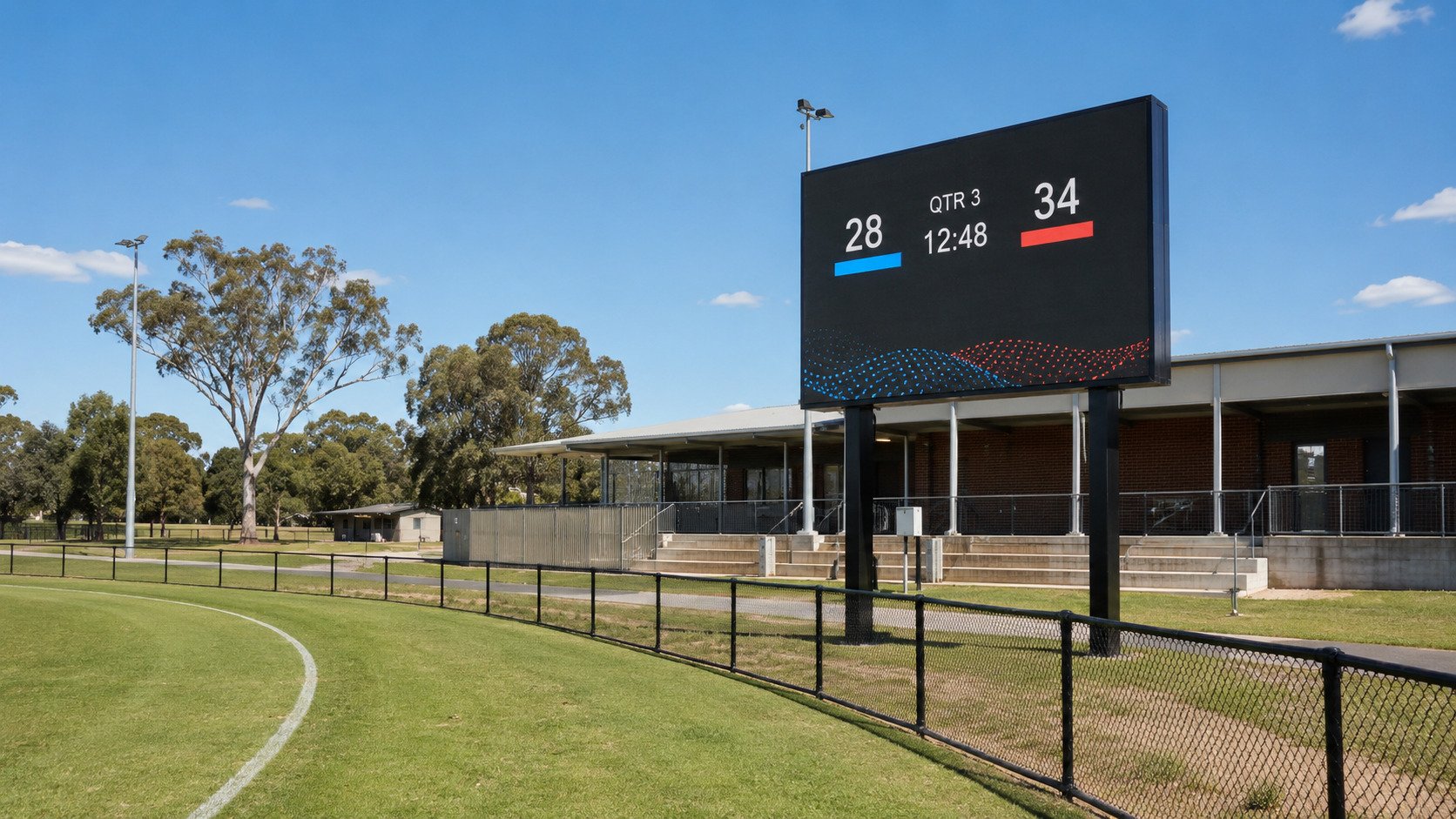
For many schools and community clubs, a scoreboard used to be a simple utility. It showed the score, counted down the time and, if you were lucky, displayed a few basic game details. That is no longer the full picture. Modern LED scoreboards are increasingly being used as multi-purpose communication assets that support sponsor visibility, fundraising, event presentation, school spirit and broader community engagement, especially when they are planned as part of a wider digital signage strategy rather than treated as a single-purpose piece of sports equipment. Blink Digital already works across LED scoreboards, LED school signs and broader digital signage solutions in Brisbane and across Australia, which puts us in a strong position to help schools and clubs think beyond the scoreline.
That broader view matters because Australian school sport and community sport sit inside a bigger participation ecosystem. The Australian Sports Commission’s Sporting Schools program is designed to increase children’s participation in sport and connect schools with community sporting opportunities, while Queensland’s education guidance notes that sport supports children’s physical, mental, social and emotional health and contributes to community and social connectedness. School Sport Victoria makes a similar point, describing its role as connecting school and community sport pathways for students. In other words, a school oval, a club field or an indoor court is not just a place where a game happens. It is a meeting point for students, parents, volunteers, sponsors, staff, alumni and the wider community.
At the same time, clubs and school sports programs are under real financial and administrative pressure. The Australian Sports Foundation says clubs are dealing with fewer volunteers, more administration and rising participation and running costs while traditional revenue sources are declining. The same organisation also states that community clubs raise an average of $7,850 per year through its platform, and that donations to eligible sport can be tax deductible through the ASF. These are exactly the conditions in which infrastructure needs to work harder. A modern LED scoreboard is not simply a cost line. When it is planned properly, it can become an asset that earns attention, supports sponsors, helps fundraise, lifts presentation standards and gives the venue more value across the full calendar.
At Blink Digital, we see that shift clearly. Our LED scoreboards are positioned not just as scoring displays but as customisable digital systems that can show team names, game time and additional stats while creating a more professional and immersive experience indoors or outdoors. Our school LED signs are also built around clear, real-time communication, from daily announcements to celebratory messages and emergency alerts. Put together, those capabilities point to a practical truth for schools and clubs: if the screen can attract attention, it should be doing more than one job.
Why LED scoreboards now matter far beyond the scoreboard box
The strongest case for LED scoreboards is no longer limited to what happens during active play. Yes, accurate scoring still matters. Timing still matters. Visibility still matters. But the real return comes from everything around those functions: how the display shapes the atmosphere before a match, how it helps people understand what is happening on site, how it recognises supporters, and how it gives local businesses or donors a stronger reason to invest in the venue. Blink Digital’s scoreboard service page emphasises clear and accurate scores, easy programming, customisation and dynamic displays that keep fans engaged. Those are core sports functions, but they are also the building blocks for broader communication.
This matters especially for schools and grassroots clubs because they rarely operate on a single-event model. A school may use the same oval or hall for sport, assemblies, carnivals, house events, welcome evenings, open days and community programs. A local club may use its ground for junior fixtures, senior fixtures, training nights, gala days, presentation events and sponsor functions. The Australian Government’s community sport guidance notes that there are multiple grants and funding pathways for community sporting organisations, while education and school sport bodies consistently place school sport inside a wider framework of participation, wellbeing and community connection. That is exactly why the most useful scoreboard is the one that serves the whole venue, not just the final score.
There is also a presentation gap that many schools and clubs are trying to close. Parents, players and supporters now expect cleaner communication and more polished event experiences than many older facilities were designed to provide. Major scoreboard and sports-display providers clearly frame modern video-enabled scoreboards as engagement tools that can run branded content, stats, sponsor overlays, promotion zones and timed playlists. That does not mean every local ground needs a stadium-scale production. It means even community-level venues can take practical lessons from modern game-day presentation: short countdowns, clean welcome screens, sponsor thank-yous, player introductions, fixture reminders and clear wayfinding all make the event feel more organised and more valuable.
For schools, there is another layer. A scoreboard can reinforce identity and school culture in a way a basic analogue board never could. Blink Digital’s school LED signs page highlights the role of digital displays in sharing announcements, celebrating achievements and helping schools stay connected with students, staff and parents. A scoreboard at the sports ground can extend that same communication approach into game-day settings. Instead of merely displaying home and away totals, the screen can reinforce house spirit, honour student participation, showcase upcoming events and recognise volunteers or alumni who support the program.
The real value of LED scoreboards and digital signage for sports clubs
The phrase “digital signage for sports clubs” usually makes people think about foyer screens, menu boards or sponsor panels around a venue, but for many clubs the scoreboard is the most visible digital asset on site. It often has the clearest line of sight, the largest audience attention window and the strongest emotional context, because people naturally look at it during moments of excitement, uncertainty or transition. That makes it one of the best places to carry messages that matter to the club’s finances and community presence, so long as the content is controlled well and does not clutter play.
For community clubs, this is practical rather than theoretical. AusSport’s guidance on generating income from digital scoreboards points specifically to sponsor logos, naming rights, advertising placements and even the use of a scoreboard as added value during community events. In parallel, the Australian Sports Foundation describes grassroots sport as underfunded and under pressure, with clubs needing smarter ways to create sustainable income. Put those two realities together and the value proposition becomes straightforward: an LED scoreboard can help a club communicate professionally while also creating new sponsor inventory that static signage alone may not match.
For schools, the value is slightly different but just as strong. School sport is part of a broader education and wellbeing environment, not an isolated entertainment product. Queensland’s education guidance explicitly links sport with social connectedness and overall wellbeing, while Sporting Schools aims to connect students with long-term participation pathways. In that setting, an LED scoreboard can support far more than match administration. It can become a focal point for house carnivals, interschool competitions, sports awards, participation messaging and school pride. When schools treat the display as part of their communication toolkit, they get more value from the asset across the whole year.
A modern scoreboard also helps smaller organisations look better organised. Blink Digital’s LED scoreboard positioning centres on clear, reliable and dynamic displays, and on creating a seamless viewing experience through custom design and professional installation. That matters because presentation affects perception. Clean, legible information tells supporters, visiting teams, parents and sponsors that the venue is active, current and cared for. In community sport, that kind of professionalism can help with retention, sponsorship conversations and the overall sense that the club or school is moving forward rather than just maintaining old infrastructure.
Importantly, the extra value does not require every scoreboard to become a full entertainment showpiece. The best community implementations are often simple: a short sponsor loop before first whistle, a “next game” fixture reminder after full time, a timed countdown before tip-off, a “thanks to today’s volunteers” slide during breaks, or a canteen reminder at half-time. Watchfire’s sports software describes scheduling, rotating advertisements, branded layouts and advertising zones as standard functional possibilities, which means the technology is already aligned with this style of practical use. The strategic question is not whether the screen can do it, but whether the venue has planned the content properly.
What schools and clubs should show before games, during breaks and after full time
The easiest way to unlock more value from LED scoreboards is to map content to the rhythm of an actual event. The screen should not run the same message all day. It should change according to what the crowd, players, officials and volunteers need at each stage.
Before the game
Before a match or carnival begins, the scoreboard’s job is part atmosphere and part orientation. This is the ideal time for a welcome screen, a fixture title, team names, venue reminders, “gates open” style cues, a countdown to start time and a sponsor loop. Daktronics’ school creative services materials explicitly list countdowns, “the game will begin in” content, match-up screens, starting line-ups, team intros, sponsor overlays and upcoming events among the standard features schools can run on their displays. That means the pre-game window is not dead time; it is sponsor time, information time and expectation-building time.
For schools, this same pre-event window can support house identity and interschool pride. A school can rotate house colours, mascot graphics, headshots, sportsmanship reminders, age-group race schedules or recognition for students selected in representative teams. Daktronics’ school event content library also includes options for graduation, homecoming, pep rallies, musical events, theatre backgrounds and upcoming events, showing how sports displays can support wider school calendars when they are not locked into a single-use mindset. That versatility is helpful for campuses that want one piece of infrastructure to serve sport, culture and community functions through the year.
For clubs, the pre-game period is where local sponsor value can become visible without interrupting live play. A simple rotation of “today’s match partner”, “junior program sponsor”, “canteen sponsor” or “club supporter of the week” helps a sponsor feel seen in a more dynamic way than a static fence sign alone. At Blink Digital, we can help clubs structure those visual moments so the scoreboard serves the sponsor, the audience and the event flow all at once. That kind of planning is what turns LED scoreboards from hardware into working digital signage.
During play and during intervals
During active play, the scoreboard should stay disciplined. The core sports information must remain clear, quick to read and professionally presented. Blink Digital’s scoreboard page highlights team names, game time and additional stats as core functions, and that should remain the priority while the game is live. If the display has video or zoning capability, that extra capacity should complement the match rather than distract from it.
Intervals, quarter-time breaks, set changes, innings breaks and timeouts are where the display can start doing heavier lifting. Daktronics’ school content options include halftime, player and season stats, featured fans, sponsor overlays, trivia, “player of the game” features and concession stand content. Watchfire similarly describes playlists, live video, custom branding and advertising zones as part of scoreboard software. In practical terms, that means intervals are perfect for canteen promotions, raffle reminders, sponsor thank-yous, volunteer recognition, junior clinic sign-ups, safety notices and announcements about the next fixture on the program.
For schools, breaks are also the best time to reinforce the educational and community side of school sport. A display can carry messages about upcoming house carnivals, swimming carnivals, open days, school musical dates or charity drives. Because school sport bodies emphasise participation, wellbeing and community connection, these intervals are more than ad slots; they are moments to link the sporting event back to the broader life of the school. For larger campuses, the best result often comes when the scoreboard content is coordinated with school LED signs at the entrance or reception, so the same key messages reach families both on arrival and at the oval or court.
For clubs, intervals create commercial opportunities that are still community-friendly. Instead of squeezing value from a single “major sponsor” mention, clubs can design a better tiered structure: naming rights, quarter sponsor, junior development sponsor, canteen sponsor, player-of-the-match sponsor and fundraising partner. An LED scoreboard supports this because content can rotate, schedule and change without reprinting anything. For volunteer-run clubs, that flexibility matters. It improves fulfilment for the sponsor while reducing the friction of managing extra physical signage every time a package changes.
After full time and beyond the season
The scoreboard should not go quiet the moment the final siren sounds. After full time is when many venues miss an easy communication opportunity. The display can show final results, thank supporters, recognise sponsors, remind people about the next home fixture, point visitors to presentations or clubrooms, and highlight upcoming trials or registration periods. For schools, it can shift straight into “congratulations” messaging, house points results or reminders about the next sports event. These are small touches, but they extend the value of the event and keep the venue communicating right to the point when people leave.
Off the field, the scoreboard can also serve during other gatherings. Daktronics’ school event package references graduation, theatre and school events, while AusSport notes that scoreboards can add value when community organisations use a ground for broader events. That matters for venues trying to justify capital investment across the whole year. A scoreboard that only earns attention for two hours on a Saturday is underused. A scoreboard that supports sports days, presentation nights, school carnivals, community celebrations, open days and fundraising events is a stronger long-term asset.
Sponsorship, fundraising and community return
If schools and clubs want LED scoreboards to create real financial value, the biggest shift is mental rather than technical. The screen should be treated as sponsor inventory. Major sports-display providers already say exactly that. Daktronics’ high school information states that many schools use video boards to feature sponsors, run digital ads, recognise donors and promote school events, while Watchfire describes advertising zones and sponsor requirements as normal parts of scoreboard use. That is the clearest signal that modern scoreboards are now part of fundraising and sponsorship thinking, not just operations.
For local clubs, this opens up better sponsorship packaging. A fence sign still has value, but a digital sponsor slide can feel more premium because it is time-based, rotating and integrated into the event itself. A sponsor can be attached to a countdown, a quarter break, a “player of the match” award, a trivia segment, a junior highlight, a race day, or a seasonal registration drive. Daktronics’ creative services materials go further by showing that activities such as sponsor overlays, trivia, fan games and even race-style engagement content can be customised and monetised for sponsors. That kind of flexibility gives clubs more ways to match sponsor goals with audience attention.
Schools can use the same principle, but usually with a stronger emphasis on community fit and donor recognition. Not every school wants a highly commercial feel, and that is perfectly reasonable. The answer is not to ignore sponsorship; it is to package it appropriately. A school might prefer “community partner” language, donor acknowledgements, alumni support slides, P&C fundraising messages or local business thank-yous attached to carnivals and representative sport. Because the content is digital, the tone can remain consistent with school values. At Blink Digital, we can help schools design screens and content workflows that look polished and respectful rather than cluttered or overly sales-driven.
Fundraising also becomes easier when the asset itself can help tell the story. The Australian Sports Foundation describes itself as Australia’s national non-profit sports fundraising organisation and the only place where donations to sport are tax deductible, and it says clubs and organisations are raising funds for facility upgrades, equipment and participation outcomes. That is highly relevant for schools and clubs considering a scoreboard purchase or upgrade. If the display can actively support donor recognition and campaign messaging once installed, it strengthens the case for the investment because the infrastructure helps attract and acknowledge the support that funds it.
This is also where the “more than scores, more value” idea becomes real. A scoreboard that attracts sponsors, recognises donors, promotes a canteen special, supports a raffle, announces junior registrations and thanks volunteers is not just keeping score. It is supporting the club’s or school’s operating ecosystem. In a sector where revenue pressure and volunteer constraints are already well documented by the ASF, that wider contribution matters.
From LED scoreboards to school LED signs and digital signage Brisbane venues can use every day
A scoreboard works best when it is not expected to do absolutely everything by itself. For some schools and clubs, the smartest approach is to treat the scoreboard as the centrepiece of a wider display network. That is where school LED signs, canteen screens, foyer displays, entry signage and other LED signs come in. Blink Digital already provides a broad mix of digital signage products, including LED scoreboards, LED school signs, indoor LED signs, outdoor LED signs, small fixed LED signs and mobile displays across Brisbane, the Sunshine Coast, the Gold Coast and wider Australia. That range matters because the right answer is not always a single screen.
For example, a school might use the scoreboard for sport-day presentation and major event moments, while its school LED signs at the entrance handle daily reminders, enrolment messages, emergency notices and celebration content. A club might use the scoreboard on the oval for match-day communication, while an indoor screen near the canteen rotates menus, sponsor loops and fundraising totals. In that sense, LED scoreboards are part of a wider digital signage Brisbane strategy rather than an isolated category. Schools and clubs that think this way usually get better operational flow because each screen has a job that suits its location and audience.
This is especially relevant for organisations comparing options under searches like “LED signs Brisbane” or “digital signage Brisbane”. The scoreboard may be the hero purchase, but the full communication result often depends on how it connects with other screens and signs around the venue. If parents see a fixture reminder at the gate, a sponsor welcome on the scoreboard and a canteen special near the clubroom, the venue feels coordinated. If every message is competing from one screen in one place, the venue can feel busier but less clear. At Blink Digital, we can help map that ecosystem so the scoreboard works as part of a smarter signage plan, not just as a single bright object.
For Brisbane and South East Queensland venues, local support matters too. Blink Digital describes itself as a local team servicing Brisbane, the Sunshine Coast, the Gold Coast and other Australian cities, with installation support, site assessment and long-term parts support. For schools and clubs, that practical capability is important because the success of digital signage is shaped as much by placement, installation and content planning as by the screen itself.
Planning the right LED scoreboard for a school or community venue
The best LED scoreboards are chosen around use, not hype. The first planning question is not “How big can we afford?” It is “What will this display need to do over a full year?” Blink Digital’s scoreboard and services pages emphasise customisation, site assessment, installation and matching the right display to the setting. That is the right starting point. A junior club field, a school gym, a shared community oval and a regional sports complex all need different solutions in terms of visibility, content format and operating workflow.
Sport type matters too. Blink Digital offers both LED scoreboards and portable scoreboard options, with portable solutions covering simple timing and scoring for activity sports. That means schools and clubs do not have to solve every need with one permanent system. A venue may invest in a main LED scoreboard for its principal court or field while also using portable scoring options for carnivals, secondary spaces or travelling events.
Operator simplicity is another major issue for community venues. Many schools rely on staff and student helpers. Many clubs rely on volunteers. Daktronics explicitly notes that school systems are designed so students and volunteers can run scoring, graphics and video content through intuitive sport-specific interfaces, while Watchfire positions its software as usable for professionals or volunteers. Even if a venue uses a different hardware stack, the principle remains the same: if the system is too difficult to run, the venue will underuse it. At Blink Digital, we can help clients choose the right level of complexity so the scoreboard is impressive without becoming another burden for volunteers.
Content governance matters just as much. A scoreboard gets messy quickly when nobody owns the content plan. Schools should decide who approves sponsor messages, who loads event schedules and what tone suits school communication. Clubs should decide how sponsorship tiers map to actual time on screen, who updates fixture notices and how often content gets refreshed. This is where a partner who understands both hardware and content strategy becomes valuable. Blink Digital’s broader digital signage capability means we can help clients think beyond installation and into the day-to-day practical use of the screen.
Finally, planning should look beyond the scoreboard frame itself. Viewing distance, ambient light, weather exposure, mounting position, power, content aspect ratio and sightlines all shape whether the sign performs well in real conditions. Blink Digital’s installation service highlights site assessments, secure installation, expert wiring and calibration for optimal performance, which is exactly the kind of groundwork schools and clubs need if they want a display that is still doing its job years later.
Funding pathways and long-term return
Most community organisations do not fund a new scoreboard from one tidy budget line, and they do not need to. The more realistic model is usually layered: club funds or school capital funds, local sponsorship, fundraising, donor support and grants. The Australian Government’s community sport page points to a range of grant and funding opportunities for sporting organisations, including the Australian Sports Foundation and state and territory programs. Queensland’s Active Clubs initiative supports not-for-profit local and regional sport and active recreation organisations, and Victoria’s Sporting Club Grants Program supports community sport and active recreation organisations across the state.
The Australian Sports Foundation is particularly relevant because it sits at the intersection of fundraising and infrastructure. ASF says it has distributed nearly $700 million over time, that community clubs raise meaningful funds through its platform, and that more than $3 million in recent grants has gone to equipment and facility upgrades for local sporting communities. That does not mean every scoreboard project will be funded the same way, but it does show that clubs and community sporting organisations are already using structured fundraising and grant pathways to improve physical assets and participation infrastructure.
The return on a scoreboard should also be measured properly. The obvious return is better scoring visibility and a stronger event feel. The less obvious return is repeated communication value. How many times can the display carry a sponsor message in a season? How often can it support a fundraiser? How many school events can it improve? How much easier does it make it to recognise volunteers, announce future fixtures or present the venue professionally to visiting families and community groups? When a scoreboard is used across sport, school communication and sponsor fulfilment, the value calculation looks very different from a simple equipment purchase.
This is why Blink Digital can help clients think strategically rather than just transactionally. A cheaper board that only replaces manual digits may solve one problem. A smarter LED scoreboard that also supports sponsor visibility, event communication and future signage integration may solve five. For many schools and clubs, that is the more useful conversation to have at the start.
Why Blink Digital can help schools and clubs get more from LED scoreboards
At Blink Digital, we already work across LED scoreboards, school LED signs and broader digital signage solutions for Brisbane and Australia. Our scoreboard service page highlights over 22 years of experience, customised scoreboard designs, professional installation and support, while our services page emphasises local site assessments, installation, calibration and long-term parts support. That combination matters because schools and clubs usually do not just need a screen. They need advice on the right format, the right placement, the right content plan and the right way to get long-term value from the investment.
We can help you think through the full picture: whether the venue needs a main LED scoreboard, whether portable scoring also makes sense, how sponsor messaging should be structured, whether other LED signs around the site would improve the overall result, and how the display can support sport, school communication and community events through the year. Because Blink Digital also provides school LED signs, indoor LED signs, outdoor LED signs and wider digital signage capabilities, we can look at the venue as a system rather than treating every project as a one-screen decision.
That is particularly useful for schools and clubs searching for practical help with LED scoreboards, digital signage Brisbane solutions or LED signs Brisbane venues can rely on over the long term. Local support, planning and real-world installation experience make a difference when the sign has to perform on busy sport days, school events and community weekends, not just in a product photo. Blink Digital’s Brendale base, installation capability and broader signage offering mean we can help with both the technical side and the communication side of the project.
If your school, college, sports club or community venue is exploring LED scoreboards and wants to understand how to get more than just scores from the investment, contact us at Blink Digital for more information and assistance. We can help you compare options, plan the right display, shape a content strategy, and build a scoreboard solution that delivers stronger game-day presentation, better sponsor value and more useful communication for your whole community.
If your school, sports club or community venue is ready to get more value from its scoreboard, Blink Digital can help you choose the right LED scoreboard solution for your space, sport, audience and budget. From clear game-day scoring and sponsor visibility to fundraising messages, fixtures, announcements and community updates, Blink Digital can help you create a scoreboard that works harder all year round. Contact Blink Digital for more information and assistance with LED scoreboards designed to support better communication, stronger event presentation and long-term value for your school or club.