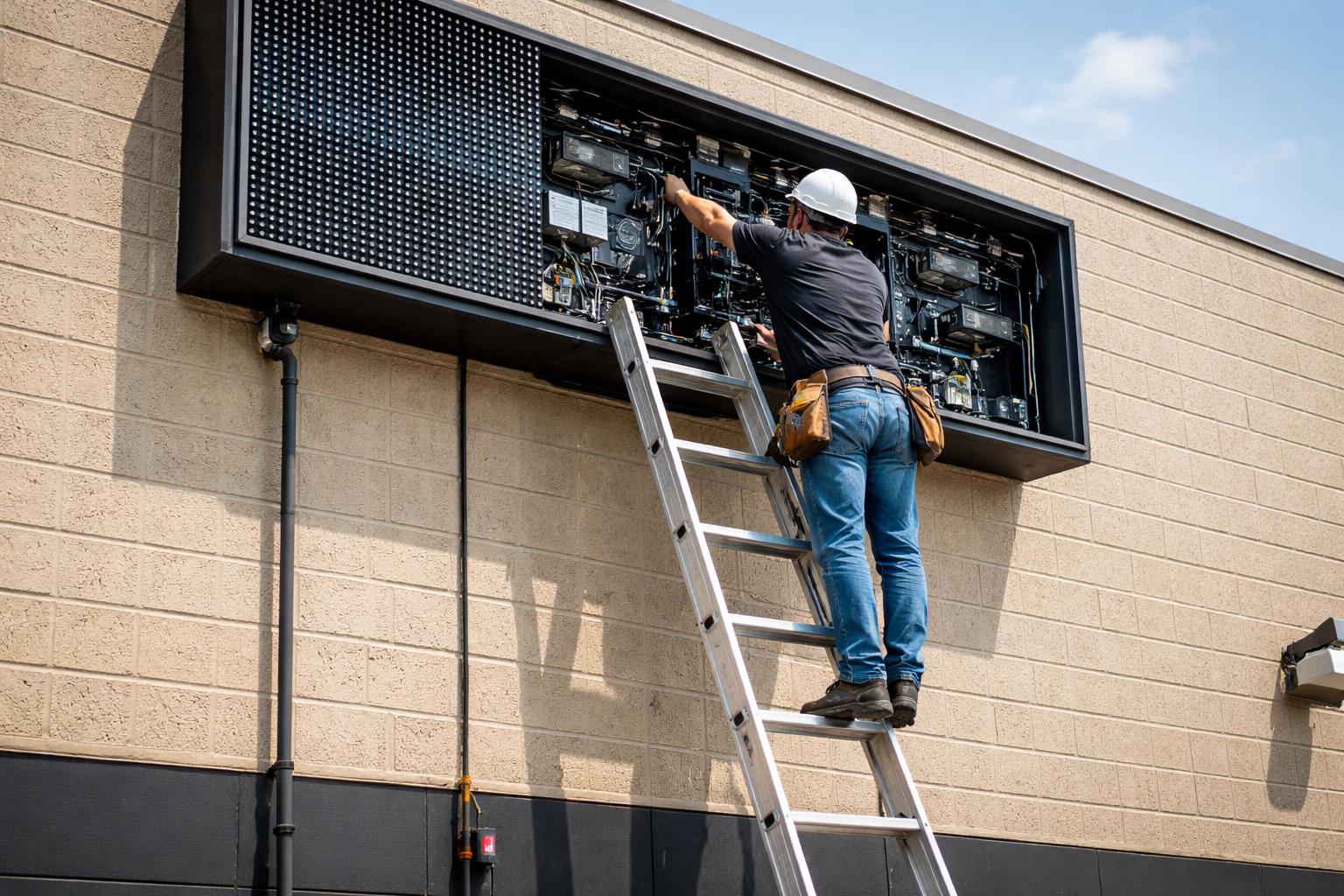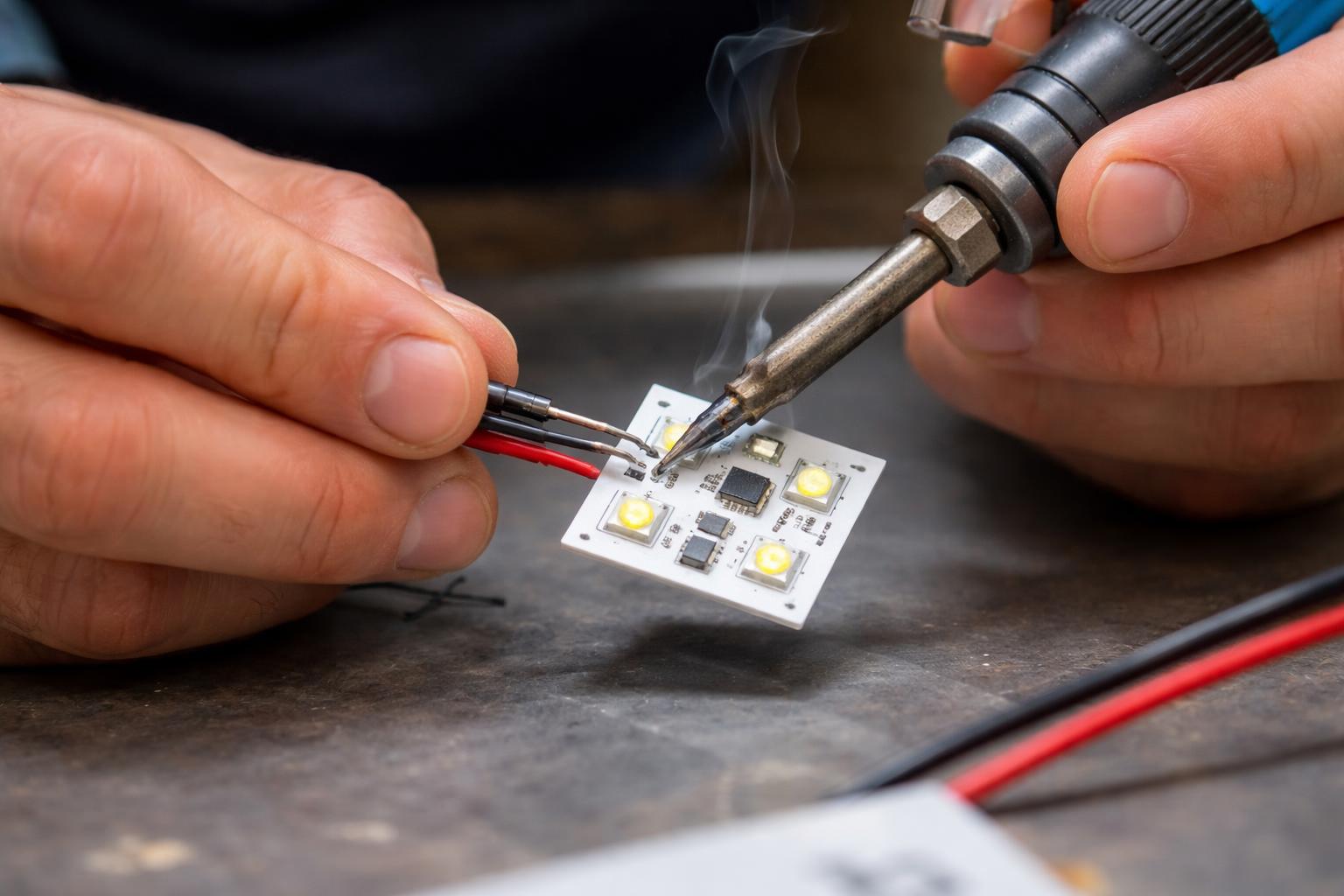
An ageing LED sign rarely fails all at once. More often, the warning signs appear gradually: a cluster of dead pixels, one panel that looks darker than the rest, colours that no longer match, content that freezes unexpectedly, intermittent power faults, or moisture appearing inside the cabinet after heavy rain.
At first, these problems may seem minor. Replacing a module or restarting the controller might restore the display for a while. However, when faults begin returning more frequently, the important question is no longer simply, “Can this sign be repaired?” The better question is, “Which option will deliver the best value over the remaining life of the sign?”
For owners of commercial LED signs, the answer usually falls into one of three categories:
- repair the failed component and continue operating the existing system;
- refurbish the display by retaining suitable structural elements while upgrading its electronics; or
- replace the complete display with a modern system.
Each option can be appropriate. The right decision depends on the age and condition of the display, the availability of compatible components, the integrity of the cabinet, the reliability of the controller and communications system, energy use, repair history and the importance of the sign to the business.
At Blink Digital, we help businesses assess existing LED displays, troubleshoot performance problems and determine whether repair, partial refurbishment or complete replacement is likely to provide the strongest long-term result. Blink Digital provides digital signage installation, maintenance and support across Brisbane, the Sunshine Coast, the Gold Coast and other Australian locations, backed by more than 22 years of experience in LED technology.
This guide explains how to recognise the difference between a repairable fault and a sign that has reached the point where continued repairs may no longer be economical. It is particularly relevant to businesses researching LED sign repair, LED sign refurbishment, digital signage Brisbane services, or ways to upgrade an LED sign without unnecessarily replacing usable infrastructure.
What the Problems in Ageing LED Signs May Be Telling You
An LED sign is not a single component. It is an integrated system consisting of LED modules, receiving cards, data cables, power supplies, controllers, communications hardware, sensors, cooling or ventilation arrangements, electrical protection, structural cabinets and content-management software.
This distinction matters because the quoted operating life of an LED package does not automatically represent the useful life of the entire sign. Research into LED system reliability has consistently found that overall performance cannot be assessed through light output alone. Drivers, power supplies, electrical connections, optical materials, thermal management and other components may deteriorate or fail before the LEDs themselves reach their theoretical lumen-maintenance limit. Colour shift may also become unacceptable even while the LEDs continue producing light.
A sign can therefore be “working” in the narrow sense that it still turns on while no longer performing adequately as a commercial advertising asset. The following symptoms can help indicate which part of the system requires attention.
Isolated dead pixels usually appear as individual black, permanently illuminated or incorrectly coloured points. A small number may be caused by localised LED or module faults. When they are confined to one replaceable module and compatible stock remains available, a targeted repair may be straightforward. When dead pixels are widespread across modules of similar age, however, the pattern may indicate broader deterioration rather than a single defective part.
A completely dark rectangular section often points towards a failed module, data connection, receiving card or power supply rather than the failure of every LED in that area. Commercial display service documentation shows that power-supply faults can be diagnosed by identifying the affected supply, checking connections and replacing the relevant component where necessary.
Incorrect colours or poor colour uniformity may appear as a red, green or blue cast across one module, visible colour blocks, faded areas or neighbouring panels that no longer match. Colour consistency can change as LEDs, encapsulants, lenses and other optical materials age. High temperature and humidity can accelerate chromaticity shift and lumen depreciation, while heat-management design and operating current also affect long-term stability.
Colour differences may also occur after a repair if a newly manufactured module is installed beside older modules that have already experienced years of use. Even when the part number appears compatible, differences in LED batches, calibration, drive characteristics or firmware can make the replacement panel visibly brighter or differently coloured. That does not necessarily mean the new module is defective; it may reveal how far the surrounding modules have drifted from their original performance.
A display that is noticeably dimmer than it used to be may be experiencing LED degradation, power-delivery problems, incorrect brightness settings, dirty or deteriorated optical surfaces, failing sensors, heat-related derating or a combination of factors. Before assuming the entire display must be replaced, the technician should establish whether the lost brightness is consistent across the screen or concentrated in particular modules.
The distinction is important for LED signs Brisbane businesses rely on in direct sunlight. A uniformly aged display may remain technically operational but lack sufficient daytime contrast to make messages readable from the intended viewing distance. Conversely, a screen that looks adequately bright during the day may be operating far too intensely at night because its ambient-light sensor or brightness-control settings are faulty.
Flickering, intermittent blanking or random restarts frequently suggest unstable power, loose data or power connections, overheating, a deteriorating controller, damaged cabling or moisture-related faults. Intermittent problems deserve prompt investigation because they can be difficult to reproduce after the technician arrives. Recording the time, weather, displayed content and affected screen area can help identify a pattern.
A display that is online one day and offline the next may have a controller, modem, network or software issue rather than an LED-module problem. Controller replacement can also require configuration and association with the relevant cloud or content-management platform; installing new hardware does not always restore operation until the software environment has been correctly updated.
Communications compatibility has become especially important in Australia. All Australian 3G mobile networks had shut down by November 2024, meaning 3G-dependent Internet of Things equipment could no longer connect through those networks. An otherwise serviceable sign using an old 3G modem may therefore need a communications upgrade even when its display modules are still functioning.
Water inside the cabinet, corrosion or repeated faults after rain should be treated as more than a cosmetic problem. The IEC’s ingress-protection system classifies the protection provided by an enclosure against dust and water, but an original IP rating does not guarantee that an older cabinet remains equally well sealed after years of thermal cycling, ultraviolet exposure, gasket compression, cable changes, physical damage or previous service work.
If an electrical sign has been affected by storm damage or water, do not open it or attempt an improvised repair. Queensland’s Electrical Safety Office advises people to stay away from damaged electrical signs and equipment and to use appropriately licensed electrical workers for electrical work.
When LED Sign Repair Is the Sensible Choice
Repair is usually the most economical option when the problem is isolated, the remainder of the display is performing consistently and compatible replacement components are readily available.
Typical repairable faults include a small number of failed modules, one power supply, a damaged cable, a receiving card, a brightness sensor, a modem or a controller that can be replaced without redesigning the whole system. Repair can also be appropriate when a fault was caused by a specific external event, such as accidental impact, a localised leak or electrical damage, rather than widespread age-related deterioration.
The strongest candidates for repair generally share several characteristics:
| Assessment factor | Signs that support repair |
|---|---|
| Fault location | The failure is confined to a clearly identified component or small screen area |
| Display quality | Unaffected modules remain bright, consistent and visually acceptable |
| Parts | Exact or properly compatible components are available |
| Cabinet | The enclosure is structurally sound, dry and serviceable |
| Controller and software | The existing control system remains supported and reliable |
| Repair history | The sign has not developed a pattern of repeated unrelated faults |
| Business impact | The repair can be completed promptly without excessive downtime |
| Expected life | The repair is likely to provide a worthwhile additional operating period |
Replacing individual modules can be particularly cost-effective in a younger sign where the failed module is from the same generation as available spare stock. Modular construction is one of the practical advantages of many commercial LED displays: technicians can service a defined section rather than discarding the complete screen.
However, the phrase “compatible module” requires more scrutiny than simply matching its dimensions. The replacement should be assessed for pixel pitch, LED type, scan configuration, voltage, connectors, receiving-card mapping, firmware, colour characteristics, brightness and physical mounting. A module that fits into the opening is not necessarily electrically or visually compatible.
Before authorising an LED sign repair, ask the service provider to explain:
What has actually failed? A good diagnosis should identify the cause rather than merely describe the symptom. For example, “the panel is black” is an observation. “The module is receiving data but its power supply has failed” is a diagnosis.
Is the proposed repair likely to be permanent? Replacing a corroded power supply without correcting the water-entry point may restore the sign only until the next storm.
Will the repaired section match the existing display? A new module may look conspicuous beside aged modules. Calibration can help in some systems, but it cannot always eliminate differences between generations of components.
How much remaining life is expected from the rest of the sign? A low-cost repair may make sense when the surrounding equipment is sound. It may be poor value when several other power supplies, modules or cables are approaching the same failure point.
Are parts available for future repairs? The value of repairing an older display falls sharply if the installed platform is obsolete and the last available spare is being used now.
Does the repair address electrical and environmental safety? Any work involving fixed wiring or electrical components must be undertaken by appropriately qualified and licensed people. In Queensland, unlicensed electrical work is illegal and potentially dangerous.
At Blink Digital, we can assess whether a targeted repair is justified and help avoid unnecessary replacement when a sound display can be restored economically. Blink Digital’s published services include regular check-ups, troubleshooting and repairs, as well as support for unresolved maintenance and warranty issues.
The key is not to judge the repair on invoice price alone. A repair that costs less today but fails again in three months can be more expensive than a broader intervention that restores system reliability.
When LED Sign Refurbishment Offers Better Value
Refurbishment sits between component-level repair and complete replacement. It usually involves retaining useful elements of the original installation while replacing a substantial part of the display technology.
Depending on the sign, refurbishment may preserve the supporting structure, pylon, monument surround, architectural cladding, mounting steel or part of the cabinet. The LED modules, power supplies, internal wiring, control equipment, communications hardware and software platform can then be upgraded as a coordinated system.
This approach can be attractive when the existing sign structure is valuable, difficult to reproduce or expensive to remove, but the electronics inside it have become unreliable or obsolete. LED manufacturers document retrofit products designed for existing sign structures, and industry examples demonstrate that older cabinets can sometimes be retained while all display electronics are replaced.
A refurbishment may make sense when:
- the pylon, monument, frame or architectural surround remains structurally suitable;
- the original LED modules are dim, inconsistent or no longer supported;
- repeated faults are occurring across several electronic subsystems;
- exact replacement modules are unavailable;
- the old controller or communications platform is obsolete;
- the owner wants improved resolution, brightness control or remote management;
- replacing the complete supporting structure would add cost without delivering a corresponding benefit.
A successful LED sign refurbishment is not simply a large repair. The new components need to be engineered and configured as an integrated system. Mixing old and new equipment without confirming electrical, thermal, data and mechanical compatibility can introduce new failure points.
Cabinet condition is the first major test. Retaining an existing cabinet only makes sense when it is structurally sound, appropriately sealed and capable of supporting the proposed equipment. Technicians should examine corrosion, distortion, welds, fixings, doors, hinges, locks, gaskets, drainage, cable entries, ventilation and maintenance access.
Surface corrosion may be repairable. Extensive internal corrosion, deformed panels, failed seams or recurring water entry may make cabinet retention a false economy. A cabinet that is difficult to seal or service could compromise new electronics installed inside it.
Thermal performance is equally important. New modules and power supplies may have different heat loads or airflow requirements. Temperature has a significant effect on LED-system efficiency and ageing, and the effectiveness of heat management influences long-term performance.
A refurbishment assessment should therefore consider how heat leaves the enclosure, whether ventilation openings remain clear, whether fans or filters are required, where direct sun loads the cabinet and whether previous modifications have interfered with airflow.
The electrical system must be evaluated rather than assumed suitable. A replacement display may have a different maximum current, average load, inrush behaviour, circuit arrangement or earthing requirement. Existing cables, isolators, switchgear, surge protection and distribution equipment need to be assessed against the proposed system and applicable requirements.
Retrofit instructions from major display manufacturers warn that upgrading sign electronics requires knowledge of sign electrical systems and that old cables or connector arrangements may not be reusable with newer modules.
The control platform should be upgraded deliberately. A refurbishment is an opportunity to move away from unsupported desktop software, ageing local computers, manual USB updates or obsolete communications hardware. Modern cloud-connected digital signage can provide remote content publishing, scheduling, user permissions and cross-platform browser access, although the appropriate system will depend on the sign and organisation.
For a multi-site business, school, church, medical practice, shopping centre or dealership, the controller and content-management platform may be as important as the LED face. A visually improved screen still creates operational frustration if only one old computer can update it.
Visual expectations also need to be defined. Refurbishment can improve pixel pitch, contrast, colour consistency and content capability, but the appropriate specification should be based on viewing distance, traffic speed, sign size and intended content. Installing the smallest available pixel pitch is not automatically the best-value choice; additional resolution is useful only when viewers are close enough to perceive it.
Refurbishment often works best when the owner likes the sign’s location, size and structural presentation but no longer trusts the technology inside it. Blink Digital can inspect the existing installation and identify which elements may be worth retaining before recommending a repair, retrofit or new display.
When Complete Replacement Is the Better Long-Term Decision
Replacement is generally the stronger option when faults are widespread, the cabinet or structure is compromised, parts are obsolete, the control system is unsupported or the cost of restoring the old display approaches the value of a modern installation.
The fact that a sign can technically be repaired does not prove that it should be repaired. Almost any older system can be kept running if enough specialist labour, recovered components and custom modifications are applied. The commercial question is whether that expenditure will produce dependable service and an acceptable customer-facing result.
Complete replacement deserves serious consideration when several of the following conditions apply.
Faults are no longer isolated. One failed module is a repair. Repeated failures across modules, power supplies, data cards and cables suggest system-wide ageing. When each service visit uncovers a different problem, the business may be paying to move from one weak point to the next.
The display has lost visual uniformity. If the screen contains obvious brightness bands, mismatched modules, widespread colour shift or faded areas, replacing individual panels can create a patchwork appearance. The sign may continue displaying content, but the uneven result can weaken the professional image it was purchased to support.
The cabinet is allowing moisture ingress. Repeated water entry is particularly concerning because it can damage multiple components and create electrical risks. Replacing affected electronics without permanently resolving the cabinet problem is unlikely to deliver reliable performance.
Corrosion is extensive. Rusted fasteners, corroded connectors, deteriorated printed circuit boards, oxidised terminals and damaged cabinet seams can make service slower and less predictable. Once corrosion is widespread, apparent faults may be symptoms of several interacting problems.
Essential components have been discontinued. Obsolete receiving cards, proprietary modules, power supplies or controllers can make every future fault harder to resolve. Parts may occasionally be sourced from old stock or donor displays, but their condition and future availability may be uncertain.
Long-term parts support should be treated as a purchasing criterion for the next sign, not as an afterthought. For example, Blink Digital states that it maintains an eight-year supply of parts for each LED sign it provides, supporting customers beyond the initial installation period. Other established manufacturers likewise promote long-term parts-availability commitments, illustrating how important component support is to whole-of-life value.
The controller and software environment are obsolete. A sign that depends on an unsupported operating system, unavailable installer, discontinued controller, insecure remote-access method or obsolete mobile modem may be increasingly difficult to manage. Software incompatibility can also prevent the business from using current image formats, scheduling tools, user controls or cloud services.
The sign no longer suits how the business communicates. An older low-resolution screen may have been suitable for simple text but perform poorly with current branding, photographs, video-style content or detailed promotional layouts. Replacement can create value not only by reducing faults, but by making the sign more useful.
Repair access is poor. Some older installations become expensive to service because landscaping, new cladding, nearby structures or changes to the site restrict access. If each module replacement requires extensive access equipment, traffic management or dismantling, future maintenance costs can outweigh the apparent saving from retaining the display.
Energy use is materially higher than necessary. Energy alone rarely justifies replacing a functioning LED sign, but it can strengthen the business case when combined with reliability, brightness and software improvements. The correct comparison should use measured or documented average consumption, actual operating hours and the customer’s tariff rather than relying on maximum nameplate power.
For example, consider an illustrative display operating for 14 hours per day. If an older system averages 1.5 kW and a replacement averages 0.9 kW under comparable content and brightness settings, the annual difference at an electricity rate of 30 cents per kilowatt-hour would be approximately A$920. This is only an example; real savings will vary with sign size, content, ambient-light control, tariff and operating schedule.
Replacement may also reduce unplanned downtime. For a roadside retailer, car dealership, shopping centre, school, hotel or medical practice, the financial impact of a blank sign is not limited to the service invoice. The business also loses opportunities to promote offers, communicate events, direct visitors or reinforce its presence to passing traffic.
A sensible replacement decision therefore compares the full expected cost of keeping the old sign with the cost and benefits of a new system. It should include repairs, access equipment, technician travel, downtime, electricity, software limitations, content-management labour and the likelihood of further faults.
Comparing Repair, Refurbishment and Replacement Costs
No universal percentage can determine when a repair becomes “too expensive”. The answer depends on the importance of the display, the cost of downtime, the expected reliability after the work and the value of the retained assets.
A practical assessment can begin with the following comparison.
| Question | Repair | Refurbish | Replace |
|---|---|---|---|
| Is the fault isolated? | Usually suitable | Sometimes unnecessary | Usually unnecessary |
| Are exact parts readily available? | Important | Less important if the system is being modernised | Not required for the old display |
| Is the cabinet structurally sound? | Important | Essential if it will be retained | Less relevant if being removed |
| Are widespread modules ageing? | Poorer fit | Strong potential fit | Strong potential fit |
| Is the controller obsolete? | May require a separate upgrade | Can be replaced as part of the project | Replaced with the system |
| Is water ingress recurring? | Only after the cause is permanently corrected | Possible if the cabinet can be restored | Often preferable where the enclosure is compromised |
| Is the structure valuable and reusable? | Retained | Major reason to refurbish | May still be retained with a new cabinet, subject to engineering |
| Is improved resolution required? | Limited | Often possible | Fully configurable |
| Is predictable long-term support a priority? | Depends on old parts | Improved with a coordinated upgrade | Usually strongest with a supported new platform |
The next step is to estimate whole-of-life cost rather than comparing only the first invoice.
A useful internal calculation is:
Expected cost of keeping the current sign
= proposed repair or refurbishment
- likely additional repairs during the comparison period
- access equipment and call-out costs
- estimated downtime impact
- additional energy cost
- software or communications upgrades
- risk allowance for obsolete parts.
This figure can then be compared with:
Expected cost of replacement
= new sign and controller
- removal and installation
- structural or electrical work
- approvals where required
− value of avoided repairs
− estimated energy savings
− value of improved capability and reduced downtime.
Not every part of this comparison can be measured perfectly. The aim is not to create false precision, but to expose costs that are often overlooked.
Service history is one of the most valuable sources of evidence. Review invoices, technician reports, fault logs and replaced components from at least the previous two or three years. A sign with one repair after years of reliable operation presents a different risk from a sign requiring several visits each wet season.
Downtime should be valued according to the sign’s role. A small internal staff-information display may tolerate a longer outage. A prominent roadside sign promoting daily offers may be business-critical. An LED scoreboard, event display or tenant-directory sign may be particularly valuable at specific times, making reliability more important than the annual average.
The expected post-repair condition matters more than the number of parts changed. Replacing five modules might sound substantial, but it may still leave dozens of equally aged modules in service. Conversely, replacing a single central controller could resolve a display-wide communications fault and return an otherwise healthy sign to reliable operation.
Warranty coverage should be checked before work begins. Confirm whether the display, component or previous repair remains under warranty and whether unauthorised service could affect that coverage. Warranty terms commonly distinguish between parts, labour, travel, access equipment and damage caused by external factors. Manufacturer service information may also warn that repair by unauthorised parties can affect warranty rights.
Parts availability needs a time horizon. A supplier finding one compatible module today is not the same as a supplier committing to support the platform for years. Ask how many spares exist, whether they are new or recovered, whether they are from a matching production batch and what happens when that stock is exhausted.
Temporary restoration and permanent strategy can be separated. A business may choose a limited repair to restore urgent operation while planning a refurbishment or replacement for a quieter trading period. This approach can be sensible when an immediate full project would cause excessive disruption, provided the owner understands that the first expenditure is a short-term measure.
Blink Digital can help businesses compare these options without assuming that a new sign is automatically required. Where an existing display has a sound cabinet, available components and a repairable fault, restoration may provide excellent value. Where the evidence points towards repeated failures and obsolete equipment, Blink Digital can help plan a more dependable upgrade.
Digital Signage Brisbane Conditions, Brightness and Compliance
Local conditions should form part of the decision for any business assessing digital signage Brisbane installations.
Outdoor displays in South East Queensland may be exposed to intense sunlight, heat, humidity, heavy rainfall, storm activity and wind-driven moisture. Laboratory research into LED systems has found that high temperature and humidity can affect source efficiency, colour stability and light-output maintenance, reinforcing the importance of suitable enclosure design and thermal management.
That does not mean every older outdoor sign in Brisbane requires replacement. It means an inspection should consider environmental performance rather than focusing only on the visibly failed part.
For example, recurring module failures on the western side of a cabinet could suggest greater afternoon heat exposure. Faults appearing after storms may indicate a gasket, cable-entry or drainage issue. A sign that becomes excessively bright after sunset may have a failed light sensor or incorrect control settings.
Brightness is both a performance and compliance issue. Brisbane City Council states that illuminated and electronic advertising devices must meet additional technical standards. Its technical requirements reference AS/NZS 4282 and establish luminance controls for different environmental zones. They also require suitable automatic brightness control for certain electronic display components visible from roads.
This is relevant when deciding whether to repair or upgrade an old brightness-control system. A display should not simply run at maximum output throughout the day and night. Council guidance explains that ambient-light sensors can adjust electronic displays for bright sun, dusk, cloudy conditions and night-time operation. For displays with more than five square metres of electronic display area visible from a road, the technical standards require an automatic feedback loop such as a photoelectric cell.
Owners should also check whether proposed changes amount to routine maintenance, an alteration to the electronic display component, or a larger change requiring approval or reassessment. Brisbane City Council notes that some advertising devices are self-assessable when they meet prescribed conditions, while other signs require approval. Illuminated and electronic signs must satisfy the applicable technical standards.
Council requirements may vary outside Brisbane, and approvals can depend on sign type, property location, dimensions, road exposure, illumination and the scope of the proposed works. A refurbishment that materially changes the size, brightness, technology or operation of a sign should therefore be assessed in its local planning context.
The physical condition of the supporting structure also needs attention. Reusing a pylon or frame may reduce project cost, but the structure must be suitable for the proposed loads and installation. Where engineering, electrical or access work is required, appropriately qualified professionals should be involved.
For businesses searching for LED signs Brisbane support, choosing a local provider can be valuable when the sign needs an on-site assessment rather than remote guesswork. Blink Digital services Brisbane, the Sunshine Coast and the Gold Coast from its Brendale location and provides installation, maintenance, troubleshooting and ongoing support.
What Blink Digital Can Check Before You Make a Decision
The best repair, refurbishment or replacement recommendation begins with evidence. Photographs and fault descriptions are useful, but an on-site inspection may be needed to understand the display’s overall condition.
Blink Digital can help review the factors that influence the decision, including:
The sign’s age and operating history. Installation date, daily operating hours, original supplier and previous repairs provide context for the visible fault.
The manufacturer and component platform. Model numbers, module labels, controller types, receiving cards and power-supply specifications help establish whether matching components remain available.
Pixel and module condition. The inspection can identify dead pixels, colour-channel failures, brightness differences, module seams, visual artefacts and signs of widespread ageing.
Power delivery. Technicians can investigate failed supplies, unstable voltages, overloaded circuits, loose connections and patterns of repeated power-related faults, with licensed electrical workers handling electrical work where required.
Signal and data pathways. Failed receiving cards, data cables, controller outputs and configuration issues can produce display faults that resemble defective LED modules.
Controller, modem and software compatibility. Older signs may depend on obsolete communications equipment, unsupported applications or a single ageing computer. The assessment can identify opportunities to modernise content management as part of a repair or refurbishment.
Cabinet integrity. Doors, seals, drainage, corrosion, cable entries, ventilation, access and internal contamination all affect whether the enclosure is worth retaining.
Brightness control and visual performance. The sign can be evaluated in relation to its viewing conditions, ambient-light sensing, daytime visibility and night-time operation.
Structural and installation factors. Blink Digital can assess how the display is mounted and identify whether existing structures may be suitable for refurbishment or a replacement system, subject to any required engineering review.
Future parts support. The recommendation should consider not only whether a part can be sourced today, but whether the sign is likely to remain serviceable in the years ahead. Blink Digital states that it maintains an eight-year parts supply for the LED signs it provides.
Before contacting Blink Digital, gather any information you have about the sign, including its approximate age, dimensions, manufacturer, serial number, controller software and service history. Photographs of the full display, the affected area, the cabinet interior where safely accessible, and identification labels can help the team prepare for the assessment.
Do not open an energised cabinet or attempt electrical testing yourself. Damaged electrical equipment should be inspected and repaired by an authorised service provider or appropriately licensed electrician, and recycling is the recommended disposal route for electrical equipment that cannot be safely repaired.
Talk to Blink Digital About LED Sign Repair, Refurbishment or Replacement
An ageing LED sign does not always need to be replaced. A failed module, power supply, controller or communications device may be economically repairable. Where the supporting cabinet or structure remains valuable, a coordinated refurbishment may restore performance while avoiding unnecessary demolition and rebuilding. When failures are widespread, components are obsolete or the enclosure has deteriorated, complete replacement may deliver lower risk and better long-term value.
The most expensive option is often not the one with the highest initial quotation. It is the option that creates repeated downtime, continuing service visits and ongoing uncertainty without restoring dependable performance.
Blink Digital can help you:
- diagnose dead pixels, dark modules, inconsistent colours and brightness problems;
- investigate controller, data, communications and recurring power faults;
- assess water ingress, corrosion and cabinet condition;
- determine whether compatible replacement parts are available;
- compare targeted repair, LED sign refurbishment and complete replacement;
- upgrade an LED sign with modern modules, control hardware or content-management technology;
- plan new LED signs and digital signage where the existing installation is no longer viable.
Blink Digital specialises in LED signage production, installation, management, maintenance and support, with services available across Brisbane, the Sunshine Coast, the Gold Coast and other Australian locations. Customers can also view a range of LED displays at the company’s Brendale factory.
For practical advice about an existing sign, contact Blink Digital and provide photographs, dimensions, fault details and any available service records.
Call Blink Digital: 0424 505 990
Email: info@blinkdigital.com.au
Visit: Unit 1/11 Hinkler Court, Brendale QLD 4500
Whether your display needs one replacement module, a complete electronic refurbishment or a modern new system, Blink Digital can help you make an informed decision based on reliability, serviceability and long-term value.