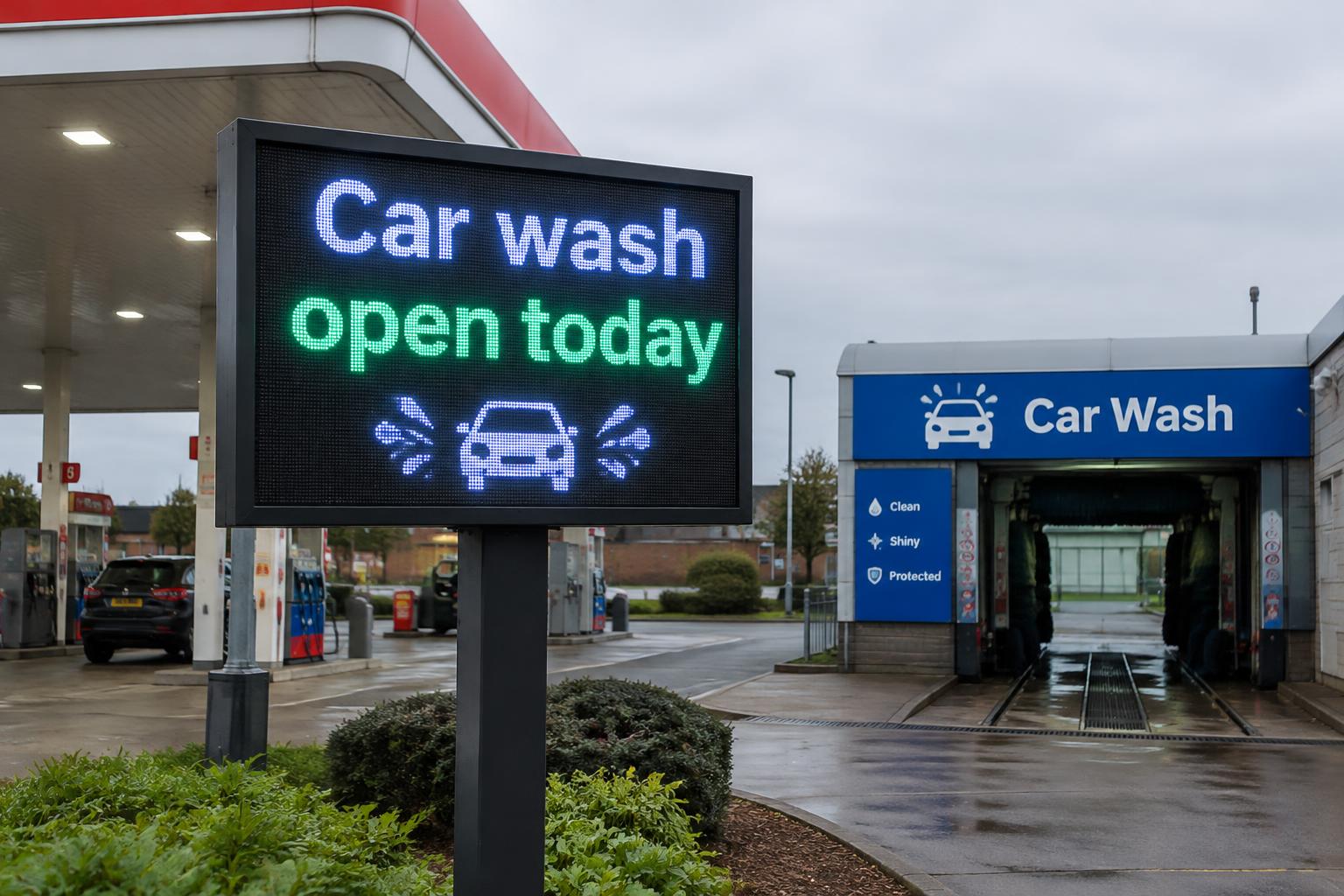
Why LED Signs Make Sense for Modern Service Stations
A service station has only a short window in which to communicate with many of its potential customers.
A motorist approaching from down the road may have only seconds to notice the site, understand an offer and decide whether to turn in. A customer who has already stopped to refuel may have a little longer, but they are still moving through a highly functional environment: entering the forecourt, choosing a pump, filling the vehicle, walking towards the store, paying and leaving.
That makes signage particularly important.
Traditional static signs remain useful for branding, directions and information that rarely changes. But when a service station wants to promote changing offers, seasonal campaigns, convenience-store products, car washes or other services, LED signs give operators much greater flexibility.
Instead of printing a new banner every time the promotion changes, a digital display can move from morning coffee messaging to lunchtime meal deals, afternoon snacks or an evening car-wash promotion according to the needs of the business.
This broader role for digital communication is increasingly relevant to the convenience sector. In September 2026, 7-Eleven Australia announced the launch of its dedicated convenience retail media network and said a new in-store digital-screen network rollout had commenced, with further expansion planned for 2027. The company described the screens as a way for brands to reach customers close to the point of purchase.
That example reflects an important shift: a petrol station is no longer only somewhere motorists buy fuel.
Major Australian operators increasingly position their sites around food, coffee, snacks, grocery essentials, loyalty programs and other convenience services. Ampol, for example, describes its Foodary locations as convenience stores as well as service stations, offering fresh food, coffee, snacks and fuel, while its current promotional activity includes app-based convenience-store offers and rewards.
For independent service stations, franchisees and multi-site petrol retailers, this creates a simple marketing challenge:
How do you tell motorists and existing forecourt customers what else is available before they drive away?
Well-planned service station digital signage can help answer that question.
At Blink Digital, we work with businesses across Brisbane and Australia on custom LED signage, outdoor screens, installation, maintenance and ongoing support. Our existing outdoor signage range is designed around high-brightness, weather-resistant applications, while our custom LED capabilities allow signage to be planned around the location, audience and available space rather than treating every site as identical.
For service stations in particular, that site-specific approach matters. The ideal screen for a suburban station on a 60 km/h road may be very different from the right screen for a highway location, a neighbourhood convenience outlet or a large travel centre.
The objective should not simply be to install the biggest LED screen possible.
The objective is to put the right message, on the right screen, in the right location, for the right amount of time.
From fuel stop to retail opportunity
Think about the different customer opportunities across a typical service station.
A person driving past may initially be interested only in fuel. Once they pull in, however, they may also be a potential customer for coffee, cold drinks, snacks, hot food, groceries, ice, barbecue gas, a car wash or another service available on the site.
This is where petrol station LED signs can perform more than one job.
A roadside display can build awareness before a vehicle arrives. Forecourt signage can speak to customers while they are refuelling. A screen near the store entrance can promote offers just before they walk inside. Indoor displays can then reinforce the promotion closer to the point of purchase.
Rather than asking one sign to perform every function, operators can think of signage as a sequence of communications along the customer journey.
That approach is especially useful for sites where fuel margins, store sales and promotional priorities can change over time. The ACCC notes that convenience-store sales are one of several factors that can influence retail petrol economics in regional markets, underscoring that the shop component is an important part of the broader service-station business model.
The opportunity, therefore, is not merely to make a petrol station brighter.
It is to make its communications more useful.
Where Service Station Digital Signage Can Work
The most effective signage plan normally starts with location rather than screen specifications.
Before deciding on pixel pitch, dimensions or cabinet design, ask where customers are, how quickly they are moving, what decision they are making at that moment and how much information they can realistically absorb.
At Blink Digital, we can help service-station operators work through those questions before recommending a particular LED solution. Our existing installation process includes site assessment, positioning, wiring and calibration, supported by consulting and design services that consider the client, audience and surrounding environment.
For a petrol station, there are several distinct signage opportunities.
| Signage location | Typical audience | Useful content |
|---|---|---|
| Roadside frontage | Passing motorists | Brand messages, store promotions, car wash, food and beverage offers |
| Entry or driveway | Motorists entering the site | Current promotion, directional information, service highlights |
| Forecourt | Customers refuelling | Coffee, meal deals, loyalty offers, car wash or convenience-store promotions |
| Store entrance | Customers transitioning indoors | Immediate offers, bundles, new products |
| Inside convenience store | Shoppers | Product promotions, menu information, seasonal campaigns |
| Car-wash approach | Customers already on-site | Car-wash packages, upgrades, instructions or promotions |
| Exit-facing position | Departing customers | Future offers, loyalty messaging or reasons to return |
The precise combination depends on the site.
Roadside promotional displays
For many service stations, the roadside display is the highest-profile location.
It has the opportunity to reach people who have not yet decided to enter the property, making it particularly useful for awareness-building and simple offers.
Examples might include:
“Fresh coffee available 24/7”
c
“Breakfast deal in store”
“Cold drinks and snacks inside”
“New hot food range”
A roadside screen may also support seasonal campaigns such as holiday travel offers, summer drinks, winter coffee promotions or limited-time convenience-store specials.
The most important rule is simplicity.
A passing motorist cannot read an advertisement the way somebody reads a website, brochure or menu. They are simultaneously controlling a vehicle, watching traffic, checking intersections and responding to road conditions.
Queensland Transport and Main Roads explicitly recognises this issue in its Roadside Advertising Manual. For electronic billboards visible from state-controlled roads, the department manages characteristics such as movement, message changes and brightness because advertising can add visual and cognitive load for drivers.
That is why effective roadside LED advertising should communicate one clear idea rather than trying to fit an entire catalogue onto the screen.
A motorist should be able to understand the main point at a glance.
Forecourt advertising
Once a customer has entered the service station, the communication opportunity changes.
They are no longer travelling past at road speed. During refuelling, there may be an opportunity to make customers aware of products or services they had not intended to purchase.
Forecourt messaging might promote:
- coffee and food;
- convenience-store bundles;
- a car wash;
- loyalty programs;
- seasonal products; or
- services available elsewhere on the property.
This does not mean a large video wall should automatically be placed next to a fuel pump. Service stations are specialised workplaces that store and handle significant quantities of hazardous chemicals, and Queensland WorkSafe notes that the flammability of these products creates unique hazards that operators are required to manage under work health and safety legislation and relevant standards.
Screen location, electrical work and the site’s hazardous-area classifications therefore need to be considered professionally.
Queensland’s Electrical Safety Regulation also contains specific requirements for electrical installations and equipment in hazardous areas, including circumstances in which inspection by a hazardous-area accredited auditor is required before connection or reconnection.
For that reason, Blink Digital can help assess potential signage positions as part of the wider site-planning process, but any service-station installation needs to take the site’s electrical and hazardous-area requirements into account rather than treating the forecourt like an ordinary retail car park.
Convenience-store signage
Inside the shop, viewing distances are shorter and customers normally have more time to read.
That changes the type of display that may be appropriate.
A giant outdoor-format LED screen may not be necessary. Depending on the environment, smaller LED displays, indoor screens or LCD digital signage may provide better close-range communication.
Blink Digital supplies both indoor LED signage and other digital display options, allowing the display format to be matched to where customers will actually see it.
Indoor content can also be more detailed than roadside content.
For example, a roadside sign might simply say:
“Coffee + breakfast deal inside”
The in-store screen can then explain the products included, promotional period and relevant terms.
This creates a useful marketing hierarchy: attract attention outside, reinforce the message on the forecourt, then provide the details inside.
Car-wash promotions
Car washes are another natural use case for service station digital signage.
A customer has already entered the property and may already be thinking about vehicle maintenance. A digital display can draw attention to car-wash availability, packages or time-limited promotions.
The messaging can also change according to circumstances.
Following dusty weather, operators may prioritise a wash promotion. Before a long weekend, the message might focus on getting the car ready for a trip. After periods of rain, the campaign can change again.
The advantage is flexibility.
The physical screen stays in place while the campaign changes.
Mobile and temporary LED signage
Not every campaign requires permanent infrastructure.
A service station launching a refurbished store, promoting a special event or temporarily directing customers around site works may benefit from portable signage.
Blink Digital supplies mobile LED signs and LED trolleys designed for temporary promotions and high-traffic locations, giving operators another option where permanent installation is not the right fit.
Permanent and portable signs can also work together.
For example, a permanent roadside display may handle ongoing promotional messages while a portable screen supports a short-term reopening campaign or special weekend promotion.
Designing LED Signs for Roadside Visibility
Good LED signage is not judged by how impressive it looks when somebody stands directly in front of it.
It is judged by whether the intended audience can understand it in the actual operating environment.
For petrol stations, that often means designing for motorists.
Several variables become particularly important: viewing distance, traffic speed, screen size, pixel pitch, brightness, sightlines, orientation and the complexity of the message.
Viewing distance should influence the screen
The first question is straightforward:
How far away will the customer be when the message needs to become readable?
A screen intended for pedestrians five metres away has different requirements from one targeting motorists approaching from 60 or 100 metres.
Pixel pitch — the spacing between individual LED pixels — is one consideration.
Blink Digital’s existing guidance compares P4, P6 and P8 displays and explains how the appropriate pitch changes with viewing distance. P4 provides greater detail for closer viewing, while P6 often balances resolution and cost for medium-distance outdoor applications. P8 is more suited to longer-distance viewing where very fine detail is unnecessary. Our guidance specifically identifies service stations as one of the possible applications for medium-distance P6 signage.
But pixel pitch should not be selected in isolation.
A very high-resolution screen can still be ineffective if it is too small for the road frontage, hidden by trees, mounted at the wrong angle or filled with tiny text.
Likewise, a lower-resolution screen can be extremely effective when its dimensions, message and viewing distance are properly matched.
At Blink Digital, we prefer to start with the practical question: where will your customer be when they need to read the sign?
From there, the appropriate dimensions, pitch and mounting arrangement become easier to determine.
Traffic speed changes how much motorists can read
The faster the audience is moving, the less information a screen should require them to process.
At 40 or 50 km/h, a motorist may have more opportunity to see a roadside promotion than somebody passing a station on an 80 km/h arterial road.
But even at lower speeds, the driver’s attention is not dedicated to advertising.
They may be watching traffic signals, pedestrians, cyclists, merging vehicles or the entrance to the service station itself.
Queensland’s state-road advertising requirements reflect this principle. For electronic billboards covered by the Transport and Main Roads manual, the department requires minimum message dwell times based on road type and speed. The manual specifies 25 seconds for devices visible from a motorway or motorway-standard road, 15 seconds for state-controlled roads with speed limits of 80 km/h or above, and 10 seconds for applicable state-controlled roads below 80 km/h.
Those requirements do not automatically apply to every LED sign at every Australian service station, but they demonstrate an important design principle:
Roadside advertising should prioritise comprehension over animation.
Trying to make the screen exciting with rapid transitions, long sentences or constant motion can be counterproductive — and, depending on the location, may conflict with approval conditions or road-safety requirements.
Keep the roadside message short
Imagine a motorist approaching at normal traffic speed.
Which message is easier to understand?
Visit our convenience store today and take advantage of our fantastic range of hot food, barista-style coffee, cold beverages and selected promotional products.
Or:
HOT COFFEE + BREAKFAST
The second version wins.
That does not mean every advertisement needs only four words, but it illustrates why message discipline matters.
For roadside LED advertising, prioritise one primary message, one clear visual hierarchy and a strong contrast between the important information and everything else.
A customer should not have to work out which of seven messages is the important one.
Brightness needs to suit changing light conditions
Outdoor displays have to remain visible in Queensland daylight, but maximum brightness all day and all night is not the objective.
Transport and Main Roads explicitly describes the goal for applicable electronic billboards as maintaining appropriate apparent brightness as ambient light changes. Its current technical guidance specifies progressively higher maximum luminance levels as surrounding daylight increases and much lower levels in dark conditions.
This reinforces the value of automatic brightness management.
During bright daytime conditions, an outdoor LED sign may need substantial output to remain legible. At night, that same output could become unnecessarily bright and may create visual discomfort or amenity issues.
Brisbane City Council also notes that illuminated and electronic advertising can distract road users or create nuisance for nearby properties, and requires relevant electronic-display signage to comply with its technical standards. Some high-impact electronic and LED billboards are prohibited in particular locations.
Automatic or scheduled brightness adjustment therefore does more than save energy. It can contribute to a more appropriate display throughout the day.
Screen orientation matters
A service station may have excellent street frontage but still have poor signage visibility if the screen faces the wrong direction.
Consider:
- the main direction of approaching traffic;
- whether traffic is travelling towards or away from the screen;
- road curvature;
- intersections;
- trees and landscaping;
- existing pylon signs;
- neighbouring buildings;
- parked trucks or other large vehicles;
- canopy structures;
- sun orientation; and
- entry and exit lanes.
Double-sided signage may make sense where meaningful traffic approaches from both directions. At other sites, the second face may add cost without adding a useful audience.
Blink Digital’s guidance on single-sided and double-sided LED signs notes that two-sided installations involve additional hardware, structural considerations, power planning and future maintenance access, so the additional face should be justified by genuine visibility.
This is exactly the type of decision that benefits from a site assessment rather than ordering a screen based only on catalogue dimensions.
Fuel-Price Boards, Promotional Signs and Compliance
One of the most important distinctions for service station operators is the difference between a general promotional LED display and signage showing retail fuel prices.
They may look like similar pieces of hardware, but they do not necessarily perform the same regulatory function.
Fuel-price boards have specific Queensland rules
Queensland’s Fair Trading (Fuel Price Board) Regulation 2017 defines a price board broadly as a board, sign or notice that is visible to a person in a motor vehicle at or passing a service station and displays information about the retail price of types of fuel at that station.
This is important for operators considering digital screens.
A screen does not necessarily fall outside the fuel-price rules merely because it is LED or because the operator thinks of it as an advertising display.
As a practical legal inference from that definition, an LED promotional screen that displays the station’s retail fuel prices and is visible to passing motorists may itself be treated as a price board. Operators should obtain site-specific advice before combining promotional content and regulated price information on the same display.
Current Queensland Government guidance states that fuel retailers are prohibited from displaying conditionally discounted fuel prices on their roadside price boards. Conditional discounts can still be offered, but the discounted price must not appear on the price board.
The regulation also controls the sequence in which price changes are displayed.
When a normal fuel price increases, the price on each price board must be changed before or at the same time as the relevant pump display. When the price decreases, the pump display must be changed before or at the same time as the price board.
Queensland retailers also have a separate fuel-price reporting obligation. They are required to report changes in their normal fuel prices through the state reporting system within 30 minutes of a bowser price change; fuel unavailability must also be reported within 30 minutes.
For signage planning, the key lesson is simple:
Treat fuel-price displays as a compliance system, not merely another advertising campaign.
Promotional signage for coffee, food, car washes and convenience-store products can be planned around marketing priorities. Fuel-price information needs to be planned with the applicable statutory requirements in mind.
Promotional LED signage has its own approval considerations
Removing fuel prices from a screen does not mean the display is automatically approval-free.
In Brisbane, Council regulates advertising devices according to the device type, location and what it calls the relevant environment classification. Businesses are directed to identify the property zone, determine its environment classification and establish the type of advertising device before deciding what form of approval is required.
If the applicant is not the property owner, Brisbane City Council requires landowner consent as part of an application where approval is needed. Council also requires site plans and design or construction information for relevant applications.
This can be particularly important for franchisees, tenants and independently operated sites where the person running the service station may not own the underlying property.
For service stations outside Brisbane, the applicable local-government rules will differ. Sites visible from Queensland state-controlled roads may also engage Transport and Main Roads requirements.
The TMR Roadside Advertising Manual states that its electronic billboard criteria can apply to devices located on private property but visible from a state-controlled road, motorway or motorway-standard road. For those displays, non-static electronic content visible to drivers is not permitted under the manual; applicable displays must remain static during each message, with restrictions on scrolling, flashing, video and message transitions.
The same manual includes location criteria intended to keep electronic advertising away from situations where it could interfere with a driver’s view of traffic signals, official signs, intersections, ramps or other road users.
The regulatory picture is therefore site-specific.
A display beside a quiet local street cannot automatically be assessed the same way as a large digital face visible from a state-controlled arterial road.
This is why Blink Digital recommends addressing approvals and location issues early — before the structure, dimensions and display specification are finalised.
Electrical and hazardous-area considerations matter at petrol stations
A service station is not an ordinary retail environment.
Petrol and other fuels create flammable-vapour hazards, and Workplace Health and Safety Queensland specifically identifies service stations as workplaces that must manage risks associated with significant quantities of hazardous chemicals.
That matters when deciding where electrically powered signage will be installed.
Queensland guidance on hazardous areas explains that electrical installation or equipment in a flammable hazardous area can be subject to specific regulatory and inspection requirements.
Electrical work itself must also be performed by appropriately licensed people. Queensland’s electrical-safety guidance states that a person performing electrical work must hold an electrical work licence authorising that work, while an electrical contractor licence is required for a business performing electrical work for others.
Accordingly, screen placement around dispensers, fuel-fill points and other potentially hazardous areas should never be based purely on advertising visibility.
Safety comes first.
Blink Digital can work with operators on signage planning, screen specification and installation requirements, but individual sites may also need appropriately qualified electrical, engineering, hazardous-area and regulatory professionals depending on the proposed location and scope.
What Should a Service Station Show on Its LED Signs?
Installing the screen is only half the project.
The other half is deciding what to put on it.
A beautifully installed display running weak, cluttered or irrelevant content will not achieve its potential.
For service stations, the strongest content strategy usually reflects the customer’s immediate context.
A driver approaching from the street has different information needs from somebody standing in the convenience store. A customer arriving at 6 am has different purchasing priorities from somebody visiting at 9 pm.
That makes time, location and customer journey useful foundations for campaign planning.
Morning promotions
Morning traffic naturally creates opportunities around breakfast and coffee.
Possible messages include:
“Fresh coffee inside”
“Breakfast on the go”
“Coffee + breakfast deal”
“Start your morning here”
The roadside message should remain brief. More detailed product information can appear inside.
Lunch and afternoon offers
As the day progresses, the content can move to different customer missions.
Lunch campaigns might promote sandwiches, hot-food options, cold drinks or meal bundles.
Afternoon messaging could shift towards cold beverages, snacks, coffee or products that appeal to commuters travelling home.
This is where digital signage provides an operational advantage over static campaign material: the same physical screen can support different promotional priorities at different times.
Car-wash campaigns
A car wash can be promoted at several stages of the visit.
Roadside signage can create initial awareness. Forecourt signage can remind customers while they are filling up. A display near the wash entrance can then present the relevant package or service.
The most effective message depends on where the customer is.
On the road:
“CAR WASH OPEN”
On the forecourt:
“Refuelling? Wash the car while you’re here.”
Near the wash:
“Choose your wash package.”
Different locations deserve different creative, even when all three displays support the same commercial objective.
Seasonal campaigns
Service stations experience significant changes in customer needs throughout the year.
Possible campaigns include:
- summer cold-drink and ice promotions;
- winter coffee and hot-food offers;
- long-weekend travel essentials;
- school-holiday promotions;
- Christmas and Easter trading messages;
- local-event traffic;
- loyalty campaigns; and
- new-product launches.
Digital signage allows the operator to change those campaigns without physically replacing the entire sign face each time.
For multi-site operators, a broader signage network can also support common campaign themes while still allowing individual sites to reflect local circumstances.
Emergency or operational messaging
A digital display can sometimes support operational communication as well as advertising.
For example, operators may need to communicate temporary changes in access, store hours or service availability.
That does not mean a promotional sign should replace mandatory safety, traffic or regulatory signage. Those functions may have separate requirements.
But where appropriate, flexible digital communication can supplement the fixed signage already on the site.
Promotions need honest pricing and clear conditions
Service-station promotional content must also reflect general consumer-law obligations.
Queensland’s fuel guidance notes that service stations must not make false or misleading claims about prices, and pricing information needs to remain consistent across relevant price boards, pumps, registers and advertising where applicable.
This is another reason to create clear governance for digital content.
Someone within the business should know:
who is permitted to update the screens, who approves promotional copy, when offers start and finish, what happens when stock runs out, and who checks that pricing information remains accurate.
A screen that can be updated quickly is useful only when the information on it is also well managed.
Do not overcomplicate animation
One of the common temptations with LED signage is to use every capability simply because it exists.
Bright effects, scrolling copy, flashing transitions and video may look impressive in a demonstration.
They are not necessarily appropriate for a roadside petrol station.
For displays captured by Queensland’s state-controlled-road electronic billboard requirements, moving, flashing, scrolling and video content visible to drivers can be prohibited, with static content and prescribed dwell times required instead.
Even where those exact provisions do not apply, restrained creative often works better for a moving audience.
Start with the information the customer needs to understand.
Then design around it.
Not the other way around.
Choosing Petrol Station LED Signs That Suit the Site
There is no universal “petrol station screen”.
A successful project may involve a large roadside LED display, a smaller pylon-mounted screen, an entrance sign, in-store digital signage or a combination of formats.
The right solution depends on the site and business objective.
At Blink Digital, we help operators work through these variables rather than beginning with a predetermined screen.
Start with the marketing objective
Before discussing hardware, define what the sign should achieve.
Is the priority to:
attract passing motorists?
promote the convenience store?
increase awareness of the car wash?
support seasonal campaigns?
improve the visibility of the overall site?
communicate with existing forecourt customers?
promote food and beverage?
support multiple objectives?
Once that is clear, the screen location becomes easier to evaluate.
Measure the real viewing environment
A site assessment should consider the actual audience rather than relying on assumptions.
For roadside signage, that means looking at traffic direction, speed, approach distance and obstructions.
For forecourt displays, it means understanding vehicle circulation, pump positions, pedestrian routes, canopy structures and hazardous areas.
For indoor screens, it means considering customer flow, counter visibility and viewing distance.
Blink Digital’s existing installation guidance emphasises this site-first approach, with assessment and positioning occurring before final wiring and calibration.
Choose pixel pitch for the viewing distance
The finest available pixel pitch is not automatically the best investment.
A display read from a substantial distance may not benefit from the additional pixel density that would be valuable at close range.
Blink Digital’s P4/P6/P8 guidance describes P4 as suited to closer viewing, P6 as a versatile medium-distance outdoor option and P8 as appropriate for longer-distance applications such as roadside signage.
A service station may therefore use different specifications in different positions.
The roadside display and the convenience-store display do not need to be identical.
Plan for Queensland weather
Outdoor electronics need to cope with conditions very different from those of an indoor television.
Blink Digital’s outdoor LED range is based around high-brightness signs with weather-resistant cabinets intended for outdoor applications.
For Queensland installations, site planning should account for heat, direct sun, rain, ventilation and the way the screen will be accessed for future servicing.
These are not just durability issues.
Heat, ventilation, brightness, electrical stability, operating hours and weather protection can all influence how an LED display performs over time. Blink Digital’s existing lifespan guidance specifically identifies these variables as contributors to long-term performance.
Think about maintenance before installation
A screen should not be designed as though it will never need to be touched again.
Modules, power supplies and other components may eventually require inspection or service.
Ask:
Can technicians access the sign safely?
Does the mounting position make maintenance unnecessarily difficult?
Is front or rear access appropriate?
Would servicing require major disruption to the service station?
How will the screen be cleaned?
Can faults be diagnosed efficiently?
Blink Digital provides maintenance and support as part of its wider digital signage offering and has experience assisting businesses with repairs, refurbishment and replacement decisions.
Thinking about service access at the design stage is much easier than discovering an access problem years later.
Consider single-sided versus double-sided signs carefully
A double-sided roadside display may be ideal where strong traffic approaches from opposite directions.
But the second display face should earn its place.
Additional faces mean additional LED hardware and may increase structural, power and maintenance requirements.
At Blink Digital, we can assess the likely viewing directions and help determine whether a double-sided sign creates meaningful additional exposure or whether a well-positioned single-sided screen would do the job.
Plan content management as well as hardware
Ask who will update the sign after installation.
An independent single-site operator may have different content-management requirements from a chain managing dozens of service stations.
The larger the network, the more valuable structured permissions, scheduling and content governance can become.
For a multi-location retailer, centrally coordinated promotions can help maintain brand consistency while allowing selected local messaging.
For a single site, the emphasis may simply be on giving a responsible manager an efficient way to keep promotional information current.
The goal is the same in both cases: make the screen easy enough to use that it remains relevant after the novelty of installation has worn off.
Plan Your Service Station Signage with Blink Digital
A service station is one of the most demanding environments in which to plan commercial signage.
The audience is constantly moving. Roadside messages need to be understood quickly. Outdoor displays need to remain visible in changing light. The site may contain hazardous areas. Local-government and road-authority requirements can affect what can be installed and displayed. Fuel-price signage has separate regulatory obligations. And the signage still needs to support the commercial priorities of the convenience store, forecourt and wider business.
That complexity is exactly why the best place to start is not with a screen size.
Start with the site.
At Blink Digital, we can help service-station operators, independent petrol retailers, franchisees and multi-site businesses assess the signage opportunities across their property and identify the LED solution that suits the intended audience.
Blink Digital is based in Brisbane and provides customised digital signage solutions for businesses across Australia. Our current capabilities include custom LED screens, outdoor and indoor LED signage, mobile LED displays, digital signage installation, consulting and design, maintenance and ongoing support. Blink Digital states that its custom modular solutions can span screens from approximately 1 to 20 square metres, giving businesses scope to tailor the display to the available location rather than relying on one standard format.
For operators researching LED signs Brisbane, that local experience can be particularly valuable when the site involves Queensland road conditions, Brisbane approval requirements and the practical challenges of installing outdoor signage in a working commercial environment.
We can help you consider:
the best location for the screen; the expected viewing distance; suitable pixel pitch; single-sided versus double-sided configurations; outdoor brightness; screen dimensions; mounting and service access; promotional content requirements; installation planning; and ongoing support.
Where council, road-authority, engineering, electrical or hazardous-area requirements apply, these should be identified and addressed as part of the project planning rather than left until the screen is ready to install. Brisbane City Council itself recommends establishing property zoning, environment classification and advertising-device type when determining approval requirements, while Queensland Transport and Main Roads applies additional controls to relevant advertising visible from state-controlled roads.
The result should be signage designed around how the site actually operates.
Frequently asked questions
Are LED signs suitable for petrol stations?
Yes, LED signs can be suitable for roadside promotions, service-station entrances, convenience-store marketing, car-wash promotions and other communications, provided the display and installation are appropriate for the location. Service stations contain hazardous chemicals and may include classified hazardous areas, so electrical equipment and installation locations require appropriate professional assessment.
What can I advertise on petrol station LED signs?
Promotional signage may be used for convenience-store products, coffee, food, car washes, seasonal campaigns, loyalty messaging and other services. However, fuel pricing is subject to specific rules in Queensland, and other advertising content remains subject to consumer-law, council and road-safety requirements where applicable.
Can I display fuel prices on an LED screen?
Digital technology itself does not remove the obligations applying to fuel-price displays. Queensland legislation defines a price board according to its function and visibility: a board, sign or notice visible to motorists at or passing a service station that displays retail fuel-price information. On that definition, an LED screen displaying fuel prices can potentially be a regulated price board. Site-specific compliance advice should therefore be obtained before designing a combined fuel-price and promotional display.
Can I advertise a discounted petrol price on the roadside sign?
Queensland prohibits conditionally discounted fuel prices from appearing on service-station price boards. Discounts such as those dependent on vouchers, reward schemes or qualifying purchases can still be offered, but the discounted figure cannot be shown as the roadside fuel price in circumstances covered by the regulation.
Do petrol station LED signs need council approval in Brisbane?
It depends on the sign and site. Brisbane City Council directs applicants to determine the property’s zone, advertising environment and device type when establishing whether approval is required. Heritage locations and other circumstances can create additional requirements, and landowner consent is required for relevant applications where the applicant does not own the property.
What happens if the petrol station is on a state-controlled road?
Additional Queensland Transport and Main Roads requirements may become relevant where electronic advertising is located within, or is visible from, a state-controlled road under the department’s jurisdiction. The current Roadside Advertising Manual includes controls dealing with static versus moving content, dwell times, brightness, location and driver distraction.
Can petrol station LED signs play video?
That depends on where the sign is located and which approval regime applies. For electronic billboards covered by Queensland Transport and Main Roads requirements and visible to drivers on relevant state-controlled roads, non-static displays are not permitted; messages are required to remain static, with moving, flashing, scrolling and video content prohibited.
How bright should an outdoor service station LED sign be?
There is no single brightness level appropriate for every installation. The requirement depends on ambient light, orientation, location and regulatory conditions. TMR’s current criteria for electronic billboards illustrate this by allowing substantially greater luminance in strong daylight than in dark ambient conditions. Automatic brightness control can therefore be useful for maintaining visibility during the day without excessive output at night.
What pixel pitch is best for petrol station LED signs?
It depends primarily on viewing distance and the amount of detail being shown. Blink Digital’s guidance positions P4 for closer-range detail, P6 as a versatile medium-distance choice and P8 for longer-distance viewing. Service stations may use different pitches for roadside and in-store applications because the audience distance is different.
Should a petrol station use a single-sided or double-sided LED sign?
A double-sided display can be worthwhile where meaningful traffic approaches from two directions. Where most customers see the screen from one direction, a single-sided sign may be more efficient. Blink Digital recommends evaluating traffic direction, visibility, structure, power and maintenance access before deciding.
Can LED signage promote the convenience store as well as the fuel business?
Absolutely. In fact, that can be one of its most useful roles. Convenience retailers increasingly operate across food, beverages, coffee, loyalty and other categories in addition to fuel, and 7-Eleven Australia’s 2026 rollout of an in-store digital-screen network illustrates the growing role of screens in convenience retail marketing.
Can the content change at different times of day?
Yes. Where the signage system and applicable approvals allow it, operators can schedule different promotional content for morning, lunch, afternoon and evening audiences. Any roadside content should still comply with applicable dwell-time, transition, movement and other requirements imposed for the site.
Can Blink Digital help with an existing service-station LED sign?
Blink Digital provides maintenance and support as well as new digital signage installations. The company also assists businesses in assessing ageing LED displays and deciding whether repair, refurbishment or replacement is the more practical long-term approach.
Does Blink Digital work outside Brisbane?
Yes. Blink Digital is Brisbane-based and describes its services as covering Brisbane and other Australian locations, with production, installation, management, maintenance and support forming part of its wider digital-signage offering.
Talk to Blink Digital about LED signs for your service station
Whether you are planning a new roadside display, upgrading an ageing sign, promoting your convenience store, improving car-wash visibility or developing a broader service station digital signage strategy, Blink Digital can help you plan a solution around your site rather than forcing your site around a standard screen.
We can help you assess the viewing distance, traffic direction, screen location, pixel pitch, brightness, dimensions, mounting requirements and long-term maintenance considerations before you commit to an installation.
For businesses searching for petrol station LED signs, LED signs Brisbane or flexible roadside LED advertising, the next step is to discuss the actual property and what you want the signage to achieve.
Contact Blink Digital today for more information, practical advice and a customised LED signage solution for your service station or convenience retail site. Blink Digital can be contacted on 0424 505 990, and its Brisbane-based team provides design, installation, maintenance and support for custom LED signage projects.