For Brisbane businesses considering an LED display, one of the first purchasing decisions is often whether to invest in a brand-new sign or consider a second-hand unit. At first glance, the choice can appear straightforward: a new sign offers the latest equipment and a fresh warranty, while a used display may offer a lower upfront purchase price. In reality, the right decision depends on much more than whether the screen has been used before.
The condition of the LED modules, the age and compatibility of the control system, brightness consistency, the availability of replacement parts, cabinet construction, weather sealing, mounting requirements and the cost of getting the sign operational at your particular site can all change the value equation. A second-hand LED sign that is well suited to its new location and has been properly assessed may represent excellent value. Conversely, an inexpensive display can become a costly purchase if it needs extensive modifications, difficult-to-source components or significant installation work before it can be switched on.
This is especially important for businesses comparing the LED signs Brisbane suppliers offer, because the screen itself is only one component of a complete signage system. Installation, electrical supply, communications, structural requirements, access, approvals, content management and ongoing support all contribute to whether an LED sign is genuinely suitable for the site.
At Blink Digital, we work with custom LED signage as well as selected second-hand equipment, and our current product range demonstrates why “new versus used” is not always a simple binary choice. For example, Blink Digital currently lists a second-hand 3,200 mm × 960 mm P10 outdoor LED sign fitted with brand-new running gear. It is an example of how an existing display structure can sometimes be combined with updated components rather than treating every part of the sign as being the same age.
Our broader service offering covers LED signage design, installation, maintenance and consulting, so we can help businesses look beyond the sticker price and consider how a proposed sign will perform as an installed, supportable system.
If you are weighing up new and second-hand LED signs in Brisbane, the following guide explains what should be checked before making the decision.
Start with the site, not simply the price of the LED sign
The most useful question is not, “Is a new or second-hand sign cheaper?” It is, “Which sign is suitable for this location, audience and application once everything required to install and operate it is taken into account?”
That distinction matters because a brand-new LED display can generally be specified around the project. Dimensions, pixel pitch, cabinet configuration, control hardware, service access and other characteristics can be selected to suit the intended location. A second-hand display works in the opposite direction: you begin with an existing set of dimensions and technical characteristics, then determine whether those characteristics are appropriate for the new site. Blink Digital’s custom signage services are built around tailoring the display to the business, audience and installation environment, while its current second-hand product listing illustrates the alternative approach of adapting suitable existing equipment.
That makes site suitability the first filter.
Imagine, for example, that you have found a competitively priced P10 outdoor sign. “P10” refers to a 10 mm pixel pitch: the distance between the centres of neighbouring pixels. Pixel pitch influences pixel density and therefore how much visual detail a screen can reproduce at a given physical size. Manufacturers such as Planar and Barco explain that smaller pixel pitches provide greater pixel density and tend to suit closer viewing, while larger pitches can remain appropriate where viewing distances are greater. There is therefore no single pixel pitch that is automatically “best”; it should be chosen around the viewing conditions and application.
That means a second-hand P10 display could be an excellent match for one roadside site and a poor fit for another location where customers will be standing much closer to the screen.
The same principle applies to physical dimensions. An available second-hand display might be attractively priced, but does its aspect ratio suit the content you intend to show? Will the whole screen be clearly visible from the main approach? Can it be mounted in the proposed position without creating additional structural work? Is the cabinet designed for front access or rear access, and is the required maintenance space available once it is installed?
A front-service display, for instance, can make sense where technicians cannot easily access the rear of the cabinet. Blink Digital’s current second-hand P10 listing specifically highlights its front-open construction as a feature that makes maintenance access easier.
This is where an apparently inexpensive second-hand purchase can begin to diverge from a genuinely cost-effective purchase. If the sign needs new framing, changes to the cabinet, a different control solution, extensive electrical work or a mounting arrangement designed specifically to accommodate it, those costs need to be considered before comparing it with a new system.
A useful high-level comparison is:
| Consideration | New LED sign | Second-hand LED sign |
|---|---|---|
| Physical dimensions | Can usually be specified for the intended site | Existing dimensions need to suit or be practically reconfigured |
| Pixel pitch | Can be selected for viewing distance and content | Fixed by the existing LED modules unless modules are replaced |
| Cabinet/service access | Can be chosen around the installation | Existing construction needs to work at the new site |
| Control system | Current system can be specified from the outset | Existing controller and receiving hardware need to be checked |
| Visual uniformity | New modules should begin from a common baseline | Condition and ageing can vary across modules |
| Spare parts | Supply pathway can be planned at purchase | Availability should be established before buying |
| Warranty | Usually clearer as part of a new supply agreement | May be shorter, limited or dependent on replaced components |
| Upfront equipment cost | Often higher | May be lower |
| Adaptation risk | Usually lower because the sign is designed for the site | Can be higher if the site and existing sign are a poor match |
| Best fit | Projects requiring a precise specification or long-term standardisation | Projects where suitable equipment is available and its condition can be verified |
The table is deliberately not a verdict in favour of one option. A well-chosen second-hand display can offer strong value. A new LED sign can provide greater design freedom and certainty. What matters is whether the equipment fits the actual project.
At Blink Digital, we can help assess that fit before installation costs and technical compromises are locked in. That is particularly worthwhile when comparing LED signs Brisbane businesses may find through different suppliers, private sellers or previous installations.
Inspect the LED panels, pixels and brightness before buying second-hand
When assessing a used LED display, the screen face deserves far more attention than a quick demonstration showing a colourful promotional video.
A video can make a display look impressive while concealing problems that become much more obvious when a uniform image is shown. Before committing to second-hand LED signage, the display should ideally be inspected under conditions that make differences between modules and pixels easy to see.
Panel age is one consideration, but it should not be treated as a simple pass-or-fail number.
LEDs generally experience gradual light-output depreciation rather than behaving only as devices that are either fully operational or completely failed. ENERGY STAR describes this characteristic in LED lighting as lumen depreciation: light output can decline progressively over time. An LED display also contains many components beyond the light-emitting diodes themselves, including modules, power supplies, receiving cards, data connections, controllers, communications equipment and the physical cabinet. Blink Digital’s existing guidance on ageing LED signs similarly notes that the condition of the overall system cannot be determined from the LED package alone.
For a prospective buyer, the practical lesson is simple: ask about age, but inspect condition.
Look for individual pixels that are permanently dark, stuck at an incorrect colour or visibly different from the pixels around them. Then look beyond individual pixels to entire modules or sections of the display. A rectangular patch that appears warmer, cooler, brighter or darker than neighbouring areas can indicate that modules have aged differently, come from different production batches or been replaced at different times.
Blink Digital’s technical guidance on ageing displays identifies symptoms such as dead pixels, darker areas, colour mismatch and progressive dimming as issues that can emerge as an LED sign ages.
Brightness uniformity matters because the eye is very good at spotting abrupt differences between adjacent panels. A screen may still be technically bright enough for its application but look patchy because one section is noticeably brighter than another.
That is why a second-hand LED sign should not be judged only by whether it “turns on”.
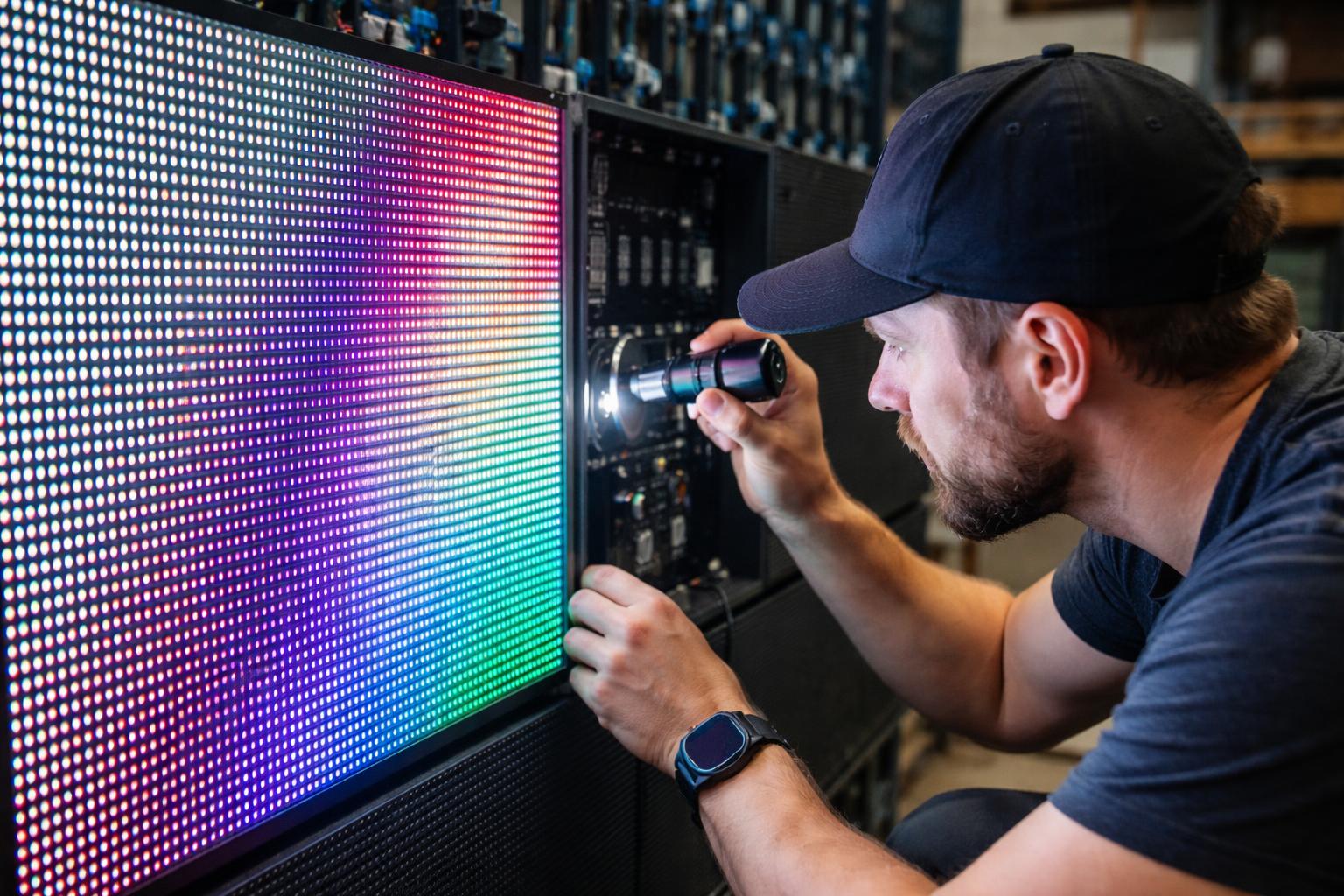
Where practical, inspect the display using simple, uniform content as well as normal advertising material. Full-screen light and dark images, individual primary colours and flat grey tones can make inconsistencies easier to identify than a rapidly moving video. View the screen from the intended audience distance as well as from closer range. The goal is not to demand laboratory-perfect uniformity from a used product; it is to understand exactly what you are buying and whether its visual condition is acceptable for your brand and application.
Ask how the screen has been used. Operating environment, accumulated use and maintenance history can matter as much as the calendar date on which the sign was originally installed. A screen that has been well maintained and operated appropriately may be a better proposition than a younger display with significant environmental damage or a history of repeated component failures.
Also ask whether modules have previously been replaced. Replacement is not inherently a problem. In fact, replacing faulty components is part of normal maintenance. The important questions are whether the replacement modules are electrically and mechanically compatible, whether their brightness and colour characteristics match the remaining display, and whether more matching modules are still available.
Blink Digital’s guidance on module replacement notes that compatibility involves more than physical size. Pixel pitch, LED configuration, scan configuration, operating voltage, connectors, receiving-card configuration, firmware, brightness, colour characteristics and mounting can all be relevant.
This is one area where new LED signs have an inherent advantage. The project can begin with a consistent set of modules and a defined component supply pathway. With second-hand equipment, you need to establish how much useful consistency remains and how straightforward future repairs are likely to be.
That does not make second-hand LED signage a poor choice. It simply means its value should be based on verified condition rather than appearance in an advertisement.
At Blink Digital, we can help businesses assess the technical condition of LED signage and determine whether an available second-hand unit is appropriate for its intended role. If the display is fundamentally sound, a used option may provide a highly practical path into LED signage. If the inspection points towards widespread ageing or difficult-to-match components, investing in a new display can make more commercial sense.
Check the controller, receiving hardware and replacement-parts pathway
The LED modules are the most visible part of a digital sign, but they are only the front end of a larger electronic system.
Behind the display are components responsible for power, data distribution, image processing and communication. Depending on the system, these can include power supplies, receiving cards, sending hardware, a controller or media player, data cabling, communications equipment, sensors and content-management hardware or software. Blink Digital’s own technical overview of LED signs identifies these supporting components as part of the complete system that determines reliability and maintainability.
For a new LED sign, these components can be selected as a compatible system.
For a second-hand sign, you need to know what is actually installed.
Start with the controller. Record the manufacturer and exact model, then establish whether it is still supported. Find out which receiving cards are fitted in the cabinets and whether the current control hardware is compatible with them. Ask which software is used to configure and operate the system and whether that software works with the computers, network environment and workflows your business intends to use.
This is not an abstract concern. Major LED control-system manufacturer NovaStar, for example, maintains hardware and software documentation that includes a specific hardware-and-software compatibility matrix as well as information covering LED control systems, processors, software and discontinued products. That illustrates why a buyer should check the exact equipment combination rather than assume that any modern controller can simply be connected to any older display.
A used screen may still have plenty of life in its cabinets and LED modules while its original controller is no longer the best choice for a new installation. In that situation, upgrading the “running gear” may be more sensible than rejecting the entire display.
Blink Digital’s currently listed second-hand P10 sign is a useful real-world example: the screen is sold as second-hand but is advertised with brand-new running gear and updated components.
That is an important distinction for buyers. “Second-hand” should prompt a more precise question:
Which parts are second-hand?
The cabinets may be reused while the controller is new. The LED modules may have previous operating history while power or communications equipment has been refreshed. Alternatively, the entire display may be in its original configuration. The risk profile is different in each case.
Replacement-module availability is just as important.
A digital sign is made up of repeatable components precisely so individual elements can be serviced, but that advantage is reduced if compatible parts are difficult to obtain. Before purchasing, establish whether spare LED modules are included with the sign, whether identical or proven compatible modules remain available and whether the supplier has a defined spare-parts strategy.
This question becomes particularly important when a screen uses an older or unusual module specification. A physically similar replacement panel is not necessarily a drop-in replacement. As Blink Digital notes in its guidance on ageing signs, matching can involve pixel pitch, LED type, scan configuration, electrical characteristics, connectors, receiving-card mapping, firmware, colour output, brightness and the mounting system.
You should apply the same thinking to power supplies, controller components and communications hardware.
Before buying a second-hand LED sign, ask the supplier what would happen if one module failed six months after installation. Could a matching module be supplied? Is repair possible? Is there a stock of spares? If an identical component is no longer manufactured, is there a tested upgrade pathway?
The answers tell you far more about the real value of the display than its purchase price alone.
Blink Digital states that it maintains an eight-year supply of parts for each LED sign as part of its maintenance and support approach. Our service offering also includes troubleshooting and repairs.
For a Brisbane business planning to use an LED sign for years rather than simply for a short campaign or temporary application, this supportability can be one of the most important differences between a bargain and a sound investment.
A second-hand sign with known components, readily available spares and an appropriate controller can be far more attractive than a nominally newer screen built around hardware for which there is no practical support pathway.
Examine the cabinet, weather sealing and ability to reconfigure the sign
A bright, clean-looking screen face can draw attention away from one of the most important areas of a second-hand LED sign: the cabinet behind it.
For an outdoor display, the cabinet is not just a frame. It protects electronic components, helps provide appropriate access for maintenance and forms part of the system that keeps environmental exposure away from sensitive equipment.
One specification buyers often encounter is the IP rating. The International Electrotechnical Commission explains that the IP, or ingress protection, classification system describes the degree of protection an enclosure provides against the intrusion of solid foreign objects and water. The two-digit IP code is defined under IEC 60529.
For a second-hand LED sign, however, the original specification on a data sheet is only the starting point.
A reasonable practical inference is that a cabinet that was designed to a particular ingress-protection level still needs to be inspected in its present condition. Doors, seals, gaskets, joints, cable entries and other physical interfaces can be affected by previous installation, removal, servicing and ageing. Blink Digital’s guidance for ageing outdoor signs specifically recommends examining cabinet condition, corrosion, gaskets, drainage, cable entries and maintenance access rather than treating the original specification as proof of current condition.
Look for obvious corrosion, damaged coatings, bent cabinet sections, cracked or degraded seals, damaged hinges and fasteners, poorly sealed cable entries and evidence that water has previously entered the enclosure.
Discolouration, corrosion around connectors or staining inside a cabinet should prompt further investigation. A sign that operates correctly during a short demonstration may still have underlying enclosure problems that become expensive after it is exposed to weather at the new site.
Service access should also be assessed before purchase.
Is it a front-service or rear-service cabinet? If access is from the rear, will technicians actually be able to reach the back once the display is mounted? If the proposed location puts the screen against a wall, a rear-service design may require a different mounting approach or additional clearance.
Then consider whether the display can be reconfigured.
This is one of the most valuable questions to ask when evaluating second-hand LED signs.
Modular LED systems can sometimes be rearranged into a different overall configuration, but the fact that cabinets or modules are modular does not mean any desired size is automatically practical. The physical cabinet dimensions, module arrangement, signal architecture, power distribution, control configuration, structural frame and available content resolution all need to work together.
A sign originally installed as a long, shallow roadside display may not be economically convertible into a substantially taller screen merely because the total number of modules appears sufficient.
Similarly, changing the physical arrangement can change the display resolution and aspect ratio. Your existing advertising artwork may then need to be reformatted, and the controller configuration may need to be updated accordingly.
Structural requirements also belong in this discussion. If a used sign is being moved from one property to another, you should not assume that the original pole, frame, brackets or foundation are automatically appropriate for the new location. Blink Digital’s technical guidance on replacement projects highlights mounting steel, engineering, access and installation as factors that sit outside the LED panel itself and need to be considered as part of the overall project.
Location can also change the regulatory picture.
Brisbane City Council provides an advertising-device assessment pathway that considers factors including the property’s zone, environmental classification, the type of advertising device and the relevant approval process. Council also has technical requirements addressing illuminated and electronic advertising devices, including the potential effects of lighting on road users and nearby properties.
In other words, buying a sign that was approved and operated successfully at one Brisbane property does not mean you should assume it can simply be relocated to another address on the same basis. The new site needs to be assessed on its own requirements.
This is an area where Blink Digital can help before money is spent on the wrong hardware. Our consulting and design services are intended to match signage to the business, audience and environment, while our installation service covers the process from site assessment through to final positioning, wiring and calibration.
For buyers researching LED signs Brisbane-wide, that site-specific assessment can be particularly valuable when a second-hand sign initially looks attractive because its physical purchase price is low.
Compare the total installed cost, not the advertised screen price
The most common financial mistake when comparing new and second-hand LED signs is to compare the purchase prices alone.
The better comparison is:
What will each option cost to become a safe, compliant, working sign at this site?
For a new display, the supplier may be quoting a package designed for the location. For a second-hand display, the advertised price may refer primarily to the equipment itself. Depending on how it is sold and where it is coming from, additional work can be required before it is operational.
Potential project costs can include removal from the previous site, transport, storage, lifting or access equipment, supporting steelwork, modifications to the cabinet or mounting system, electrical works, communications, control equipment, replacement modules, site access arrangements, installation labour, testing, commissioning and content-management setup. Site-specific circumstances can also create requirements for engineering, traffic or pedestrian management, or other access arrangements. Blink Digital’s own guidance on LED replacement projects emphasises that access equipment, electrical work, mounting structures and installation conditions can materially affect project cost beyond the screen itself.
Electrical work is particularly important to plan correctly.
Queensland’s Electrical Safety Office states that electrical work must be carried out by appropriately licensed people. It also requires electrical contractors to provide the relevant certificates for electrical installation work and electrical equipment following the prescribed testing and compliance process.
That means “it worked when we removed it” is not a substitute for properly planning the electrical component of a new installation.
Depending on the site, you may need to establish whether suitable power is already available at the intended sign position, whether new cabling or protection equipment is required and how communications will reach the display. The answers can influence both cost and installation complexity.
Then there is access.
A small sign mounted at ground level is a very different installation proposition from a large roadside display positioned several metres above a driveway or commercial frontage. Equipment for lifting the sign and providing safe technician access can add to the project requirements. A used display that is physically heavier or harder to service than a new alternative may also influence the type of structure or access arrangement needed.
Council considerations should be investigated early rather than after a sign has been purchased. Brisbane City Council directs businesses to check whether approval is required based on the property and advertising-device type, and certain sites or forms of signage can trigger additional requirements.
This does not mean every second-hand sign is complicated to install.
Quite the opposite: when the dimensions, mounting arrangement, electrical requirements and site all line up, a suitable used display can be a straightforward and commercially attractive solution. The important point is to do that assessment before deciding that the cheaper screen is the cheaper project.
Consider two hypothetical options.
A brand-new sign costs more to purchase but has been designed to fit the existing structure, includes current control hardware and comes with compatible spare parts.
A second-hand sign costs substantially less at the point of sale but needs structural alteration, upgraded controls, replacement modules, transport from another site and changes to the electrical installation.
It is entirely possible for the new option to offer the lower risk-adjusted cost over the life of the project.
The opposite can also be true.
A quality second-hand cabinet of the right dimensions, with consistent LED modules, known operating history, updated running gear and a straightforward installation path could provide a business with the required result at a substantially lower equipment cost than commissioning an entirely new display.
This is why Blink Digital recommends looking at the whole system and installation rather than making a decision from the product price alone. Our installation services cover positioning, wiring and calibration, while our maintenance and consulting capabilities allow us to consider what will happen after switch-on as well as on installation day.
For businesses searching for LED signs in Brisbane, an itemised comparison is valuable. Ask suppliers to make clear what is included and what is not: equipment, controller, mounting, freight, access, electrical, commissioning, CMS setup, training, warranty and future support.
That makes a new-versus-second-hand decision much easier to evaluate on equal terms.
Understand the warranty, remaining service life and level of risk you are accepting
Warranty can be one of the clearest differences between a new LED sign and second-hand equipment, but buyers should look past the existence of the word “warranty” and understand precisely what protection is being offered.
A new sign may be supplied with warranty arrangements covering specified components and services. A second-hand display may have a more limited warranty, no remaining original manufacturer warranty, or a new warranty that applies only to components that have recently been replaced.
There can also be a mixed situation.
Recall Blink Digital’s currently advertised second-hand P10 display: it is described as second-hand while incorporating brand-new running gear.
When a sign contains a mixture of used and new components, ask exactly which components are covered, for how long, and what happens if the fault lies in the interface between them.
Ask whether the warranty covers parts only or whether labour is included. Find out whether freight is covered if a module needs to be returned. Determine whether removal and reinstallation at height are included or treated separately. Check whether on-site support is available in Brisbane and what maintenance responsibilities you have as the owner.
Blink Digital already publishes separate guidance explaining that LED-sign warranties can differ in their inclusions and that buyers should examine the actual coverage rather than relying on the headline warranty period alone.
The written warranty is also not necessarily the same thing as the legal rights that can arise from a purchase. The Australian Competition and Consumer Commission distinguishes voluntary warranties from statutory consumer guarantees. For a commercial purchase, businesses should establish which statutory protections apply to their particular transaction rather than assuming the written warranty is the entire legal position.
For a second-hand purchase, remaining service life is equally important, but it should not be reduced to a simplistic formula such as “the screen is X years old, therefore it has Y years left”.
An LED sign is a system made from components that can age at different rates. LEDs can progressively lose output, while power supplies, communications hardware, control equipment, seals, connectors and other components have their own condition and failure history. Blink Digital’s technical guidance on ageing signs therefore recommends looking at operating condition, parts availability, cabinet integrity, controller support and repair history rather than using age alone as the decision criterion.
A more useful pre-purchase assessment asks:
What does the screen look like now?
What has already been replaced?
Which components are original?
Are matching modules still available?
Is the controller supported?
Is the cabinet structurally and environmentally sound?
Is there evidence of repeated failure in a particular part of the display?
Can the supplier support the sign locally?
What is covered if something fails after installation?
And, crucially, what level of interruption would a failure create for your business?
The answer to that final question can change the sensible purchasing decision.
If the sign is a supplementary promotional display and the business could tolerate downtime while a part is sourced, a well-priced second-hand system may be attractive.
If the display is a critical customer-information channel, a primary roadside identity sign, a high-profile display at a major venue or part of a standardised multi-site rollout, the business may place greater value on new components, repeatable specifications, a defined spare-parts pathway and clearer lifecycle planning.
This is not about declaring new equipment “safe” and second-hand equipment “risky”. Every project carries technical and commercial considerations.
It is about recognising where the uncertainty sits.
With new LED signage, more variables can generally be specified at the start. With second-hand signage, more effort should go into inspecting, testing and understanding the variables that already exist.
That is also why a very cheap used LED sign with unknown history may represent a less attractive purchase than a somewhat more expensive second-hand unit supplied by a business that can explain its components, condition, modifications and support pathway.
When does new make sense, and when can a second-hand LED sign be good value?
After working through the technical checks, the new-versus-used decision usually becomes much clearer.
A new LED sign is often the stronger option where the project requires a very specific physical size, viewing distance, pixel pitch, cabinet design or mounting configuration. It also makes sense when consistency across multiple sites is important, when the business wants current control hardware from the outset, or when predictable parts support and warranty arrangements carry a high commercial value.
A custom new display can be specified around the site rather than asking the site to accommodate whatever equipment happens to be available. Blink Digital provides custom LED screen design and installation, with screen solutions tailored to the location and application.
New can also be the logical choice when modifying a second-hand sign would remove much of the initial price advantage.
If you need to replace many modules, upgrade the controller, remake the steel structure, repair the cabinet and solve significant weather-sealing issues before installation, the question stops being “new versus cheap used” and becomes “new versus heavily rebuilt”.
By contrast, a second-hand LED sign can be excellent value when the fundamentals are right.
That generally means the size and pixel pitch make sense for the proposed site; the modules have acceptable brightness and colour consistency; the cabinet is in sound condition; service access suits the location; the controller and receiving hardware are supportable or can be sensibly upgraded; suitable spare modules are available; and the installation does not require disproportionate modification.
A second-hand screen can be especially attractive when a business has flexibility around dimensions or when an available unit happens to closely match the intended installation.
It can also make sense where selected new components can extend the practicality of the existing hardware. Again, Blink Digital’s current second-hand P10 sign with new running gear provides an example of this hybrid approach.
The important distinction is between used and unknown.
Used equipment with a known specification, documented condition, suitable spare-parts pathway and professional installation can be assessed rationally.
Unknown equipment with uncertain modules, unsupported controllers, inconsistent panels, damaged cabinets or no plan for replacement parts is harder to price accurately because the apparent saving comes with unresolved costs.
For many businesses, the strongest buying process is therefore not to decide in advance that only new or only second-hand equipment will be considered.
Instead, set the requirements first.
Determine where the sign will go, who needs to see it, the likely viewing distance, the type of content it will display, its physical constraints, maintenance access and the expected role it will play in the business.
Then compare available new and second-hand options against those requirements.
That is the approach Blink Digital can help with. Our Brisbane-based team provides consulting, custom signage, installation and ongoing maintenance, allowing the decision to be made around the complete project rather than one piece of hardware in isolation. Blink Digital states that it has installed more than 130 LED signs and operates from Brendale in Queensland, with services extending across Brisbane, the Sunshine Coast and Gold Coast.
It also creates a natural point of difference when comparing LED signs Brisbane businesses may encounter on the open market. A sign does not become a good business asset merely because it can display an image. It needs to be appropriate for the location, maintainable and practical to operate for the intended period.
Talk to Blink Digital before you buy your next LED sign
Buying an LED display should be approached as an investment in a complete signage system, not simply a transaction for a collection of LED panels.
A new sign gives you the opportunity to design that system around your site from the beginning. A second-hand sign asks a different question: does an existing system still have the right combination of physical fit, visual performance, component support and remaining useful life for the job you want it to perform?
Neither option is automatically right for every Brisbane business.
Before purchasing a second-hand display, check the age and condition of the panels, pixel performance, brightness and colour consistency, control-system compatibility, availability of replacement modules, cabinet condition, weather sealing, service access, warranty arrangements and the likely remaining service life of the complete system. Then examine whether the screen can practically be reconfigured for your site and calculate the cost of transport, mounting, electrical work, controls, access equipment, installation, testing and commissioning.
For a new display, use the same whole-of-project thinking. Compare the proposed pixel pitch, cabinet design, control platform, warranty, spare-parts strategy and support arrangements rather than making the decision solely on physical screen size or headline price.
Brisbane City Council requirements and Queensland electrical-safety obligations may also form part of the installation process, depending on the site and project, so these considerations are best investigated before equipment is committed to a location.
At Blink Digital, we can help you work through those questions.
We provide customised LED signage, installation, maintenance, consulting and design, and our Brisbane-area operation allows businesses to discuss both the immediate purchase and what will be required to keep the display operational after installation. Blink Digital’s services include site assessment, installation, wiring, calibration, troubleshooting and repairs, while the company states that it maintains an eight-year parts supply for each LED sign it supplies.
Whether you are considering a purpose-built new display, reviewing one of our available second-hand LED signs, or have found used equipment elsewhere and need to understand what an installation may involve, speaking with an experienced LED signage team before making the purchase can help expose costs and compatibility issues that are difficult to see from a product listing alone.
The aim is not simply to find the cheapest screen. It is to choose a sign that fits the site, communicates effectively, can be properly installed and has a realistic support pathway for the years ahead.
Contact Blink Digital to discuss new and second-hand LED signs in Brisbane and find the solution that best fits your site, budget and business objectives. Our team can assist with product selection, site considerations, installation planning, ongoing maintenance and technical support. Blink Digital can be contacted on 0424 505 990 or via info@blinkdigital.com.au, and our Brisbane-area premises are at Unit 1/11 Hinkler Court, Brendale QLD 4500.