Designing an LED sign involves more than choosing brightness, pixel pitch or case colour. A crucial decision is how the sign will be serviced in the future. In other words, will technicians work from the front of the display or from behind it? LED Partners explains that “the real difference” between front- and rear-service signs is “how the sign will be reached when something needs to be repaired”. Ignoring this can turn a cheap-feeling installation into an expensive problem later. Brisbane-based Blink Digital treats maintenance access as a core part of the design, not an afterthought. In this guide, we compare front-access and rear-access LED cabinets, outline which applications suit each approach, and list key questions you should ask every LED-sign supplier to avoid costly surprises.
What Are Front-Service and Rear-Service LED Signs?
-
Front-Service (Front-Access) LED Signs: These cabinets are designed so that LED modules, power supplies and electronics can be accessed and swapped from the face of the display. Technicians use magnets, quick-release latches or front-access doors to remove modules without ever going to the back. This design lets the cabinet be mounted flush against a wall or another surface, since no rear clearance is needed. Common scenarios include wall-mounted displays, shopfront digital posters, interior video walls and any sign built into a solid surface. Blink Digital notes that front-service signs are ideal when “there is no realistic room behind the sign”. In practice, front-service LED modules became popular in retail stores, control rooms and architectural branding where slim profile and a polished look are priorities.
-
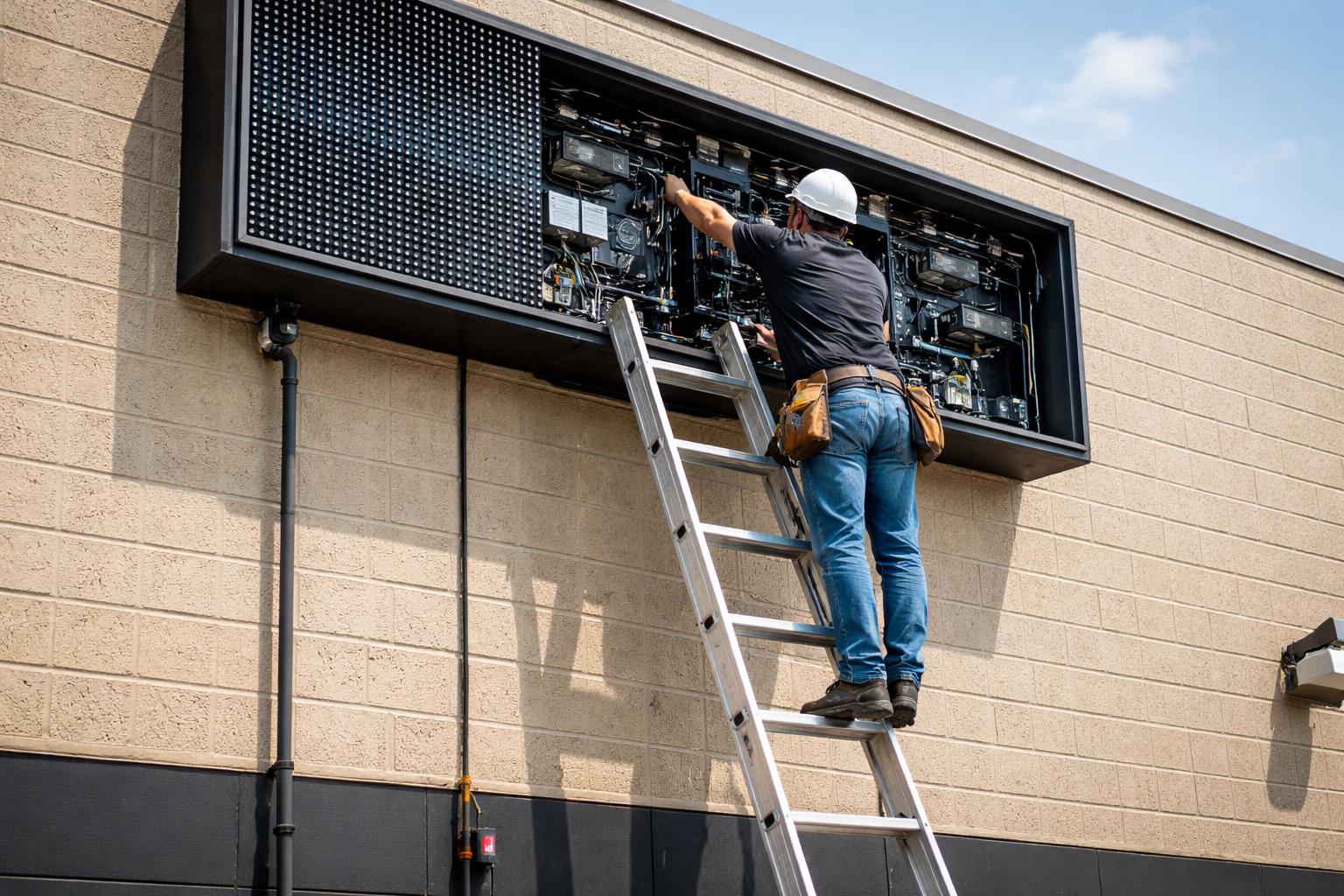
Rear-Service (Rear-Access) LED Signs: These are the more traditional design where panels and components are accessed from behind the screen. In this setup, each cabinet has an open back or service doors, and maintenance requires space behind the sign for a technician to work. Rear-service cabinets are common in large outdoor applications: roadside pylons, freestanding billboards, stadium boards and any installation that already includes safe access behind the sign. If a structure has a built-in service area or the sign is mounted on a pole or column, rear access can be provided relatively easily. Rear-service is not inherently inferior – it works well if the installation is designed around it. For example, a tall digital pylon or monument sign on open ground can accommodate a technician and tools behind it.
In summary, front-service cabinets let you maintain the sign without rear clearance, whereas rear-service cabinets rely on a maintenance corridor or removable back panels. As LED Partners notes, “Neither is automatically better. The right choice depends on the site, the structure, and how the sign will actually be serviced”.
Installation and Clearance: Planning the Space
The choice between front- and rear-service LED signs directly affects installation logistics:
-
Rear-Access Clearance: Rear-service cabinets require clearance space behind the sign, typically at least 0.8–1.2 metres (80–120 cm) to allow a person to enter. According to one industry source, “Rear-service screens require at least 80 to 120 centimetres of back space for technicians to enter”. In practice, this means planning either a walkway, platform or empty cavity behind the sign. Freestanding signs often include an access door or steel frame to permit this. For example, Blink Digital inspects a pylon or pole installation to ensure any base or maintenance access panel can be opened without excessive lifting equipment. If your sign sits near a wall or in a tight corridor, rear access will either be impossible or very costly to create.
-
Front-Access Profile: Front-service designs eliminate the need for rear clearance. Cabinets can be mounted closer to walls or inside window displays. They usually have slimmer depths, sometimes well under 100 mm, because they don’t need a heavy back structure. This allows for a flush or semi-flush installation, which is often preferred in modern storefronts and indoor environments. Blink Digital’s site survey process specifically checks whether a wall-mounted sign can be made flush or if it needs a small service rail in front. Front-access panels do mean the cabinet must have removable parts on the front face, but many designs camouflage these panels so the display looks clean when powered on.
Practical Tips for Installers
- Mounting Depth: Rear-service signs require sturdier (and therefore deeper) frames, which may push the screen surface further from the wall. If front service is possible, your installer might opt for low-profile cabinets to minimise structural work.
- Tools and Lifts: Rear-service installations may need scaffolding, ladders or lifts for maintenance. Blink Digital checks ahead of time whether a ladder outside, scaffolding or fall protection will be required for any rear work. If front service is used, maintenance can often be done from standing on the ground (with step stools or small lifts), reducing equipment costs.
- Climate and Weatherproofing: For outdoor signs, rear access cabinets often provide tighter sealing against rain and dust. Front-service outdoor screens exist but require sophisticated gaskets and engineering to match the weatherproofing of rear-service designs. Discuss this with suppliers to ensure IP ratings meet your climate needs.
When to Choose Front-Service or Rear-Service
Each approach has ideal use cases:
-
Front-Service LED Signs are best for:
- Wall-Mounted & Shopfront Displays: If the sign is flush with a building facade, a store window or an interior wall, front service is almost always more practical. For example, a digital menu inside a café or a branding wall in a hotel lobby can sit right against the wall, with technicians swapping out panels from the front during off-hours.
- Tight Indoor Spaces: In lobbies, studios or retail floors where space is limited, front-service cabinets reduce the footprint. They also keep the installation appearance clean—important in high-end environments.
- Built-In or Architectural Installations: Custom signage built into a larger structure (like a recessed frame or decorative housing) usually has no room behind. Front access avoids having to remove surrounding finishes for maintenance. Blink Digital notes that if a sign is integrated into a finished surface, front service “creates fewer long-term problems”.
-
Rear-Service LED Signs are best for:
- Roadside Pylons and Monument Signs: Large outdoor signs on poles or concrete bases often come with a service cavity or door. If the structure is already engineered for back access (for power or HVAC), rear-service cabinets fit naturally. For instance, a highway-facing LED billboard or a multi-storey pylon often leaves space at ground level or on a mezzanine behind the display.
- Large Freestanding Displays: When the screen size is very large, a rear-access frame can provide stronger support and easier access to heavy components. Stadium screens, sports scoreboards and city billboards typically use rear service, since technicians can climb behind them safely.
- Locations with Safe Access Space: If your site has a dedicated maintenance area (e.g. a fenced yard or fenced rooftop), and appearance is less of a concern, rear-access cabinets may be cost-effective. LED Partners notes that rear service is fine “when the site and structure are built for it”. The key is that the back must actually be reachable.
Remember: a rear-service design is only practical if you really allow for it. A common mistake is to assume a back corridor can be improvised later. Instead, buyers should decide up front whether that space can be reserved. As LED Partners warns, “a sign that is hard to maintain… creates longer service calls, more downtime [and] more labor”. In other words, the lowest bid with no maintenance plan can become the most expensive.
Maintenance, Downtime and Cost Considerations
How will maintenance work on each type? How much time and money does each save or cost in the long run?
-
Front-Service Advantages: By swapping modules from the front, maintenance can be very quick. Technicians often remove a faulty LED panel with special tools in seconds, without disturbing others. Blink Digital observes that this is ideal in busy environments (like retail stores) where downtime must be minimised. Fewer equipment and less labour means less cost during a service call. In fact, some sources say front-access designs “significantly reduce downtime” by eliminating the need for additional access equipment or dismantling.
-
Rear-Service Advantages: Rear maintenance often involves more steps (e.g. opening doors, climbing, etc.), so each repair may take longer. However, a rear-access design can allow easier cable routing and inspection of power supplies during maintenance (since everything is behind the display). For large outdoor screens that get serviced infrequently, this may be acceptable. Rear service also means the front of the sign can be sleek (no visible panel seams), which may be important to some businesses.
-
Cost Trade-Offs: Generally, front-service cabinets have a higher up-front cost than basic rear-access cabinets. The engineering (magnets, hinge systems, slim frames) and tools for front removal add manufacturing expense. Rear-service technology is more common and can be cheaper per panel. However, you must factor in the installation cost of rear service: building a thicker structure, leaving room behind, constructing ladders or access ways if necessary.
Blink Digital highlights that saving a few dollars on equipment can backfire: if a sign is impossible to service from the rear, it may need a complete removal or rebuild when something fails. On the other hand, the premium for front-service often pays off through easier servicing. As one industry analyst puts it, front-service signs “reduce installation labor and time, which compensates for the initial expense”.
-
Downtime Implications: Consider your business: if a few hours of screen downtime costs lost revenue or missed messages, front service is usually worth it. For outdoor displays with 24/7 content, you may prefer a design that minimises any service interruption. Remember that in Australia (e.g. under Workplace Health & Safety rules), any maintenance at height or over traffic also involves planning and potential closures. Blink Digital’s survey notes that an inaccessible screen is a “preventable problem”. They plan in advance for any fall protection, ladders or closures needed for servicing.
Think Beyond Installation: The Whole-of-Life Cost of Service Access
When businesses compare LED signs, the initial purchase and installation price naturally receives a lot of attention. However, service access can influence costs for many years after the screen is installed. A design that appears more economical at the quotation stage may become considerably less convenient if every routine repair requires specialised access equipment, additional labour or partial dismantling of the surrounding structure.
For this reason, Blink Digital encourages businesses to think about the whole-of-life cost of an LED sign rather than focusing only on the upfront cabinet price.
LED displays are modular systems. Over the life of the screen, individual LED modules, power supplies, receiving cards, cables or other electronic components may eventually require inspection, adjustment or replacement. This does not necessarily mean there is a major problem with the display. It is simply why good commercial LED signs should be designed so technicians can reach important components safely and efficiently when required.
Consider a wall-mounted LED sign installed several metres above the ground. If it uses rear-service cabinets but there is no practical access behind the wall, replacing one component could require substantially more preparation than the repair itself. The business may need lifting equipment, temporary access arrangements or, in a poorly planned installation, removal of part of the screen.
A correctly specified front-service system could make the same component considerably easier to reach.
The reverse can also be true. If a large freestanding LED sign already has a secure maintenance area behind the display, paying extra to achieve front access may offer little practical benefit. Technicians may already have straightforward access to the power supplies, cabling and modules from the rear.
That is why Blink Digital assesses the site first and the servicing method second, rather than assuming one cabinet type is automatically superior.
Consider the Cost of Every Future Service Visit
When assessing front-service versus rear-service LED signs in Brisbane, consider more than the technician’s hourly rate.
Potential servicing costs may include:
- elevated work platforms or other access equipment
- additional technicians for safe access
- scaffolding where required
- traffic or pedestrian management
- temporary closure of an area around the display
- additional time spent reaching the faulty component
- dismantling and reinstating surrounding signage or finishes
- travel and call-out expenses
- downtime while the LED sign is unavailable.
Individually, these costs may not appear significant. Repeated over the useful life of a commercial display, however, the difference between an easily serviceable installation and a difficult one can become substantial.
There is also an operational cost to consider.
If your LED sign advertises daily specials, dealership offers, upcoming events, school information or important business messages, every extended period of downtime represents time when the display is not performing its intended role.
For a busy retailer or roadside business, a screen that can be repaired efficiently may therefore provide value beyond simply reducing the maintenance invoice.
Ask What Happens Five Years After Installation
A useful test when reviewing an LED signage proposal is to imagine the screen several years from now.
Ask:
If one LED module fails, how will a technician physically reach it?
If a power supply needs replacing, what needs to be removed first?
Will routine maintenance require a lift, scaffolding or access from another property?
Can replacement components be reached without dismantling the complete display?
If the answers are unclear before installation, they are unlikely to become easier once the sign is permanently mounted.
This long-term planning is an important part of Blink Digital’s approach. When we assess a location for LED signs in Brisbane, we consider not only how the finished sign will look from the road, shopfront or viewing area, but also how technicians will safely maintain it in the future.
The best LED sign design is therefore not simply the cabinet with the lowest purchase price or the thinnest profile. It is the solution that combines visibility, structural suitability, weather protection, safe servicing and practical long-term ownership for the particular site.
Planning that access from the beginning can help prevent unnecessary downtime, difficult maintenance and avoidable costs later.
Key Questions to Ask Your LED Signage Supplier
When comparing quotes, don’t just look at price or size. Make sure you get clear answers on service access. Ask:
-
Front vs Rear Access: Will the cabinets allow front access to modules, or must we service from the rear? Request a detailed cabinet specification. If the supplier suggests front access, ask “How do the panels release? Magnets or latches?” If rear, ask “What clearance do you recommend behind the sign?”.
-
Space and Structure: How much free space is needed behind the sign? Make sure the supplier commits to your site’s reality. If your sign is near a wall, confirm that a front-service variant is available. If it’s on a pole or freestanding, ask how they will provide a safe maintenance zone. Will they include access ladders or platforms if needed?(As Blink Digital does for coastal or industrial sites).
-
Installation Requirements: What installation components are included? Some quotes list only the display panels, while others include mounting frames, legs, footings and electrical housings. Clarify: if rear access is used, does the price include building a rear platform or enclosure? If front access, ensure pricing includes any front-service brackets. LED Partners advises insisting on separate line items for structure and installation, to compare bids fairly.
-
Maintenance and Repairs: What’s the process for a failed panel? Ask how long it typically takes to replace a module. Some suppliers guarantee same-day onsite service, others may ship parts out. Lower-end deals might only offer part replacements by postage, meaning weeks of downtime. Also ask about spare parts: will you get an extra module or power supply with the sign? Blink Digital often discusses warranty cover (parts vs parts+labour) as part of choosing a sign.
-
Safety Considerations: How will technicians reach the sign? If rear service is proposed, ensure there’s a plan: “Can a ladder or scissor lift reach the back?” If not, you may need scaffolding or a swing stage – factor those costs. Blink Digital checks these in a site survey, noting when scaffolding or special gear would be needed. Even for front-service, ask if any panels are high up requiring lifts.
-
Compliance and Local Rules: Does the design meet relevant standards? For example, outdoor signs in Brisbane must meet Council’s advertising-device code and AS 4282 (obtrusive lighting). Make sure the quote assumes compliance – for instance, if night dimming is needed, the controller should include it. Also check if any permits (e.g. BCC development approval) are included in the service or will be your responsibility.
-
Warranty and Support: What warranties cover the display? LED sign warranties can vary (parts-only vs parts+labour, 3-year vs 5-year). A reputable supplier should offer at least 3 years parts and have optional on-site service packages. Ensure after-sales support and technical help is included or available. Blink Digital discusses how warranties and ongoing support factor into the total cost, beyond just the hardware price.
Using these questions as a checklist will help you compare quotes based on real needs, not just the cheapest specs. For example, a lower quote might come from a vendor assuming wall-access maintenance on a sign that cannot actually be serviced that way. Avoid that pitfall by making service access a non-negotiable requirement in writing.
Making the Right Choice for Your Site
Ultimately, neither front- nor rear-service is universally “better” – the right choice depends on your site conditions. The rule of thumb is simple:
-
Choose front-service LED cabinets when the sign will be close to a wall or glass (where technicians cannot easily reach the back). Typical examples include indoor screens, shop windows or built-in building facades. Front-access ensures a flush installation and minimises the need for special access equipment later.
-
Choose rear-service LED cabinets when your structure already provides a safe service corridor behind the display. This is common in outdoor free-standing or pole signs, and large-scale displays. Rear service can be appropriate if the installation environment truly allows it (ample space, removable panels, or integrated maintenance access).
If neither option seems practical — for instance, if you have no rear space but front service would overly complicate the design — it may be worth rethinking the sign location or mounting method. As LED Partners advises, redesign the approach rather than force a “solution” that won’t be serviceable.
Blink Digital’s experience in Brisbane shows that careful planning pays off. During our site assessments, we explicitly check front vs rear access before finalising any design. This way, your LED sign can be both striking for customers and sensible for technicians.
Need Help with Your LED Sign Design?
Choosing and designing LED signage involves many technical details, and Blink Digital is happy to help Brisbane businesses get it right. Our team specializes in LED signs in Brisbane and throughout Australia, covering everything from custom design and installation to after-sales maintenance and support.
If you have questions about front-access cabinets, rear-service requirements, or any other aspect of a digital signage project, please get in touch. Our experts can provide a detailed site survey, clarify compliance issues, and recommend the service-access strategy that suits your site. Contact Blink Digital today for more information and assistance – we’ll ensure your new LED sign is designed to fit your location and be easy to service for years to come.
Have questions about front- vs rear-service LED signs or other signage topics? Contact Blink Digital and let us guide you to the best solution for your business.