In Brisbane’s busy commercial districts, LED signs and digital signage can set your business apart – but only if they’re placed where people will actually see them. Rather than picking a sign and forcing it onto your site, it’s best to start with the location. Your sign might be read by speeding cars on a highway, drivers turning into your driveway, or pedestrians strolling past a shopfront. Blink Digital works with Brisbane businesses to match signage type to site: roadside pylons for highways, building‑mounted screens for urban facades, window displays for foot traffic, and even digital boards at entrances or inside lobbies. In this guide, we compare the main display formats – freestanding pylon or pole signs, building‑mounted LED signs, window‑facing digital screens, entrance/driveway signs and indoor displays – and explain the site factors (like viewing distance, road speed, angles and regulations) that should drive your choice. By understanding these factors, you can ask Blink Digital for a tailored solution that attracts the right customers.
For example, sign experts urge business owners to “start with the site – not the screen”. That means considering property layout, road access, visibility, sun direction and local rules before choosing a display. An LED sign that works for one shop might be completely wrong for another, even in the same street. Blink Digital helps you assess all these variables on location and recommend the optimal sign type. Below we explain the options and key considerations for LED signs Brisbane owners.
Roadside Pylon and Freestanding LED Signs
Roadside pylons (or monument signs) are tall, ground-mounted structures visible from a distance. These are ideal for busy roads or highways. A large pylon sign – often double-sided – gives your business a bold presence. Blink Digital describes such a sign as the “gateway to your business” and “the first impression visitors see when approaching your site”. Because they stand above trees and parked cars, pylon and pole signs “attract attention and can be seen across busy highways, motorways, and streets”.
Image: A freestanding LED monument sign set back from the road. In Brisbane, council setbacks (e.g. the 25-foot setback shown) and right-of-way restrictions often dictate exactly where such a sign can go.
Advantages of roadside pylons/pole signs:
- High visibility from afar: A tall pylon can be glimpsed by motorists on fast-moving roads. This means more time for drivers to read your message before they pass by.
- Larger messages: Because viewers see the sign from tens or hundreds of metres away, you can use large text and simple graphics. Blink Digital can help design the message and size to match your approach speed (faster roads need fewer, bigger words).
- Suitable for multi-lane roads: If you’re set back from the street, an elevated sign is often the only way to be seen. For example, a car dealership on a broad lot might need a 10–12m tall LED pylon so passing traffic can spot it in time.
Considerations and limits:
- Space and setbacks: Pylon signs require space. Brisbane’s rules allow an in-ground sign up to about 1.8m tall and 6m² in area without approval. Larger pylons must comply with council guidelines – typically up to 12m high and 36m² per face, set back a prescribed distance from roads and boundaries. Blink Digital will ensure your sign meets these standards.
- Height vs foot traffic: Extremely tall signs are great for highways, but if your site is in a low-speed, pedestrian area (like a suburban shopping strip), a 12m sign might not perform any better than a shorter one. We choose the right height for the distance – e.g. a moderate-height monument might suit a school or church, while a full pylon is best for major thoroughfares.
- Structural requirements: Tall signs need sturdy foundations. If you have soil/geotech concerns or existing underground services, Blink Digital will factor that into the design and cost.
Types of Roadside Signs:
- Single-pole signs: A single metal post holding an LED display. These are typically limited to 5m height and ~4m² face area in Brisbane. They’re cost-effective for small shops or pharmacies.
- Double-pole or framed pylons: Larger two-post structures that can support bigger, wider panels. These work well for multi-tenant sites or businesses needing a very large display.
- Double-sided LED sign: Many pylons have displays on two sides, so traffic from both directions can see your message. Blink Digital can install double-sided screens if the road traffic flows both ways.
- Monument (solid base) signs: These have a continuous base (often brick or stone) supporting the LED face. They give a “grounded” look which some clients prefer, and can display carved or painted logos on the base as well.
In practice, Blink Digital will survey your site’s traffic and sightlines. For example, at one Brisbane church we advised a 6.6mm-pitch LED panel mounted on a tall H-frame pedestal to capture drivers’ attention from the adjacent road. The image above shows a similar freestanding sign placed a safe distance from the roadway (the dashed arrow indicates Brisbane’s typical 7.5m urban road reserve).
Building-Mounted (Facade) LED Displays
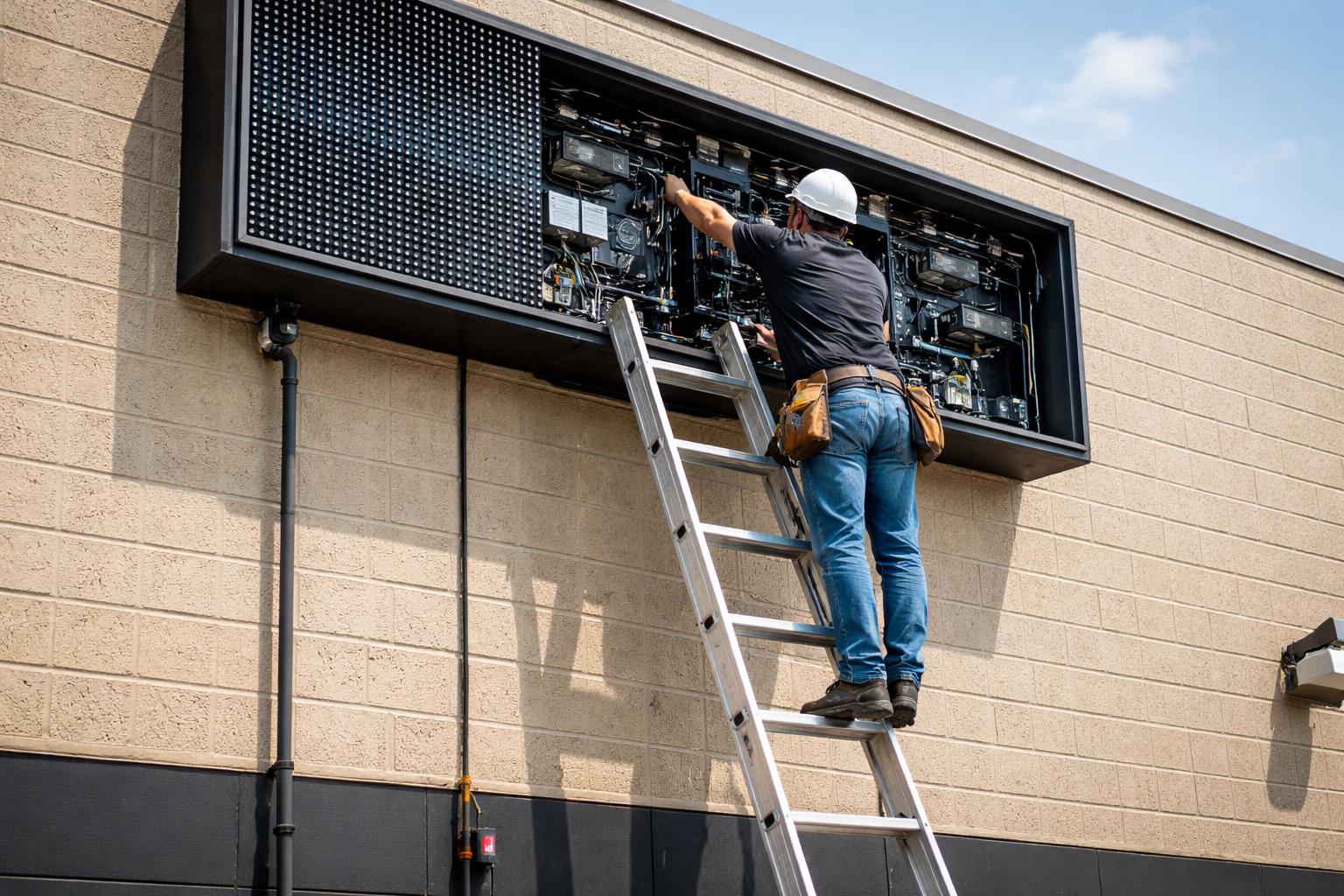
When ground space is tight, mounting a sign on the building itself is a great alternative. Building-mounted LED signs (also called facade or wall signs) attach flat to the wall or fascia. They turn your storefront into a display. For example, Blink Digital can install a large LED panel above shop windows, on a blank warehouse wall, or even projecting over an entrance. These are especially effective in city centres or shopping streets where pedestrians and slow-moving traffic dominate.
Advantages:
- Maximises existing frontage: If your shop has a broad facade facing footpaths or a parking lot, a building sign uses that full area. This can yield a very large message without needing extra land.
- Pedestrian-friendly: Wall signs are at the height of eye-catching: drivers approaching slowly or pedestrians looking around easily read these signs. Blink Digital often places building LEDs just above street level to align with nearby eye-lines.
- Skyline presence: In dense areas with multiple businesses per block, high-mounted facade signs can still be seen from a distance (especially if above a row of lower shops). The contrast of a bright LED panel against a flat wall is hard to miss.
Key factors:
- Council limits: Brisbane typically limits wall sign area to ≤5m² and total projection to 300mm off the wall. (The maximum vertical height is 12m above ground.) Blink Digital will design your sign to fit these limits, often using multiple smaller panels if one big one isn’t allowed.
- Structural support: We check the wall construction. Masonry and concrete can hold larger signs, while steel-framed sheds might need additional bracing.
- Orientation and angle: A flat sign looks best when people pass directly by. If the wall is at an angle to the road, sometimes a projecting or under-awning variant is better (the next section). Blink Digital will measure approaches to ensure your facade sign isn’t hidden around a corner or behind parked vehicles.
- Indoor reflected light: Unlike a roadside sign, a building LED may reflect off windows. We ensure brightness and anti-glare coatings (or placement) avoid blinding drivers or neighbors, in accordance with local glare rules.
Use cases: Building-mounted displays shine in retail strips, malls and campuses. For example, a multi-storey shopping centre might use a huge LED banner across its facade. A medical centre or office tower can have an LED attached high on the building to catch drivers’ eyes before they turn in. Blink Digital can even integrate digital menu boards or content inside a glass entrance (facing outwards) – see the next section on window displays.
Window-Facing Digital Displays
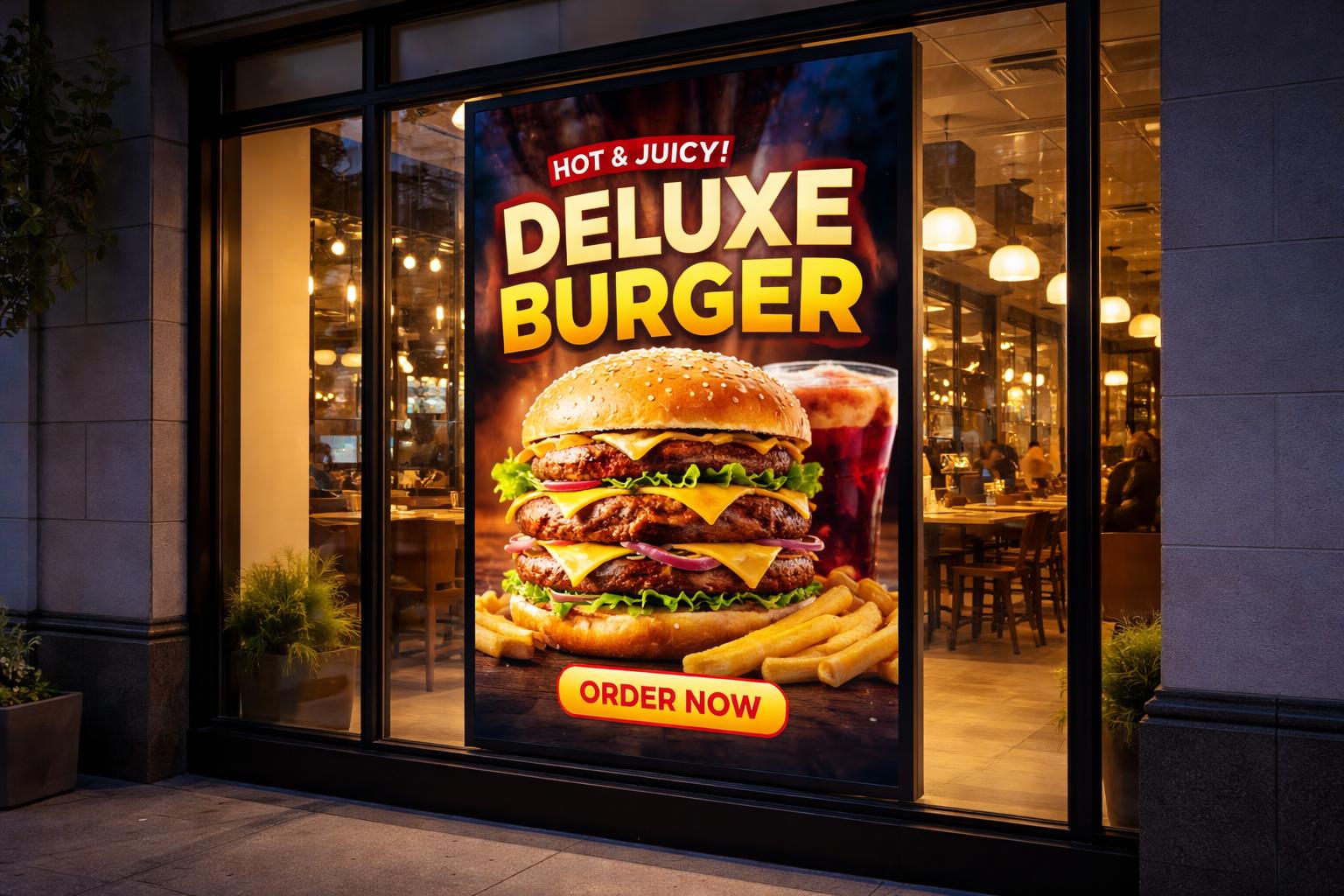
For street-front retail outlets, an indoor screen facing the window is another location strategy. Window digital signage sits just inside a shop window or glass door, broadcasting animated content to pedestrians outside. Think of it as an ultra-high-brightness video poster in your window.
Benefits:
- Captures foot traffic: Busy shopping streets or malls have lots of pedestrians. A well-placed window LED sign (at or below eye level) can literally stop passers-by in their tracks with bold colours and motion. It’s like having a digital billboard right at street-front, teasing people to look in. As one signage guide notes, vivid animations and promotions in a storefront “make even the most hurried passers-by stop and take a closer look”.
- Day and night visibility: Modern window displays are designed for daylight. They use high-intensity panels (often 5,000+ nits) so that text and images remain visible in the sun. At night or in low light, they can automatically dim to avoid glare. Blink Digital specifies an LED brightness tailored to Brisbane’s strong sun and your window’s orientation.
- Interactive options: Windows allow touch or gesture features in some setups. For example, you could have an informational kiosk or QR code screen near the window for shoppers to explore.
Considerations:
- Regulations: Brisbane’s Advertising Devices rules treat a digital window sign as a “window sign.” To be self-assessable, it must cover ≤25% of the glass and ≤2m² per sign. Blink Digital helps calculate this so your display won’t breach local laws. (If you need a larger display, we can advise on approvals.)
- Glare & Reflection: Even with high brightness, a screen may reflect external light. Placement and anti-reflective coatings are chosen to minimise mirror effects. Blink Digital also takes into account winter vs summer sun angles for window signs.
- Power and Connectivity: An indoor window sign needs safe indoor power and network. This is usually simpler than outdoor signs, but Blink Digital still ensures cables are hidden and weatherproofed (to protect from rain blowing through open entrances).
- Content Update: Window displays often show promotions (sale information, menu items, brand videos). Unlike static posters, they can be updated remotely. Blink Digital provides a content management system so you can quickly change graphics as needed.
Overall, window displays are ideal when your goal is to lure people off the street into the store. For example, a retail shop or café on Elizabeth Street might install a 55″ LED screen facing the sidewalk to advertise lunch specials or new products. The dynamic content can be scheduled for peak foot-traffic hours, maximising impact on shoppers. As one industry guide puts it: window-facing displays act as a “powerful magnet” that increases foot traffic and sales.
Entrance & Driveway LED Signs
Sometimes the best spot is at your site’s entrance or driveway. These signs aren’t about high-speed visibility – they’re for drivers already on your property. Still, they serve an important purpose: welcoming visitors, guiding customers to the right area, or advertising promotions as people arrive.
Typical uses include:
- Directional signs: An LED arrow or message at the driveway can guide cars to valet, car park, or main building. Blink Digital can create a digital pointer (for example, an LED arrow saying “ENTRY” or “PARKING”) that automatically switches sides of the road if traffic flow changes.
- Entrance promotion: For a multi-tenant office park or hotel, you might display welcome messages, visitor instructions or advertising at the entry gate. A small LED panel here is seen by every visitor driving or walking in.
- Drive-through menus: Fast-food restaurants often use LED screens at order windows. If your business has a drive-through (e.g. a pharmacy or café), we can install outdoor-rated LED menu boards with high brightness and weather sealing.
Factors to note:
- Viewing distance: Cars slow down near driveways, so we can use slightly more text or detail. Blink Digital calibrates pixel pitch accordingly (shorter distance = finer resolution).
- Mounting: Entrance signs may be single-sided (only need to face inbound traffic). They can be pole-mounted at 2–3m height for driver eye-level, or attached to an entry gate structure.
- Timing: Since these signs are only relevant during your open hours, content scheduling is key. We recommend syncing the sign’s schedule with your business hours so it doesn’t display outdated messages after closing.
For example, a multi-building complex we worked with has an LED display at the front entrance, telling visitors which wing hosts that day’s meeting. Blink Digital set it to automatically show “CHECK-IN: Building A” during weekdays when staff are on duty, and to display general welcome messages on weekends.
Pole-Mounted Signs
“Pole sign” is often used interchangeably with “pylon,” but in Brisbane planning terms a pole sign usually means one or more slender vertical posts holding a sign panel. These tend to be smaller and lower-cost than large pylons.
Pole signs suit small businesses, car parks and trailer parks, or companies with limited frontage. Key points:
- Single pole (per frontage): Brisbane allows at most one pole sign per street frontage, up to 5m high and 4m² per side. Blink Digital typically proposes pole signs only when a pylon is too big, but visibility still matters.
- Dual (twin) pole frames: To hold a larger panel, some use two slim poles. This is a design middle-ground between a single pole and a full monument sign.
- Examples: Picture a service station: it might have a small pole sign with fuel brand on top and a digital price display below. Or a private clinic could use a 3m double-pole sign at the driveway.
Advantages of pole signs: easier installation (just dig a couple of holes), and often cheaper due to smaller panel size. Disadvantages: they can sway in heavy winds and generally have lower height. Blink Digital will recommend pole signs only if they suffice for your viewing distance.
Indoor Digital Displays for Foot Traffic
Finally, don’t overlook indoor screens if your site has heavy pedestrian traffic inside a building. Lobby TVs, menu boards behind a counter, or digital A-frame screens in a hallway can enhance communication and sales.
For example:
- Lobby welcome screens: In a medical centre or hotel, an indoor monitor near reception can greet visitors by name, display information, or up-sell services.
- Hallway posters: Shopping mall corridors often have screens running advertisements or wayfinding content. These signs are low-height and designed for people walking by.
- Retail in-store: Large retailers may use video walls or digital posters for brand stories or promos. These indoor displays benefit from higher resolution (smaller pixel pitch) since viewers are close.
These aren’t the focus of outdoor placement, but Blink Digital can advise on them as part of your overall signage network. They require different controllers and usually no weather-proofing, but still need to be placed at eye level, avoid glare from indoor lighting, and be near power and network.
Key Factors in Choosing Sign Location
No matter the sign type, the following factors should guide placement:
-
Viewing distance: How far will people be when they see the sign? A driver on the road might be 50–200m away, whereas a pedestrian could be 5m away. The further the distance, the larger the text and simpler the message should be. Blink Digital helps calculate the optimal height and character size for your expected viewing distance.
-
Traffic speed: As one LED sign guide notes, “speed changes everything”. On a 60km/h road, a driver has only a few seconds to read. We design roadside content to be extremely brief (often one line of text or a clear call-to-action). Near slower spots (like school zones or driveways) we can include slightly more detail. Blink Digital will advise placing signs near locations where traffic naturally slows or stops (e.g. just before a turn-in or at a pedestrian crosswalk).
-
Road orientation and approach angle: If your sign is at the side of a building, consider whether drivers will see it head-on or at a sharp angle. A slight repositioning (even a few meters forward or back) can bring it into better view. Blink Digital always checks approach lines: for example, mounting a facade sign slightly around a corner can sometimes serve better than flush to the wall.
-
Setback and sightlines: Brisbane’s rules (and good practice) require signs to be set back from roads, pedestrian crossings and property edges. This prevents obstruction. For example, [40] shows a school’s LED board with a 25-ft setback marked. Blink Digital will ensure your sign does not encroach on sightlines or legal setbacks. (Right-of-way corridors, utility easements, and driveways all limit possible locations.)
-
Obstructions: We survey for trees, poles, streetlights, or neighbouring buildings that might block the view. The sign must clear any overhead wires or trees and not conflict with street furniture. Sometimes a seemingly ideal spot fails because a new building would block it soon; we consider potential future developments.
-
Audience: Who is your primary audience? Drivers on the road? Shoppers in a plaza? Parents waiting in cars (e.g. at a school)? The audience determines content complexity and format. For instance, Blink Digital has installed signs aimed specifically at pedestrians (bright color animations at eye level) versus ones for car drivers (big text with phone numbers).
-
Operating hours: Signs placed outdoors should operate when your business is open. Consider neighbouring businesses: a sign across an alley might only need to run 9–5 if shopworkers are the audience, whereas a roadside sign might stay on all night for visibility. Blink Digital’s scheduling can automatically adapt brightness or content for day/night and weekdays/weekends.
-
Installation/access: Logistics matter. Will a crane or cherry picker be needed? Is there power nearby (or will we bury conduit)? How will the sign be mounted? For example, a rooftop sign might require structural engineering input. Blink Digital coordinates these details so your chosen location is feasible.
-
Future maintenance: Even the best spot won’t help if you can’t service the sign. We recommend leaving at least 1m clearance around freestanding signs for maintenance, and ensuring wall signs can be reached by lifts. Our team will point out any issues like inaccessible roofs or locked areas.
In short, Blink Digital treats site assessment as part of our service. We often create a checklist (very much like a mini “LED sign site survey”) that covers viewing distance, approach speed, power access, and council constraints. By comparing your situation to industry best practices, we make sure you end up with a sign in the right place, not just a high-end panel in the wrong spot.
Brisbane-Specific Considerations
Being a Brisbane business has some unique implications:
-
Local regulations: As noted, Brisbane City Council has specific signage rules. For example, a freestanding (in-ground) sign is self-assessable only if it is ≤1.8m tall and ≤6m²; any larger pylon needs approval. Additionally, illuminated and digital signs must meet technical standards (for brightness, flashing, etc.). Blink Digital is familiar with these local rules and helps prepare any permit applications. In many cases, our recommended sign will be a “self-assessable” type so you don’t need a costly permit – but if you do, we assist with council documentation (site plans, Form 15 certificates, etc.).
-
Weather and environment: Brisbane’s subtropical climate means bright sun, high UV, heavy rain and humidity. Outdoor LED signs must be built for this. We use IP65-rated cabinets, UV-resistant diffusers and extra cooling. As one Australian signage manufacturer notes, outdoor LED signs are specifically engineered for “extreme temperatures, UV exposure, and moisture”. Many displays meant for Brisbane boast 5,000–8,000 nit brightness so the sun can’t wash out the image. Blink Digital selects components that endure our local climate – for instance, choosing higher-grade outdoor LEDs for sun-facing installations.
-
Sunlight direction: The angle of the sun matters more here than in cooler climates. A north-facing sign must battle intense midday sun, whereas an east/west sign may get glare at dawn/dusk. During site assessment, we record sun paths to avoid placing an LED where it will always be in shadow or glare. (For window displays, we especially check if morning or afternoon sun blots out the screen.)
-
Neighbourhood context: In heritage or character overlay areas (e.g. some Brisbane shopping villages), signage rules are stricter. Blink Digital will advise if your proposed spot is in a heritage zone – if so, building permits and design reviews may apply. We also consider community fit: a rustic country storefront might opt for a retro LED neon style rather than a sleek steel pylon, for example.
-
Electric infrastructure: We coordinate with local electricians and the council’s infrastructure team. If your sign is large or near a high-voltage line, extra permits or engineering may be required. Blink Digital handles these technical checks up front.
-
Visibility data: For some high-profile sites, we might even use traffic or footfall data. For example, if you share a strip mall, we look at pedestrian counts to decide which shop façade merits the digital sign. If you’re on a highway, we consider average speeds and traffic volumes when designing the sign content.
In every case, Blink Digital uses its Brisbane experience to balance ambition with practicality. We’ve placed LED signs in rainforests (Kuranda), on floodplains and under tropical storms – so we know the features you really need (and where planners might raise concerns).
Examples by Site Type
Here are some typical scenarios to illustrate how location affects sign choice:
-
Shopping strip store: Usually limited street frontage, often mixed pedestrian and slow car traffic. A facade sign or under-awning LED might be best. For example, a café on Boundary Street might use an under-awning LED menu board to capture foot traffic; a wall-mounted sign above the awning could highlight the store name. A tall pylon would be overkill (and likely not permitted) in a dense strip. Blink Digital might recommend a 3–4m² high-brightness fascia sign and a small sidewalk A-frame display (non-LED) for combos.
-
Car dealership: High road speeds and long view distances, plenty of land. Here a very large pylon or pole sign is common. Dealers often have two-sided LED price boards visible from the highway, along with a big illuminated factory pylon. Blink Digital can supply 10–12m tall LEDs with coarse pixel pitch so logos and phone numbers are legible at 100m+. The panel might sit on a tall mast halfway back from the road to capture both directions of traffic.
-
Medical centre or office park: Medium road speed, moderate distance, multiple tenants. A common solution is a single in-ground monument (≤1.8m high) with two or more tenant panels; one of those could be an embedded LED panel cycling through tenant names or messages. If the site has multiple street frontages, Blink Digital often recommends two smaller LED signs at each entrance rather than one giant sign.
-
School or Church: Traffic peaks at drop-off/pick-up times (morning and afternoon), moderate speeds. A low to medium-height pylon or monument sign at the entrance is typical. Blink Digital emphasizes readability here (parents shouldn’t have to squint to see the sign at 40km/h). School signs often include changeable electronic messages (assembly notices, calendar events). We would site it so drivers leaving have a clear view without crossing drive lanes.
- Example: The Deception Bay Church installed a custom LED on a pedestal next to the building; it broadcasts service times to cars driving by (see image below). Because the road speed there was moderate, the LED is sized for about 20m viewing distance and mounted at 3m height.
-
Industrial site or big-box store: These often lie far from the road. A very tall pylon sign may be needed so that the line-of-sight is clear over road median and trees. If road speed is high, Blink Digital will recommend simplifying text (e.g. brand name + logo only) because drivers see it quickly.
-
Multi-tenant complex (mall, office park): A totem or multi-sided pylon is common, with digital panels for each tenant. Alternatively, a large digital video wall could face the main carpark, showing mall ads and wayfinding. Blink Digital can create a modular video-matrix sign allowing each store to update its own content on schedule.
Each case shows the site first, then the sign. Blink Digital evaluates the site’s traffic flow, typical viewing angles and purpose (branding vs directional) to suggest the right solution. We’ve done everything from small pole signs in suburban areas to massive outdoor video displays in city centres. In every case, the chosen location maximizes the sign’s effectiveness for the intended audience (drivers vs walkers).
Working with Blink Digital
Effective LED signage is about more than tech specs – it’s about strategic placement. Blink Digital helps Brisbane businesses get both right. We’ll assess your site (foot and vehicle traffic, viewing angles, sun path, structural constraints and council rules) before recommending a solution. Whether you need a roadside LED sign or an indoor digital display, our team can handle the design, permit planning and installation.
From advising on the best pixel pitch for your viewing distance to ensuring the sign mounts safely above a sidewalk, we cover the details. We also coordinate with local councils and landlords. For example, if your sign needs electrical approvals or a Form 15, we assist with those steps so the project stays on schedule.
Finally, Blink Digital stands by you after installation. We provide training on the content system (so you can update your messages), and we offer maintenance packages to keep the sign bright and running. If the location needs tweaking later (for example, if road conditions change), we can adjust the content strategy accordingly.
Contact Blink Digital today to discuss the ideal placement for your next LED or digital signage project. Our Brisbane team will ensure your sign not only looks great, but is also located where it will reach the right audience and comply with all regulations. Whether you need advice on a pylon sign on the highway, an eye-catching building facade display, or a vibrant window screen for foot traffic, we can help. Get a free consultation and quote by calling 0424 505 990 or visiting Blink Digital’s website. Together we’ll create a signage plan that guides customers to your door and boosts your brand visibility.