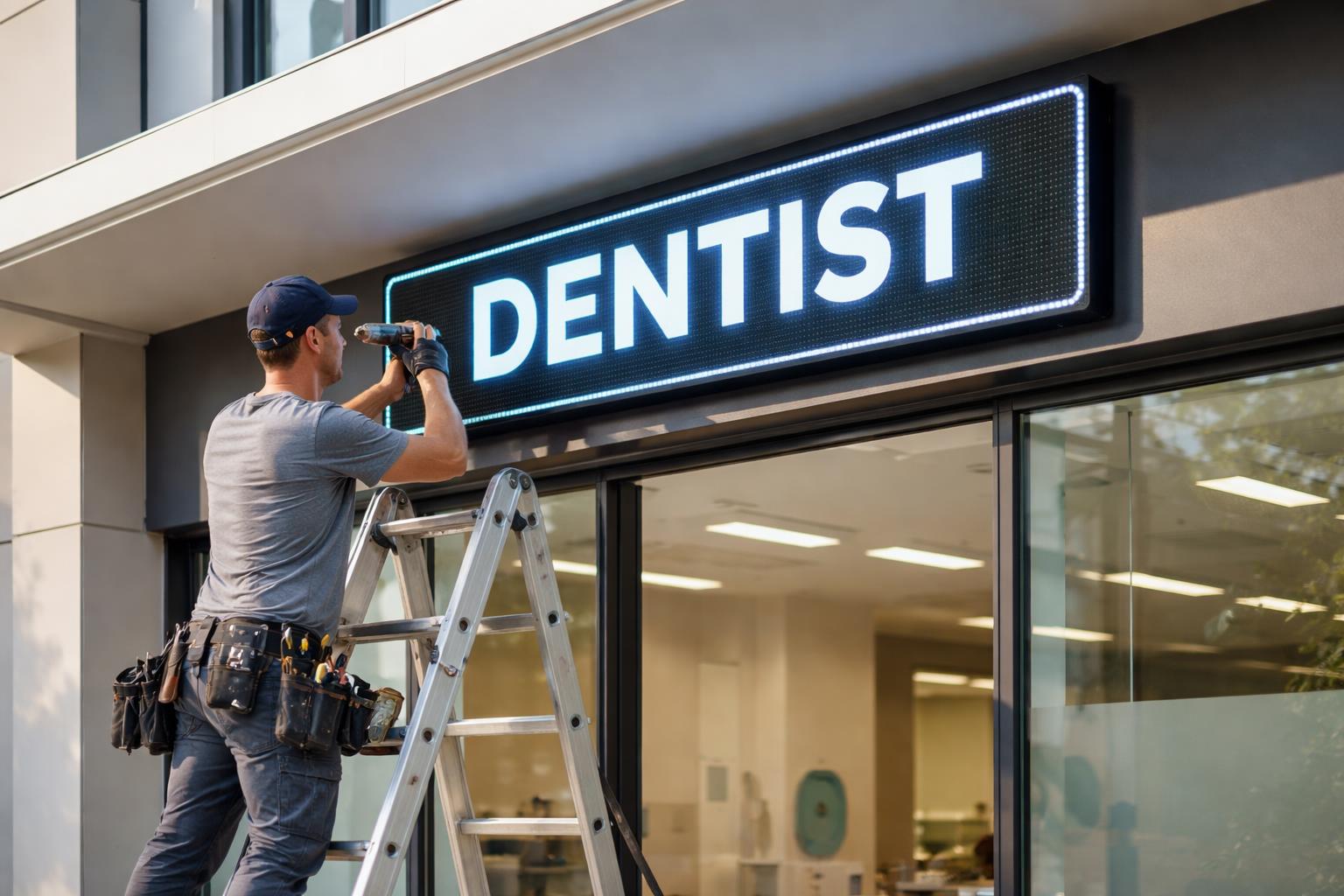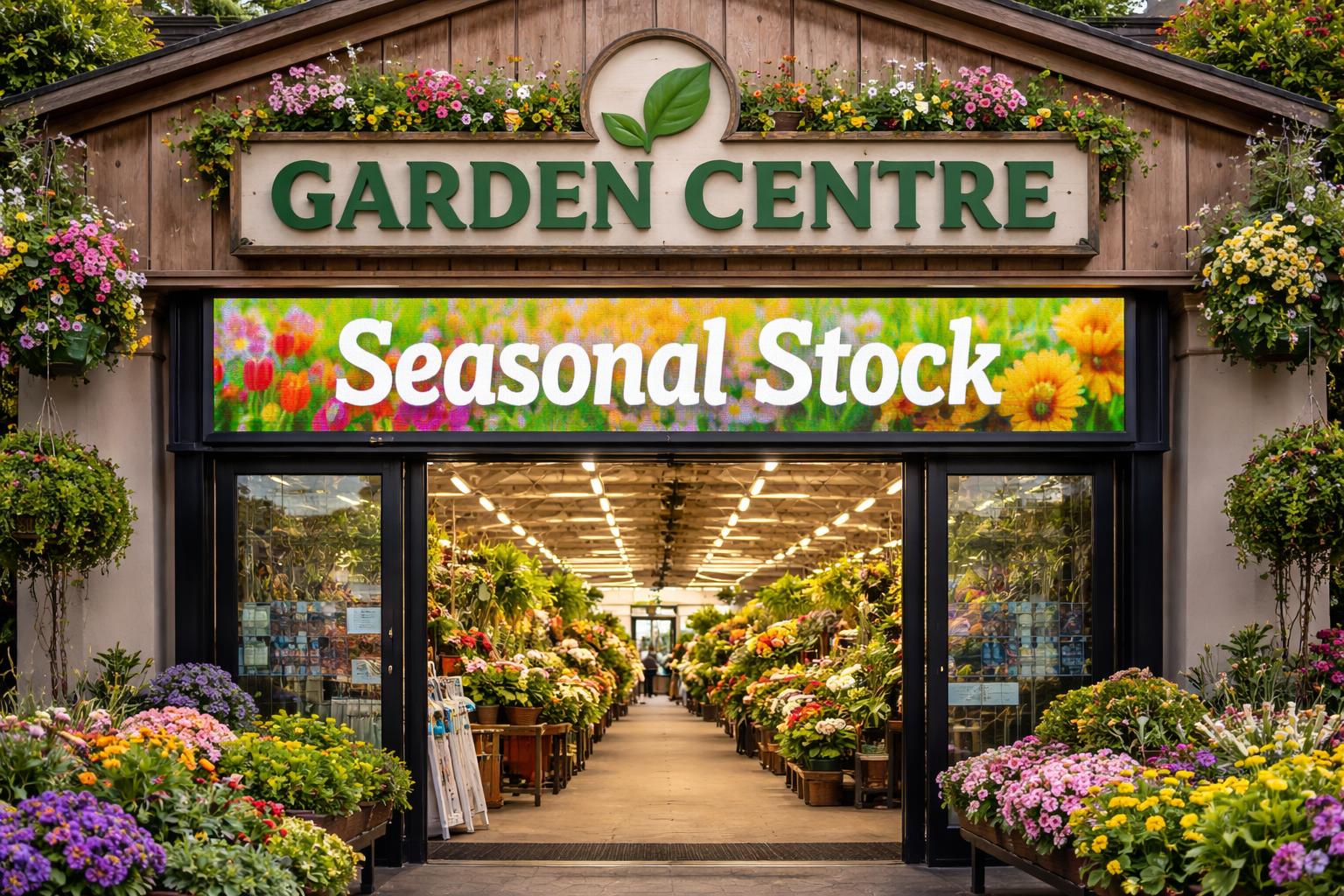
Garden centres, plant nurseries, landscape supply yards and building-material businesses face a signage challenge that is very different from that of a typical shopfront.
The products customers are looking for can change with the season. Stock can arrive, sell through or become temporarily unavailable. Delivery capacity can change across the week. Weekend promotions may need to be advertised quickly. Trade customers may need different information from homeowners. Meanwhile, a large outdoor yard can contain several entrances, collection points, product bays, loading zones and service areas that a first-time visitor has never seen before.
That is exactly where well-planned LED signs can become more than an advertising tool.
Rather than relying entirely on fixed signs that carry the same message month after month, digital LED signage gives garden centres and landscape suppliers a way to change selected messages as the business changes. A roadside display can advertise current stock or a weekend offer. An entrance display can tell customers where to go. Signs deeper inside the site can reinforce directions, explain collection procedures or promote complementary products.
This does not mean replacing every conventional sign with a digital screen. Often, the strongest approach is a coordinated signage system in which permanent branding and directional signage provide consistency while LED displays handle the information that needs to change.
Blink Digital has direct experience with this kind of large-site signage. In 2026, our team completed a comprehensive signage project for Apollo Landscaping Supplies in Coopers Plains, Brisbane. The project included a large gate sign, pylon signs, yard signage and a 10-metre-wide directional sign, creating a more structured journey from the entrance through the site.
For businesses considering LED signs for a garden centre, nursery or landscape supply yard, the key question is therefore not simply, “Where can we put a screen?”
A better question is:
What does a customer need to know at each point of their journey, and which of those messages need to change regularly?
That is the approach we take at Blink Digital.
Why garden centres and landscape supply yards need a different signage strategy
Australia’s greenlife sector encompasses a broad nursery and plant supply industry. Greenlife Industry Australia, the national peak body for the nursery industry, represents organisations across the greenlife supply chain and identifies growers, nursery businesses, climate adaptation, innovation and industry development among its areas of focus.
Within that broader sector, retail garden centres and landscape supply yards can be particularly complex customer environments.
A suburban nursery might combine plants, pots, fertilisers, mulch, soil conditioners and gardening products. A larger landscape supplier may add bulk soil, sand, gravel, bark, pavers, sleepers, retaining-wall products and delivery services. Apollo Landscaping Supplies, for example, lists products including mulch, fertiliser, sand, soils and bases and operates from its Coopers Plains site in Brisbane.
The signage challenge becomes even greater when a business serves both consumers and commercial customers.
A homeowner might arrive wanting two cubic metres of mulch and need help understanding where to order, pay and collect it. A landscaper might already know exactly what product is required but want to get in, load up and return to a job quickly. Another visitor may only be driving past and have no intention of stopping until a roadside promotion tells them that the product they need is available.
Those customers do not require the same message.
That is why Blink Digital recommends thinking of LED signs as part of a customer-information system rather than as isolated advertising screens.
A large static sign might permanently establish the business name and entrance. A directional sign can continually point customers towards “Office”, “Deliveries”, “Trade Collection” or “Yard Entry”. The digital element can then be reserved for information with a short useful life: stock arrivals, seasonal products, specials, delivery notices, opening-hour changes or urgent operational messages.
This distinction matters because not every message benefits from being digital.
Your business name should not disappear every few seconds because a promotion has entered the rotation. A critical directional instruction should not vanish while somebody is trying to decide which driveway to use. On the other hand, paying for a new printed sign every time the price of mulch changes or new seedlings arrive can make little practical sense.
The aim is to put permanent information on permanent signage and changeable information on displays designed to be updated.
Blink Digital can design both sides of that equation. Our broader signage range includes outdoor LED displays as well as pylon, directional, entrance and other general signage solutions, allowing a site to be planned as one coordinated environment rather than as a collection of unrelated signs. Blink Digital’s Apollo project demonstrates this integrated approach: gate, pylon, yard and directional signage were used together to improve visibility and navigation across an active landscape-supply site.
Think about the site from the customer’s perspective
One of the easiest ways to identify signage opportunities is to forget, temporarily, how well you know your own premises.
Imagine somebody visiting for the first time.
They approach from the main road. Can they identify the business early enough to prepare to turn?
They reach the driveway. Is it immediately obvious which entrance they should use?
Once inside, do they know whether to stop at the office, proceed directly into the yard or follow signs to a collection area?
Can they distinguish customer parking from truck access?
Can they find soils, mulches, pavers, plants or loading areas without asking a staff member?
If they have ordered ahead, is collection clearly marked?
When they leave, can they find the exit without driving against the intended traffic flow?
Each point of uncertainty is a potential signage problem.
For Blink Digital, that means the most useful signage plan often begins not with the screen itself but with the journey through the site. Our Apollo Landscaping Supplies project was designed around exactly that principle: Blink Digital states that its combination of directional, entry and yard signage created a clearer customer journey from the entrance and gate to important areas within the premises.
For garden centres and landscape suppliers, LED signs can then be added at the points where information changes frequently.
Planning LED signs from the roadside to the yard
A useful signage strategy follows the customer in the same order that the customer experiences the site.
That can begin hundreds of metres before somebody enters the property and continue until the vehicle leaves.
Roadside LED signs: win attention before the customer passes you
For many garden centres and landscape yards, roadside visibility is commercially important.
Customers may be travelling to another destination rather than specifically looking for your business. Others may know that they need garden materials but have not yet decided where to buy them.
A fixed pylon can establish who you are. A strategically positioned LED display can answer the more immediate question:
Why should I turn in today?
That makes the roadside screen particularly well suited to messages such as:
Native seedlings now in stock
Premium garden soil available today
Mulch weekend special
Landscaping gravel in stock
Delivery available
New season plants have arrived
Trade customers welcome
Open this Saturday
These are examples rather than recommended wording for every business. The important principle is that the message should give passing customers a reason to act.
Blink Digital offers outdoor LED signs in pylon- and wall-mounted configurations, and its outdoor signage range is intended for applications where businesses need high-visibility, changeable communication.
Roadside signage also has to be designed for the actual viewing environment. A driver does not read a roadside LED display the way somebody reads a website. Viewing distance, direction of travel, approach angle, surrounding visual clutter and the time available to read the message all influence what will work. Blink Digital’s existing location guidance similarly identifies viewing distance, road speed, angles and regulatory requirements as important considerations when selecting between pylon, building-mounted, window, entrance and other display formats.
For that reason, more information is not necessarily better information.
“Premium screened topsoil, organic garden mix, mushroom compost and landscape soil available now with delivery throughout the greater Brisbane region — enquire inside” may contain everything you would like to say, but it asks too much of somebody travelling past the site.
“SOIL IN STOCK – DELIVERY AVAILABLE” may do far more useful work.
Blink Digital can help determine suitable screen size, orientation, placement and message format based on the way your customers actually approach the property.
Entrance signs: confirm that the customer is in the right place
After the roadside sign has attracted attention, the next job is reassurance.
A customer entering a busy landscape yard should not have to stop in the driveway and guess what to do.
This is a particularly good location to combine permanent signage with digital information.
Permanent elements might identify:
CUSTOMER ENTRY
TRADE ENTRY
OFFICE
DELIVERIES
YARD ACCESS
An LED section can then provide today’s information:
PLEASE REPORT TO OFFICE BEFORE ENTERING YARD
or:
ONLINE ORDERS → COLLECTION BAY
or:
DELIVERIES CURRENTLY AVAILABLE FOR FRIDAY
or even:
YARD CLOSING AT 3 PM TODAY
The distinction between permanent and changing content keeps essential navigation continuously visible while still giving the business operational flexibility.
Blink Digital’s Apollo project used both a large gate sign and pylon signage at the Coopers Plains landscape-supply site, alongside directional and yard signage.
Internal directional signage: reduce uncertainty across a large yard
Once a customer enters the property, advertising becomes less important than orientation.
This is where many businesses make the mistake of continuing to sell when the customer actually needs directions.
Imagine a visitor entering a large yard and immediately seeing digital promotions for four types of mulch, three types of soil and a retaining-wall special — but no indication of where to drive.
The screen may technically be advertising successfully while the site experience is failing.
Directional communication should come first.
Depending on the premises, useful destinations might include:
- office and sales;
- customer parking;
- trade counter;
- soil and mulch bays;
- plants and nursery area;
- pavers and retaining-wall products;
- loading area;
- prepaid collection;
- truck deliveries; and
- exit.
Not all of these directions should be delivered digitally. Indeed, fixed directional signs often make more sense because those instructions need to remain continuously visible.
Blink Digital can then position LED displays at natural stopping or decision points where additional, changeable information has time to be read.
For example, a screen near a soil-and-mulch section could rotate between availability, complementary products and ordering information. A display near customer parking could promote delivery. A screen adjacent to the sales area could promote higher-value products or upcoming weekend specials.
The result is a hierarchy: identify, direct, inform, then promote.
That tends to create a much more coherent site than trying to make every sign perform every job.
What should garden centres and landscape suppliers show on LED signs?
Installing the screen is only the beginning.
The real value comes from what the business communicates after installation.
Blink Digital’s cloud-based signage approach allows authorised users to update and schedule content rather than treating a digital sign as a fixed poster. Blink Digital provides content-management options for its digital signage, and its existing guidance explains how cloud CMS systems can be used for remotely managed and scheduled content.
For garden centres and landscape supply businesses, this creates several particularly useful content categories.
Promote stock that changes frequently
Inventory-driven messages are one of the clearest uses for LED signage.
A garden centre does not necessarily want to advertise the same products in January, April, July and October. A landscape supplier may have a popular mulch available this week but temporarily unavailable the next. New paver lines, decorative stones or retaining products can arrive throughout the year.
Instead of making your sign generic enough to remain correct forever, digital content can reflect what customers can buy now.
Possible messages include:
NATIVE SEEDLINGS IN STOCK
FRESH MULCH AVAILABLE
NEW PAVERS HAVE ARRIVED
PREMIUM TOPSOIL AVAILABLE TODAY
DECORATIVE STONE NOW IN STOCK
SPRING PLANTS HAVE ARRIVED
This approach is especially useful when stock availability itself creates urgency.
However, the process needs internal discipline. Somebody in the business should be responsible for ensuring that what appears on the display corresponds with what is actually available.
That is particularly important when prices and promotions are included. The Australian Competition and Consumer Commission states that businesses must communicate clear and accurate prices and must not mislead consumers about pricing. The ACCC also notes that prices may be communicated through in-store signage and advertising and that businesses displaying multiple prices for the same item can face obligations to honour the lowest displayed price or stop selling until the discrepancy is corrected.
In practical terms: if the mulch special finishes, update the LED sign.
A flexible screen is only useful when the information on it is maintained.
Use seasonal messages without rebuilding the sign
Garden-related purchasing naturally creates opportunities for timely campaigns.
A nursery can build content around planting periods, new stock arrivals, warmer-weather gardening, wet-weather needs or seasonal outdoor projects. A landscape supplier can feature materials relevant to common garden and renovation projects at different times of year.
The advantage of LED signs is that the physical display does not have to change when the campaign does.
Blink Digital can help businesses build reusable templates so staff are not starting from a blank canvas every time. One template might be used for stock arrivals, another for weekend specials and another for delivery notices. Branding, typography and layout remain consistent while the content changes.
That gives even a relatively small team a practical content system.
Advertise weekend and short-term offers
Landscape projects often happen when customers have time to work around the home, making short-term promotions a useful content category for relevant businesses.
Instead of printing a banner every time you run a limited promotion, an LED screen might advertise:
SATURDAY MULCH SPECIAL
WEEKEND PAVER OFFER
THIS WEEK ONLY – SELECTED POTS
TRADE SPECIAL ENDS FRIDAY
The important point is not to create artificial urgency. Promotions should be genuine and their terms accurate.
The ACCC warns that businesses must not present an ordinary price as a special price and can mislead consumers where a purported sale price is compared with a previous price that was not genuinely used for a reasonable period.
Good digital signage makes offers easier to change; it does not change the business’s responsibilities regarding truthful advertising.
Blink Digital can help with the display system and content format, while businesses should ensure that promotional claims, prices and availability remain accurate.
Promote delivery while the customer is thinking about quantity
Landscape products create another opportunity that ordinary retail does not always have: customers may want far more material than they can take home themselves.
Apollo Landscaping Supplies, for example, promotes both landscape products and delivery from its Brisbane business.
That suggests a useful signage principle for the broader industry.
Do not advertise delivery only at the roadside.
Also promote it where a customer is looking at the product.
Somebody standing beside a large pile of soil may suddenly realise that putting several cubic metres into a small trailer is not realistic.
A nearby display might simply say:
NEED IT DELIVERED? ASK OUR TEAM
or:
BULK DELIVERY AVAILABLE
or:
ORDER TODAY – ASK ABOUT DELIVERY OPTIONS
Again, the specific claim should match the actual service available.
A display near the office could go further by showing current booking information where operationally appropriate, such as “Next available delivery: Thursday”. Because that information can change, it is much better suited to digital signage than permanent print.
Communicate to trade customers
A landscaping supplier may have two overlapping audiences: retail consumers completing home projects and trade customers buying materials repeatedly.
That creates opportunities for targeted messaging.
For example:
LANDSCAPERS – ASK ABOUT TRADE ACCOUNTS
TRADE COLLECTION THIS WAY
BULK QUANTITIES AVAILABLE
EARLY TRADE PICK-UP – ASK OUR TEAM
Some businesses could also schedule trade-focused content during periods when professional landscapers are more likely to visit and switch to consumer promotions later in the day.
This is where scheduling becomes particularly valuable. Blink Digital’s cloud CMS capabilities are designed to allow signage content to be updated and scheduled remotely, making it possible for different messages to appear at planned times rather than requiring staff to manually replace physical advertising.
Change messages with the weather
Weather can influence both garden demand and day-to-day yard operations.
For Brisbane businesses, this is especially relevant. Bureau of Meteorology observations for its Brisbane station show mean maximum temperatures of around 30°C in January and February, while mean rainfall is considerably higher in the summer months than in the drier winter and early-spring period.
That does not mean automatically changing a sign whenever rain appears in the forecast. It means having the flexibility to make timely messages part of the content plan.
A garden centre might promote products relevant to current conditions. A landscape yard might communicate changes to collection or loading procedures following heavy rain. Businesses that alter operating arrangements during severe weather can also use digital displays to communicate those changes quickly, provided the screen can be operated safely and the information is appropriate to the location.
Queensland Government guidance emphasises the seriousness of floodwater and changing road conditions, including the direction not to drive through floodwater.
For safety-critical situations, LED signage should support — not replace — formal emergency procedures, official traffic controls or required safety signage.
Keep opening hours current
There is a simple use case that can save a surprising amount of customer frustration: opening hours.
Public holidays, stocktakes, weather events or seasonal trading can all result in temporary changes.
An entrance screen can communicate:
CLOSING AT 2 PM TODAY
OPEN SATURDAY 7 AM–1 PM
CLOSED PUBLIC HOLIDAY MONDAY
NORMAL TRADING RESUMES TUESDAY
That is more useful than allowing a temporary printed notice to become lost among other signs at the gate.
Choosing the right LED signs for an outdoor garden centre or supply yard
The best screen is not necessarily the biggest screen.
It is the one that matches the viewing conditions, location, purpose and content.
Blink Digital’s outdoor range includes multiple screen sizes and configurations, including landscape and portrait formats, pylon applications and wall-mounted displays.
Before recommending a solution, we look at how the sign will actually be used.
Viewing distance should influence screen specification
A roadside screen viewed from a moving vehicle has very different requirements from a display positioned near a pedestrian sales counter.
One may need to be read from considerable distance with very simple content. The other can be smaller and support somewhat more detailed information.
This also influences pixel pitch — the distance between the centres of adjacent LED pixels. As viewing distance decreases, finer pixel pitches may be appropriate; for longer viewing distances, the requirements can be different. Blink Digital already treats pixel pitch, viewing distance and screen location as interrelated decisions in its outdoor signage guidance.
Rather than beginning with a specification such as “we want a P6 screen”, begin with the customer:
Where will they be when they need to read it?
Blink Digital can then recommend specifications around the use case instead of forcing the use case around a preselected screen.
Daylight visibility matters
Outdoor screens also need to compete with daylight.
Blink Digital describes its outdoor LED range as high-brightness signage with weather-resistant cabinets intended for outdoor use, and its Brisbane signage guidance identifies brightness as an important consideration in Queensland’s outdoor environment.
Again, higher is not automatically better in every circumstance.
The right brightness depends on factors such as orientation, surrounding light, operating hours and location. Brightness management can also be important after dark, both for visual comfort and regulatory compliance.
A professional site assessment should therefore examine when the screen will operate, which direction it faces and where viewers will be.
Outdoor construction matters in a landscape yard
Landscape supply sites can expose signage to conditions that indoor retail displays never experience.
Screens may operate in open-air areas with rain, heat, dust and the general activity associated with an outdoor commercial yard.
Blink Digital’s outdoor products use cabinets designed for outdoor environments, and Blink Digital’s LED-lifespan guidance notes that factors such as operating hours, brightness, heat, humidity, ventilation and electrical stability can all influence the useful life of a display.
Placement therefore matters.
A screen should not simply be fixed wherever there happens to be empty space. Access for servicing, electrical supply, exposure, mounting structure and the movement of vehicles around the sign should all be considered during planning.
Blink Digital can assess those factors as part of a broader signage project.
Think beyond one screen
A common mistake is trying to solve an entire site’s communication needs with one enormous roadside display.
Sometimes that is exactly what a business needs.
Sometimes it is not.
Consider a landscape yard with three separate problems:
The business is difficult to notice from the road.
Customers use the wrong driveway.
Once inside, visitors cannot find the relevant product area.
One larger roadside LED sign might solve the first issue brilliantly while doing almost nothing about the other two.
A better solution could combine:
a pylon or roadside LED display for marketing;
a clearly branded entrance or gate sign;
permanent directional signs throughout the property; and
a smaller digital display near the sales or collection area.
Blink Digital’s work for Apollo Landscaping Supplies is a useful example of why an integrated approach can work well. Rather than treating a single sign as the entire solution, the project combined gate, pylon, directional and yard signage to improve the site journey and presentation.
For another landscape business, LED signage could be incorporated into that same site-planning logic wherever messages need to change regularly.
LED signs Brisbane businesses should plan for local conditions
Businesses searching for LED signs Brisbane suppliers are not simply buying a display that could be installed anywhere without adjustment.
The Brisbane location itself matters.
Local weather, the property’s layout, road environment, sign classification and Council requirements can influence what type of signage is practical and how it should be implemented.
Brisbane’s climate should inform outdoor signage choices
Bureau of Meteorology statistics for Brisbane record an annual mean maximum temperature of 26.7°C at the referenced Brisbane station, with January and February mean maxima above 30°C. The same dataset records an annual mean rainfall of about 1,065 millimetres, with monthly averages substantially higher in the summer period than in the winter months.
For a customer researching LED signs in Brisbane, those conditions reinforce the importance of choosing genuinely outdoor-suitable equipment rather than assuming an indoor screen placed under partial cover will provide the same solution.
Blink Digital offers outdoor LED signage designed specifically for outdoor operation and can assess screen orientation, weather exposure and installation conditions when designing a system for a Brisbane garden centre or supply yard.
Check Brisbane City Council requirements before assuming a sign can be installed
Signage regulations are another reason to plan before purchasing hardware.
Brisbane City Council regulates advertising devices under its Advertising Devices Local Law 2021. Depending on the sign and location, an advertising device may be prohibited, self-assessable subject to requirements, or require Council approval. Council specifically notes that high-impact electronic display signs such as electronic or LED billboards can be prohibited in certain locations. Illuminated and electronic signs can also be subject to additional technical standards.
Council’s rules also cover familiar formats such as pylon, pole and wall signs.
That means a business should not order a large LED display on the assumption that permission will automatically follow.
Where approval is required, Brisbane City Council may require information including site plans and design and construction details. Where the applicant does not own the property, landowner consent is also required.
The appropriate pathway depends on the property and proposed sign, so businesses should confirm the current regulatory position for their particular site.
Blink Digital can help customers consider signage type, placement and practical project requirements, while formal approval decisions remain with the relevant authority.
Coordinate LED signs with permanent site signage
Local search intent around LED signs Brisbane often focuses heavily on the screen: size, pixel pitch, brightness and cost.
Those factors matter, but a large garden centre or landscape yard also needs a functional wayfinding system.
Blink Digital’s Brisbane Apollo project is especially relevant here because the objective extended beyond advertising. Blink Digital installed a 10 m × 2.1 m directional sign, a large gate sign, pylon signage and yard signage, helping customers move from the entrance through key areas of the property.
For another Brisbane business, a carefully located LED sign could complement that type of system by handling promotions and real-time information while static signs continue carrying permanent navigation.
That is often a more useful strategy than turning every directional instruction into digital content.
How Blink Digital can build a smarter signage system for your garden centre or landscape yard
The most effective signage projects begin with the business problem, not the product catalogue.
At Blink Digital, we can help garden centres, nurseries, landscape suppliers, hardware-style yards and building-material businesses work through the site from the customer’s point of view.
That might begin with the roadside:
Can customers see the business early enough?
Does the existing pylon identify the property?
Would an LED display add value by promoting current stock, seasonal products or delivery?
Then we look at the entrance:
Is the right driveway obvious?
Are customer vehicles, trade vehicles and deliveries being directed clearly?
Would a gate sign or entrance sign solve the problem more effectively than another advertising screen?
Then we move through the property:
Can customers find parking?
Can they locate the office?
Can they navigate towards soils, mulch, plants, pavers or other product areas?
Is order collection clearly marked?
Are the directions to the exit obvious?
Only after answering those questions does it make sense to decide where digital content adds the most value.
Blink Digital already designs, produces and installs multiple types of signage, including outdoor LED displays, pylon signage, directional signs and custom commercial signage. Our Apollo Landscaping Supplies project in Brisbane demonstrates our ability to approach a large supply-yard environment as a complete signage system rather than a single-sign installation.
For the digital component, we can also help businesses establish a sensible content-management process. Blink Digital’s cloud-based content systems allow signage to be updated and scheduled remotely, making them suitable for businesses that want to rotate seasonal campaigns, adjust product messages or manage changing information without physically replacing a printed sign.
The objective is not to change messages simply because you can.
It is to change them when doing so helps the customer or the business.
That could mean replacing a generic “Quality Landscape Supplies” promotion with a timely “Premium Garden Soil Available Today” message.
It could mean changing Friday’s roadside promotion to advertise Saturday trading.
It could mean removing a sold-out product from the rotation within minutes rather than leaving outdated advertising in place.
It could mean scheduling a trade-account message early in the morning and consumer promotions later in the day.
It could mean informing customers at the gate that prepaid orders have moved to a different collection bay.
And it could mean using a permanent directional sign rather than an LED screen when the instruction never needs to change.
That balance is what turns individual signs into a signage strategy.
For garden centres and landscape suppliers in Brisbane and across Australia, Blink Digital can help with the planning, supply and installation of LED signs as part of a broader commercial signage solution. Blink Digital states that it specialises in the production, installation and management of digital signage, general signage and billboards across Australia.
Turn passing traffic into customers — and help customers navigate once they arrive
Your roadside sign may be the first interaction somebody has with your business.
Your entrance signage determines whether that customer knows where to go next.
Your internal signage influences whether the site feels easy to navigate or confusing.
And your changeable digital content gives you the opportunity to communicate what matters today rather than only what mattered when the sign was first installed.
For garden centres, nurseries and landscape supply yards, that could mean promoting seasonal plants, newly arrived stock and weekend offers.
For bulk landscaping suppliers, it could mean highlighting mulch, soils, sand, gravel, pavers, delivery availability and trade services.
For larger sites, it could mean combining roadside LED signs with gate, pylon, yard and directional signage so customers receive the right information at every stage of their visit.
Blink Digital can help you decide what should be digital, what should remain permanent and how the different elements should work together.
Planning new LED signage for a garden centre, nursery or landscape supply yard? Contact Blink Digital to discuss your site, your customers and the messages you need to communicate. Our team can help assess the available locations, recommend suitable LED signage and develop a complete signage solution from the roadside through to the yard. Blink Digital invites businesses to get in touch to discuss custom LED signage projects and quotations.