Why warehouse LED signs should be planned as part of the whole site
A warehouse, factory or distribution centre rarely has just one audience.
On the same day, the site may need to communicate with interstate truck drivers who have never visited before, local couriers looking for the correct dock, contractors arriving for maintenance work, office employees entering through one gate, warehouse employees entering through another, visitors looking for reception, forklift operators moving stock, delivery drivers waiting for instructions and prospective employees passing the property from the road.
That is why effective LED signs for warehouses and logistics sites should not be treated simply as a screen mounted on a wall. They should be planned as part of the way people and vehicles move through the entire property.
For industrial businesses, the useful question is therefore not simply:
“Where can we put an LED sign?”
A much better question is:
“What does this person need to know at this exact point in their journey through the site?”
That change in thinking can make an enormous difference.
A roadside display may need to confirm that a truck driver has reached the correct company. A sign at the gatehouse may need to explain where deliveries should report. Another display deeper within the property may direct vehicles towards particular loading bays. A warehouse entrance screen may communicate shift information, while an internal message board can reinforce operational notices, upcoming maintenance or staff announcements.
This site-wide approach also aligns with the way workplace traffic management should be considered. Safe Work Australia describes workplace traffic management as the organisation and control of moving and stationary traffic, including pedestrians, trucks, cars and powered mobile plant such as forklifts. Its warehousing guidance specifically recommends considering workplace layout, pedestrian walkways, loading areas, traffic flow, exclusion zones and signage together rather than treating any single measure in isolation.
For a busy logistics operation, that matters because communication requirements can change quickly. A loading bay might become temporarily unavailable. A contractor entrance could change during building works. A yard may have a temporary traffic route. Delivery instructions could be different during a peak period. A business may also want to communicate recruitment opportunities, production milestones or important site announcements without replacing printed signs every time information changes.
Electronic displays can be particularly useful where information genuinely needs to change. Safe Work Australia specifically recognises electronic signs as one option that can reduce the need for workers to physically change or cover static signs. At the same time, its guidance makes clear that signs form part of a broader system of controls that can include separation, barriers, clearly defined routes and other engineering or administrative measures.
That distinction is important.
LED signs should support a well-planned industrial site; they should not be expected to make a poorly designed traffic system safe by themselves.
At Blink Digital, we can help businesses think beyond the screen itself. Our current manufacturing and industrial signage offering includes applications ranging from roadside and loading-zone displays to safety message boards and warehouse information displays, while our broader signage service covers production, installation and management of digital and general signage.
A useful way to plan the system is to follow the journey through the property from the public road all the way to the loading bay and warehouse floor.
From the roadside to the gatehouse: make the first decision easier
The first useful LED sign may sit before a visitor ever reaches your front gate.
Large warehouses and industrial sites can be difficult to identify, particularly within industrial estates where neighbouring buildings may look similar, business names may sit well back from the road and multiple driveways may service adjoining properties. For an unfamiliar truck driver approaching with traffic behind them, the opportunity to identify the correct entrance may be brief.
Roadside identification should answer one immediate question: “Is this the right place?”
That makes roadside signage a very different communication tool from a screen in reception.
A roadside LED display may be used to reinforce the company name, identify a facility, highlight the correct truck entrance or communicate simple operational information. Where appropriate, it can also carry recruitment messaging, brand campaigns or other business communications when directional information is not required.
The content should match the viewing environment. A driver passing the site has much less time to process information than a worker standing in a lunchroom. From a practical signage-design perspective, that usually means prioritising short messages, large text, strong contrast and a clear visual hierarchy rather than trying to fit several instructions onto one screen. Safe Work Australia likewise recommends that traffic signs be clearly visible, placed in the road user’s line of sight and avoid obstructing other signs or creating mixed messages.
For warehouse operators, it is therefore worth separating brand communication from site navigation.
An LED sign saying:
ACME DISTRIBUTION CENTRE
TRUCK ENTRY — NEXT LEFT
has a very different job from a rotating marketing message containing several promotions, phone numbers and paragraphs of text.
Where a display is positioned close to a driveway, safety-critical instructions should take priority over advertising whenever vehicles need to make a decision.
This is one of the areas where Blink Digital can help with LED signage planning. Rather than choosing a screen purely on the basis of its physical dimensions, the display can be considered in relation to road approach, viewing distance, orientation, surrounding structures, expected audience and the type of information it needs to communicate.
Think about what happens immediately after the turn
Once a driver enters the property, the communication need changes.
They now need answers to questions such as:
Where do I stop? Which lane do I use? Do I report to the gatehouse? Is there a separate visitor entrance? Where do couriers go? Where should heavy vehicles wait?
A digital display near the gatehouse can be valuable when those instructions change according to time, workload or operating conditions.
For example, a logistics site could use a gatehouse LED display to communicate messages such as:
ALL INBOUND FREIGHT — REPORT TO GATEHOUSE
COURIERS — USE BAY 2
SITE INDUCTION REQUIRED BEFORE ENTRY
BAY 4 CLOSED — FOLLOW DETOUR
WAIT HERE UNTIL CALLED FORWARD
Because those messages are operational rather than promotional, the sign should be positioned where the intended driver can comfortably see it before reaching the relevant decision point.
WorkSafe Queensland’s traffic-management guidance recommends developing a site map based on site-specific conditions and distinguishing pedestrian zones, restricted vehicle or mobile-plant areas and shared zones. It also stresses the use of communication and appropriate signage where routes or areas change.
That gives warehouse operators a useful planning method: map each point at which somebody has to choose where to go, then ask whether the existing communication at that point is sufficient.
Not every decision point needs an LED screen. In fact, many permanent instructions are better communicated with conventional directional, regulatory or safety signs.
Digital displays are most valuable when the information is important and genuinely variable.
For example, “RECEPTION →” may never change and could be an ordinary directional sign. “DRIVERS FOR BAY 1–4 REPORT TO GATEHOUSE; BAY 5–8 CONTINUE STRAIGHT” may change regularly and therefore could benefit from a digital format.
Blink Digital supplies both digital displays and conventional directional signage, allowing the two formats to be considered together rather than expecting one signage type to do everything. Blink Digital’s directional-signage service includes customised wayfinding solutions and installation, while the industrial offering specifically covers roadside and warehouse information applications.
For larger industrial properties, that combination can create a clearer information hierarchy: permanent signs establish the site layout, while LED signs communicate what has changed today.
From the yard to the loading bay: put information before the problem
For many warehouses and distribution centres, the internal yard is where signage becomes most operationally important.
This can be an environment containing semi-trailers, rigid trucks, couriers, passenger vehicles, forklifts, pedestrians, contractors and employees, sometimes moving through overlapping areas.
Safe Work Australia identifies traffic collision risks within warehouses and recommends separating pedestrians and forklifts wherever possible. Its warehousing guidance also recommends clearly marking pedestrian walkways, minimising intersections and blind spots, defining exclusion areas, marking docking areas and clearly indicating traffic flows, driver safety zones and other operational areas.
In that environment, an LED sign works best when it provides information before a vehicle reaches the point where uncertainty creates unnecessary movement.
Consider a truck arriving for collection.
If the driver has to enter the yard, stop in an unsuitable position, get out, walk to an office and ask which loading bay to use, the communication system has already failed to some degree.
A strategically positioned display could instead provide a clear instruction while the vehicle is still in an appropriate waiting area.
For example:
NORTHBOUND FREIGHT — BAYS 1–3
CONTAINER DELIVERIES — HOLDING AREA B
BAY 7 CLOSED FOR MAINTENANCE
WAIT FOR GREEN SIGNAL BEFORE APPROACHING DOCK
ALL DRIVERS REPORT TO DISPATCH BEFORE UNLOADING
The exact message should, of course, reflect the site’s approved operating procedures and traffic management plan.
The key principle is simple: place the message where somebody still has time and space to act on it safely.
A sign positioned after the relevant turn is too late. A sign obstructed by parked trailers is ineffective. A screen mounted at a convenient electrical connection but facing away from the actual approach path may technically be installed correctly while still failing operationally.
This is why Blink Digital can assess potential LED sign locations in the context of actual viewing conditions rather than treating installation as a purely architectural exercise.
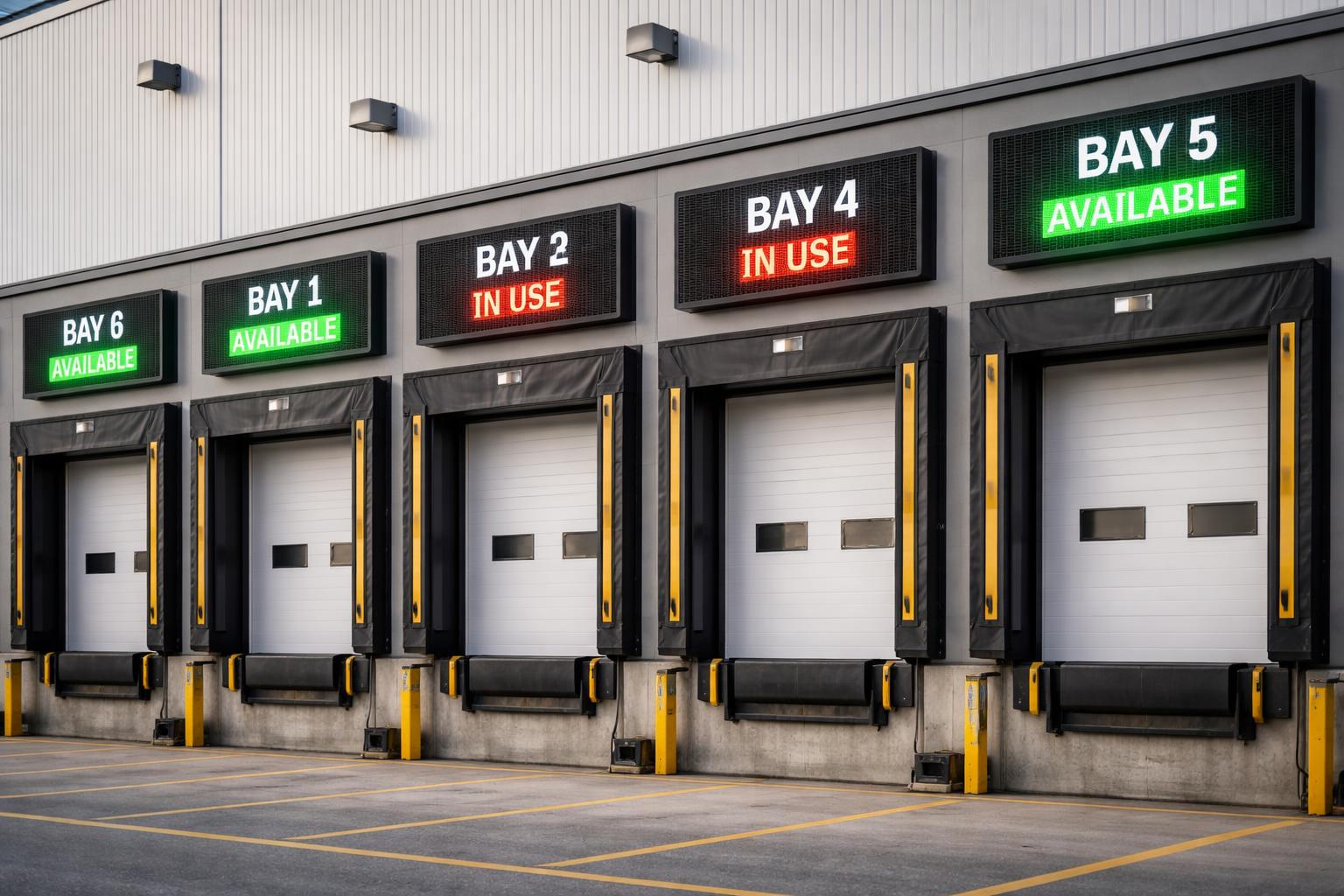
Loading-bay changes are a strong use case for digital signage
Loading bays are particularly suited to changeable displays because their status may vary during the day.
A bay could be occupied, temporarily closed, assigned to a particular carrier, reserved for dispatch, unavailable because of maintenance or operating under a temporary process.
Traditional printed signs cannot automatically reflect those changes.
A digital loading-zone display can.
Depending on the site’s systems and operational requirements, a screen could be used to show a bay number, availability status, carrier instruction, dock status or temporary operational message.
There is an important caveat: an LED screen does not replace engineered dock-safety controls, barriers, traffic signals, safe work procedures or other required systems.
Safe Work Australia recommends that loading and unloading areas be designed to keep pedestrians and vehicles separated, and its guidance identifies designated safety zones for drivers as one way of reducing exposure to mobile plant. Queensland guidance similarly recommends exclusion zones around loading and unloading areas and clearly communicated procedures.
Accordingly, a message such as “BAY 3 READY” should only communicate the status determined by the site’s actual operating system or authorised personnel. It should not be relied on as the sole control preventing a truck from approaching an unsafe loading area.
That is an important distinction when planning warehouse LED signs: digital signage should communicate the process clearly, not invent the process.
Think about temporary changes, not just normal operations
A good industrial signage plan should also consider what happens when the site is not operating normally.
What happens when:
a loading dock is unavailable;
a truck route is temporarily blocked;
roadworks change the usual entrance;
a section of the yard is closed;
maintenance contractors are present;
a major delivery changes vehicle movements;
a production shutdown changes access arrangements;
or weather affects normal operations?
Temporary conditions are exactly where changeable signage can become particularly useful.
WorkSafe Queensland’s traffic-management template states that temporary closure of pedestrian or restricted zones requires appropriate communication and may involve signage, barriers and traffic cones. Safe Work Australia also recognises electronic traffic-control devices and electronic signs as useful tools within workplace traffic management.
That creates an opportunity for LED displays to act as part of the site’s change-management communication.
For example:
TEMPORARY TRUCK ROUTE — FOLLOW ARROWS
DOCK 2 CLOSED — USE DOCK 4
MAINTENANCE IN PROGRESS — AUTHORISED ACCESS ONLY
PEDESTRIAN ROUTE CHANGED — FOLLOW SITE SIGNAGE
Again, LED signs should supplement the appropriate physical controls and approved signage already required for the condition.
Driver waiting areas are another overlooked location
Not every LED display needs to give directions.
A screen visible from a designated waiting area can provide useful operational information without requiring drivers to repeatedly approach an office.
Depending on the site’s procedures, messages might include:
VEHICLE ABC123 — PROCEED TO BAY 6
PLEASE REMAIN IN DESIGNATED DRIVER AREA
CURRENT WAIT TIME: APPROXIMATELY 15 MINUTES
DISPATCH WILL CALL YOUR VEHICLE NUMBER
Such a system may reduce unnecessary questions and improve information consistency, although the exact workflow should be designed around the site’s traffic-management procedures and other communication systems.
Safe Work Australia recommends that visiting drivers who are not required during loading and unloading be provided with safe areas away from vehicle movements; it also notes that where drivers need to observe loading operations, a safe viewing area should be provided.
Digital signage can complement that approach by bringing the information to the driver rather than requiring the driver to repeatedly move through operational areas to obtain updates.
Inside the warehouse: communicate with employees, contractors and visitors
The journey does not stop once somebody walks through the warehouse door.
Internal LED signs can serve a different purpose from the large displays used at the roadside or within a truck yard.
Here, viewers are generally closer to the screen and may have more time to read the message. That creates opportunities for richer internal communication.
Blink Digital’s manufacturing and industrial signage offering includes warehouse information displays, safety message boards and production or KPI displays, alongside its outdoor roadside and loading-zone solutions.
That means businesses can think about LED signage as an internal communication network, rather than simply a collection of advertising screens.
Safety and operational reminders
A screen near a warehouse entrance can reinforce current site information before staff enter an operational area.
Examples might include:
TODAY’S MAINTENANCE AREA: AISLE 14
FORKLIFT TRAFFIC INCREASED IN DISPATCH
VISITORS MUST REPORT TO SUPERVISOR
NEW PEDESTRIAN ROUTE NOW IN USE
DAILY PRE-START — 6:45 AM
These messages can be changed as circumstances change.
However, safety messaging needs to be handled carefully. An LED message board should not become a substitute for mandatory safety signage, employee training, physical barriers, inductions or safe operating procedures.
Safe Work Australia’s hierarchy of controls places measures such as eliminating risks, isolating hazards and using engineering controls ahead of administrative measures. Its traffic guidance gives physical barriers, separate pedestrian and vehicle access, exclusion zones and traffic controls as examples of stronger measures, while signs and instructions form part of the wider system.
A good rule is therefore:
Use dynamic signage to reinforce and communicate the current system — never to compensate for the absence of one.
Shift communication
Large warehouses often have an additional communication challenge: not everybody starts work at the same time.
Information explained verbally during one meeting may not automatically reach the afternoon or night shift.
An LED screen positioned near staff entry, clock-on areas, break facilities or other suitable gathering points can give each shift access to consistent information.
This might include:
SHIFT B — DOCK 5 PROCEDURE UPDATED
PLANNED MAINTENANCE: SATURDAY 7 AM–11 AM
STAFF PARKING AREA C CLOSED TOMORROW
TEAM BRIEFING — TRAINING ROOM AT 2 PM
NEW CONTRACTOR ACCESS PROCEDURE FROM MONDAY
The ability to schedule digital content can be particularly useful here. Rather than leaving every message on-screen indefinitely, relevant information can be shown when the intended audience is most likely to see it.
Morning-shift messages can appear around morning changeover. Afternoon information can run later. A visitor screen can carry different content from an employee communication display.
That is one of the practical advantages of digital signage for warehouses: different screens do not have to display the same thing.
Recruitment messages
Industrial sites can also use selected displays for recruitment.
This is particularly relevant to large employers with substantial road frontage or regular contractor, supplier and community traffic.
A roadside or reception LED display could promote messages such as:
NOW HIRING — WAREHOUSE OPERATORS
APPRENTICESHIP APPLICATIONS OPEN
JOIN OUR LOGISTICS TEAM
The important point is to separate recruitment advertising from safety and navigation information.
A driver approaching an intersection does not need to see a recruitment advertisement when they need a loading-bay direction. The recruitment message belongs on a screen and at a time where advertising is appropriate.
The best LED signage strategy therefore assigns a purpose to each display.
At Blink Digital, we can help industrial businesses map those purposes before recommending screen locations. That can avoid a common mistake: buying several displays first and then deciding what to put on them afterwards.
Production and KPI communication
Manufacturing and distribution businesses may also use internal screens to communicate operational information such as output targets, milestones, service levels or other internally approved performance information.
Blink Digital specifically includes production and KPI displays within its manufacturing and industrial offering.
The content should be chosen according to the people viewing the screen and the operational objectives of the business. A supervisor’s detailed dashboard may not belong on a large general staff display; a simple daily target or status indicator may be more appropriate.
This is another reason screen selection should follow the content requirement rather than the other way around.
Choosing the right LED signs for an industrial environment
Once the required locations and messages have been mapped, the next step is selecting displays that suit each application.
There is no single “best” warehouse LED sign.
A screen intended to be read by truck drivers from the other side of a yard has very different requirements from an internal screen viewed from a few metres away.
Start with viewing distance
One of the first technical considerations is pixel pitch.
Pixel pitch is the distance between neighbouring LED pixels, usually measured in millimetres. Smaller pixel pitches create greater pixel density and are generally better suited to closer viewing, while larger pitches can be appropriate where the audience views the screen from further away. Display manufacturers also caution that specifying a finer pixel pitch than the viewing environment requires can add cost without providing a meaningful visual advantage at the intended distance.
For a warehouse project, that means the first question should not be:
“What pixel pitch should we buy?”
It should be:
“Where will the viewer be when they need to read this?”
A display across a truck yard may favour large, highly legible text viewed from distance. A reception or staff-communication screen may need to reproduce finer detail at close range.
Blink Digital can help match the screen specification to the intended location rather than simply recommending the highest resolution available.
Consider the environment around the display
An outdoor sign in an exposed industrial estate has a very different operating environment from an internal warehouse screen.
Outdoor displays may need to contend with direct daylight, rain, heat, dust, changing viewing conditions and nighttime operation. The enclosure, mounting system and display specification should therefore be selected for the actual installation location.
Brightness also needs thought.
A display that is difficult to see in daylight has limited value, but an excessively bright illuminated sign at night can create glare. Brisbane City Council specifically identifies illuminated signs as a potential source of light nuisance and describes glare as excessive brightness or intensity of light.
For that reason, brightness should be appropriate to the application and surrounding environment rather than simply being set as high as possible.
Site orientation matters too. A screen facing direct afternoon sun may have different requirements from one under an awning. A screen near vehicle routes may need protection from potential impact. A display high on a warehouse façade needs maintenance access to be considered before installation.
Those factors are easier — and usually far less disruptive — to address during planning than after the screen has been installed.
Plan power, data and future access
Every proposed display location should also be reviewed for the practical infrastructure it requires.
How will the sign receive power?
How will content reach it?
Is a network connection available?
How will technicians access the display for inspection or maintenance?
Would servicing require a scissor lift, elevated work platform or temporary closure of a vehicle route?
Could parked trailers routinely obstruct access?
Could a future building extension block the viewing angle?
These questions may sound secondary when choosing an LED display, but they can substantially affect how practical the final system is to operate.
Blink Digital’s signage services cover production, installation and management, and its directional-signage service describes an end-to-end approach spanning design, manufacture, installation and ongoing support.
Bringing installation considerations into the design phase can therefore help avoid choosing an apparently convenient display position that becomes inconvenient every time the sign needs attention.
Plan the content system as carefully as the hardware
An LED screen is only useful while somebody is responsible for its information.
Before installation, warehouse managers should decide:
Who is authorised to update each screen?
Which messages require approval?
How quickly must a temporary message be removed?
Who checks that an instruction is still current?
What happens if connectivity fails?
Which screen receives which type of information?
Could an outdated message create confusion?
For safety-related operational communication, these questions are especially important.
Safe Work Australia recommends that traffic signs and road markings be regularly checked and maintained so they remain visible and relevant, and that traffic-management controls be reviewed when conditions change.
Digital signage makes changing a message easier, but the organisation still needs responsibility for the accuracy of that message.
A sensible industrial signage plan therefore includes both hardware ownership and content ownership.
Safety, approvals and compliance need to be considered before installation
There is an important difference between using an LED sign to improve communication and assuming that the sign itself makes the site compliant.
Warehouse and logistics traffic risks must be managed according to applicable work health and safety requirements and the site’s own risk assessment and traffic-management arrangements.
Safe Work Australia’s warehousing guidance states that separating pedestrians and forklifts is the best way to minimise forklift-related injury risk. It recommends measures including changing layouts, using high-impact barriers, implementing exclusion zones and controlling speed where required.
WorkSafe Queensland takes a similar approach, advising workplaces to separate people from vehicles where possible and identifying engineering controls such as barriers and other measures as part of effective on-site traffic management.
Signs are part of that system.
Safe Work Australia recommends signs for exclusion and safety zones, parking areas, speed limits, vehicle crossings, blind corners and areas where forklifts operate. It also recommends placing signs clearly in the viewer’s line of sight and maintaining them so they remain easy to see.
So while LED signs can make changing information much easier, the screen should sit within the site’s wider traffic-management and WHS framework.
For example, a digital message saying “NO PEDESTRIAN ACCESS” does not remove the need for physical separation where physical separation is required.
A screen saying “FORKLIFT OPERATING AREA” does not remove the organisation’s obligation to manage the actual interaction between people and forklifts.
A display saying “SPEED LIMIT 10” cannot physically control an unsafe traffic route on its own.
The aim should always be to use digital communication to make established controls easier to understand and follow.
Do not overlook council requirements for external LED signs
Businesses planning external LED signs in Brisbane should also investigate whether the proposed display requires Brisbane City Council approval.
Council’s current process asks applicants to identify the property’s zone, determine its advertising-device environment classification and identify the relevant type of advertising device before establishing the applicable requirements or approval pathway.
Brisbane’s Advertising Devices Design and Assessment Rule also distinguishes between different categories of signage. For example, the rule defines an “information sign” as one that provides information about the use of site facilities or features, such as entrances or parking, and specifies requirements applying to that category.
The practical point for warehouse owners is that a roadside advertising display, business-identification sign and internal operational message board should not automatically be assumed to have identical approval requirements.
Check the intended sign type, site location and applicable council rules before installation.
Where a warehouse is leased rather than owner-occupied, it is also sensible to confirm any relevant landlord, body corporate or property-manager requirements early in the project.
Blink Digital can assist with the signage side of project planning, while the site owner or operator should ensure that all necessary property, planning, workplace and other specialist approvals relevant to the particular project are addressed.
How to plan your warehouse signage with Blink Digital
The best time to decide where your LED signs should go is before the screens are ordered.
A practical project can begin with a simple exercise: follow several different people through the property.
First, imagine an interstate truck driver who has never visited your site.
Where do they first see the company?
At what distance can they identify the correct entrance?
What tells them which driveway is for heavy vehicles?
Where do they stop?
How do they know which dock to approach?
What happens if their normal loading bay is closed?
Where do they wait safely?
Now repeat the journey as a courier.
Then as a new employee.
Then as a maintenance contractor.
Then as a visitor arriving for a meeting.
Then as somebody leaving the property.
Each journey may reveal a different communication gap.
WorkSafe Queensland’s traffic-management guidance explicitly recommends preparing a site map based on site-specific conditions. Safe Work Australia’s guidance likewise says a traffic-management plan may describe pedestrian and vehicle movement, expected interactions and the layout of barriers, walkways and signs.
That same map can become a useful starting point for LED signage planning.
At each location, Blink Digital can help determine whether the communication need is best handled through an LED display, conventional directional sign, another form of signage, or a combination.
At the roadside, the priority may be visibility and identification.
At the entrance, it may be clear routing.
At the gatehouse, it may be changeable delivery instructions.
Within the yard, it may be bay status and temporary route updates.
At the loading zone, it may be controlled operational messaging.
At the staff entrance, it may be shift communication.
Inside the facility, it may be warehouse information, safety reminders or production updates.
At reception, it may be visitor information.
This approach avoids filling a property with screens that have no clearly defined role.
It also allows each display to be specified for the distance, content and environmental conditions of its actual audience.
Keep messages simple and specific
Industrial sites are not the place for unnecessarily complicated digital content.
When a viewer needs to make an immediate decision, the message should usually contain one clear instruction.
Compare:
PLEASE BE ADVISED THAT DUE TO SCHEDULED MAINTENANCE ACTIVITIES VEHICLES MAKING DELIVERIES TODAY SHOULD USE THE ALTERNATIVE ACCESS ROAD ADJACENT TO WAREHOUSE B
with:
DELIVERIES TODAY
USE ENTRY B →
The second message is far easier to act on.
Safe Work Australia’s guidance reinforces the importance of signs that are clearly visible and do not present conflicting or mixed messages.
Animation and changing content should be treated similarly.
Just because an LED sign can show multiple messages does not mean it always should.
At a driver decision point, the operational instruction needs enough screen time to be seen and understood. Marketing content can run elsewhere or at another time.
Review the signs after the site starts using them
A signage installation should not necessarily be considered finished the moment the screen switches on.
Watch how people actually interact with it.
Are drivers slowing too late?
Do visitors still miss the reception entrance?
Can the loading-zone screen be seen when trailers are parked?
Are employees reading the internal display?
Does direct sunlight affect visibility at a particular time?
Is a message being updated promptly when conditions return to normal?
Safe Work Australia recommends reviewing traffic-management control measures to ensure they continue to work as planned and remain effective.
The same principle makes sense for digital signage.
Sometimes a small change in message wording, display timing or content hierarchy can make the sign substantially more useful without changing the physical installation.
Why work with Blink Digital?
Blink Digital already provides signage specifically for manufacturing and industrial environments, including warehouse information displays, safety message boards, production and KPI displays, outdoor roadside signs, and loading-zone and delivery displays.
More importantly, we can help businesses look at how those elements work together.
Rather than treating the roadside screen, gatehouse sign, warehouse display and directional signage as unrelated purchases, Blink Digital can help develop a more coordinated signage solution based on how your actual property operates.
Our broader capability includes digital signage, LED signage, general signage and billboards, with production, installation and management services available for businesses across Australia. Blink Digital is based in Brendale, Queensland, making us well placed to assist Brisbane and South East Queensland businesses while also servicing projects more broadly.
For warehouses, logistics operators, manufacturers and distribution centres, that creates the opportunity to work with one signage provider from planning through to installation and ongoing signage needs.
Ready to plan LED signs for your warehouse or logistics site?
The most effective LED signs for warehouses and logistics facilities are not simply the biggest screens or the brightest displays.
They are the signs that provide the right information, to the right person, at the point where that information is actually needed.
A roadside display should help somebody identify the property.
An entrance sign should help them choose the right route.
A gatehouse display should make the next instruction obvious.
A yard sign should communicate changes before a driver reaches the affected area.
A loading-bay display should support established operational procedures.
An internal screen should keep employees and contractors informed.
And every display should sit within a wider site design that properly considers traffic management, pedestrian separation, safety controls, approvals and operational responsibility. Australian workplace-safety guidance consistently treats signage as one part of a broader system involving site layout, physical separation, traffic routes, communication and other controls.
That is why a site-wide plan is usually more valuable than choosing screens one at a time.
At Blink Digital, we can help you assess where LED signs could add genuine value across your warehouse, distribution centre, manufacturing facility or logistics site. We can look at the journey from the roadside and entrance through to the gatehouse, yard, loading bays and internal work areas, then help identify suitable display and signage options for each communication requirement. Blink Digital’s existing industrial solutions already cover roadside displays, loading-zone signage, warehouse information screens, safety messaging and KPI displays.
Whether you are planning one outdoor LED sign or a coordinated signage system across a large industrial property, the starting point should be the same: understand who needs information, where they need it and how quickly they need to act on it.
From there, Blink Digital can help turn that plan into a practical signage solution.
Contact Blink Digital to discuss LED signs for your warehouse, factory, distribution centre or logistics site. Our team can assist with signage planning, product selection, design, installation and ongoing support, helping you build a solution that fits the way your site actually operates. Blink Digital invites businesses to discuss their project, request a quote or learn more about custom signage solutions through its Brisbane-based team.
Call Blink Digital on 0424 505 990 or get in touch through the Blink Digital website to start planning your warehouse and logistics signage project.