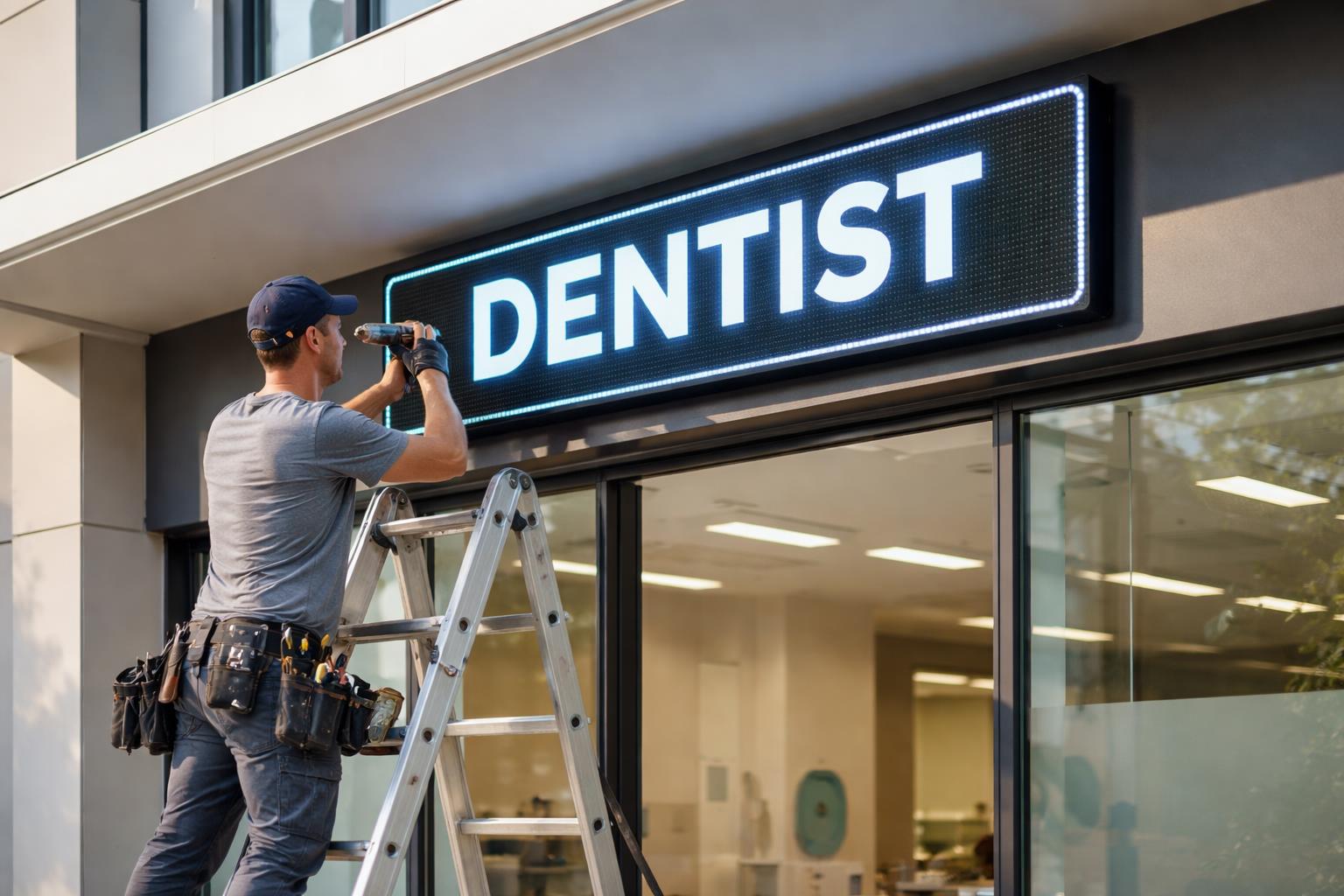
Investing in digital signage in Brisbane is about far more than choosing a screen and arranging a day for someone to bolt it to a wall. Once you have received and accepted a quote, there is still a carefully coordinated process between the initial decision and the moment your new display is switched on and ready to communicate with customers.
Depending on the site and type of display, that process can involve confirming measurements, finalising screen specifications, reviewing the mounting structure, arranging engineering, preparing electrical and data connections, checking signage approvals, manufacturing custom components, organising access equipment, installing the screen, testing the system, configuring content management software and training the people who will use it.
For a business owner, property manager, school, retailer, dealership, hospitality venue or organisation installing a digital display for the first time, it can be difficult to know what happens when — or which responsibilities sit with the signage company, the property owner or other contractors.
At Blink Digital, this is exactly where our experience can help. We provide consulting and design, custom LED signage, digital signage installation, maintenance and ongoing support. Our installation service covers the journey from the initial site assessment through to final positioning, wiring and calibration, while our consulting team helps tailor the solution to the client, audience and environment.
This guide picks up where our LED Sign Site Survey Checklist leaves off. A site survey establishes important fundamentals such as visibility, available mounting space, structure, power, data, access, servicing and potential approval requirements. Here, we look at what comes next: the practical journey from quote to installation, commissioning and switch-on.
There is no universal installation schedule. A straightforward indoor screen and a large outdoor LED pylon are very different projects. Approval requirements, structural engineering, custom fabrication, electrical work, site access and even weather can all affect the sequence. The purpose of this guide is therefore not to promise an arbitrary turnaround time, but to help you understand the stages involved and prepare for them properly.
For businesses comparing digital signage Brisbane providers, understanding this process is also useful before accepting a quote. The screen itself is only one component of a successful project. The quality of the planning, mounting, electrical preparation, control system, commissioning and after-sales support can be just as important to the long-term result.
What happens after you accept a digital signage quote?
Accepting a quote should turn the project from a broad proposal into a clearly defined scope.
During the quoting stage, you may have discussed the approximate screen size, location, technology and price. Before manufacturing and installation begin, however, those assumptions normally need to become confirmed decisions.
At Blink Digital, our consulting and design approach starts with understanding what the client is trying to achieve, rather than simply recommending a screen because it fits a particular wall. Blink Digital provides customised LED solutions across applications ranging from storefronts and billboards to schools, churches and more specialised displays.
That means one of the first conversations after the quote should still be about purpose.
Is the sign primarily intended to attract passing motorists? Promote changing retail offers? Display menus? Communicate school notices? Welcome customers? Promote events? Show safety information? Support wayfinding? Replace an existing static sign?
These questions matter because the answer affects almost every subsequent choice.
A roadside display viewed from across a car park has different requirements from a screen positioned behind a shop window. An indoor display watched from a few metres away has different priorities from a high-mounted outdoor LED sign designed to be visible from the road. A business that wants to change campaigns remotely from head office will also need a different control and connectivity arrangement from a site that rarely changes its message.
The quoted scope should therefore be reviewed carefully before the project is locked in.
Important points to confirm include the final display dimensions, location, mounting method, screen technology, control system, access requirements, electrical responsibilities, connectivity requirements, installation inclusions and any work expected from the client or another contractor.
This is also the time to identify exclusions. For example, does the installation require existing structures to be modified? Is a new electrical circuit required? Is structural engineering necessary? Does the location require specialist access equipment? Does the property owner need to provide consent? Is Council approval applicable?
Resolving these questions early is much easier than discovering them once a custom display has already been manufactured.
Final site measurements are particularly important.
An approximate dimension may be enough to generate an initial budget, but custom digital signage needs to match the actual installation environment. Walls can contain architectural features that were not obvious in photographs. Existing signage may conceal mounting conditions. A nominated location may interfere with doors, awnings, drainage, services or access points. Freestanding signs can raise questions about foundations and underground services.
Blink Digital’s existing site-survey guidance identifies mounting structure, power and data, installation logistics, servicing access and approvals among the factors worth investigating before an installation proceeds.
A good final measurement process is therefore not simply about checking the width and height. The team needs enough information to answer a more important question: can the proposed display be safely, practically and effectively installed in this exact location?
That final confirmation protects both the finished appearance and the installation process.
It is also a useful opportunity for the client and signage team to agree on communication responsibilities. One nominated contact from the client’s side can make approvals, artwork decisions and site-access arrangements much smoother than receiving conflicting instructions from several stakeholders.
For larger organisations, the person approving the screen is not always the same person responsible for the building, IT network, marketing content or electrical infrastructure. Bringing those people into the discussion early can prevent seemingly small issues from holding up the final switch-on.
Choosing the right screen, mounting system and control setup
Once the location and project scope have been confirmed, the next step is translating the business requirement into the final technical specification.
This is where a professional digital signage Brisbane project should move beyond the question, “How big is the screen?”
Size matters, but it is only one part of the specification.
Pixel pitch and viewing distance are especially important for LED displays.
Pixel pitch describes the spacing between LED pixels. In general, a finer pitch places more pixels into a given area and can provide greater detail when the display is viewed at closer range. The most suitable specification depends on the intended viewing conditions rather than automatically choosing the smallest available pitch. Blink Digital’s own guidance on comparing LED quotes emphasises viewing distance as one of the key considerations when selecting pixel pitch.
For a customer standing close to a display, fine detail may matter. For a large roadside sign viewed from much farther away, spending substantially more for a specification designed for close viewing may provide little practical benefit.
That is why we look at the real environment rather than treating one technical specification as universally “better”.
Brightness and ambient light are another consideration.
A display inside a controlled indoor environment does not face the same conditions as a screen installed in a shopfront window or outside in Queensland sunlight. At the same time, brighter is not automatically better. The display needs to suit its surroundings and, where relevant, comply with applicable requirements governing illuminated and electronic advertising.
Brisbane City Council specifically notes that illuminated and electronic advertising devices can affect road users and neighbouring properties and requires electronic-display components to comply with the relevant Advertising Devices Technical Standards.
For that reason, the design stage should consider not only whether the screen is visible during the day but how it will operate after dark.
Physical construction matters as much as image quality.
An outdoor display needs to be suited to the conditions in which it will operate. The final specification should take account of exposure, enclosure design, ventilation or thermal management, cabinet construction, weight and how technicians will access components if servicing is required.
Service access deserves attention before the screen goes up.
A screen that looks perfect in an architectural drawing can create unnecessary maintenance complications if a technician cannot reach its components without removing major sections of the surrounding structure. Depending on the screen and installation, front or rear access may affect the mounting depth and the space that needs to remain available around it.
Blink Digital provides ongoing maintenance and support in addition to installation, so we consider the installation as something that needs to remain serviceable after switch-on rather than treating installation day as the end of the project.
The mounting system also needs to match the building or supporting structure.
A wall-mounted screen may require brackets or framing suited to its dimensions and weight. A freestanding LED display may involve a pole, pylon or purpose-built supporting structure. The correct solution depends on the site and the structure rather than the screen alone.
Where the work involves a professional engineering service, Queensland has specific engineering requirements. The Board of Professional Engineers of Queensland states that professional engineering services for Queensland must be carried out by a Registered Professional Engineer of Queensland (RPEQ), or by someone working under the direct supervision of an RPEQ.
Queensland’s building-licensing framework also has a specific restricted builder licence class covering the construction, installation, maintenance and repair of signs and their supporting structures, including associated footings. Which building, engineering and certification requirements apply will depend on the individual project, so these should be assessed for the proposed installation rather than assumed.
Then there is the control system.
Modern digital signage is not simply a display panel. It also needs the hardware and software that tell the screen what to show.
Depending on the solution, this can involve a media player or controller, content management system, network connection and user accounts. Blink Digital’s guidance notes that remote updating may require suitable Wi-Fi, wired networking or cellular connectivity, depending on the system chosen.
These decisions should be made before installation, not after someone discovers that a screen mounted several metres above the ground cannot easily connect to the network it is meant to use.
Think about who will manage the content, where that person is located, how frequently updates will occur and whether more than one employee or location requires access.
A single-site retailer may have simple requirements. A multi-site organisation may want central control. A school may want authorised staff to publish notices without needing technical assistance every time. A venue may need scheduled content that changes according to the time of day.
At Blink Digital, we can help configure a solution around the way your organisation actually intends to use the sign rather than leaving your team with hardware that does not fit its workflow.
Approvals, engineering, landlord consent, power and data in Brisbane
For many businesses, this is the stage of a digital signage installation in Brisbane that creates the most uncertainty.
Does the sign need Council approval? What if the premises are leased? Does an engineer need to be involved? Who organises electrical work? Can the existing power point simply be used?
There is no single answer that applies to every sign.
As at September 2026, Brisbane City Council regulates advertising devices under its Advertising Devices Local Law 2021. Council explains that a proposed advertising device may fall into one of three broad situations: it may be prohibited, it may be self-assessable if it satisfies the applicable requirements, or it may require Council approval.
That distinction is important because “self-assessable” does not mean “there are no rules”. Council states that self-assessable advertising devices can be displayed without lodging an approval application, but they still need to meet the applicable designation requirements. Where illumination or electronic display components are involved, the relevant technical standards also apply.
Council also identifies certain high-impact electronic display signs, including some electronic and LED billboards, as prohibited in particular locations.
In other words, it is risky to assume that an existing static sign can automatically be replaced by a digital one of the same dimensions without checking the applicable requirements.
For businesses researching digital signage Brisbane installations, the approval pathway should be identified before committing to a design that may not be permitted at the proposed site.
Brisbane City Council’s current process requires the applicant to identify the property’s zone, determine the environment classification, establish the type of advertising device and then determine which application pathway applies to that combination.
The location can make a major difference.
Heritage sites, for example, have additional requirements. Brisbane City Council says an advertising device on a heritage place requires approval even where it would otherwise be permitted within the applicable environment, while sites on the Queensland Heritage Register can also involve state heritage requirements.
Property ownership matters too.
Where Council approval is being sought and the applicant does not own the property, Council requires landowner consent as part of the application. Council also asks for supporting information including an accurate site plan showing existing structures and the proposed sign, as well as design and construction details.
For tenants, it is sensible to address property-owner or landlord approval early rather than waiting until the installation is booked. Your lease or centre-management arrangements may also impose their own requirements in addition to Council requirements, so these should be checked against your individual agreement.
At Blink Digital, we can help clients identify the practical information needed for the proposed installation and work through the signage planning process. Where specialist engineering, certification, approval or electrical expertise is required, it is important that the appropriate qualified professionals are involved.
Structural engineering can become especially relevant as size, height and structural complexity increase.
The screen has a weight of its own, but the support structure also needs to deal with the loads applicable to the installation. Wall construction, brackets, steelwork, foundations and the characteristics of the proposed location can all influence the final design.
Not every digital screen requires the same engineering process, which is precisely why this should be assessed site by site.
Where formal building work is involved, building certification requirements may also need consideration. The Queensland Building and Construction Commission describes building certifiers as qualified professionals who assess plans, inspect relevant building work and provide certification in accordance with the applicable building requirements.
The key message for the customer is simple: do not leave structure and approvals until installation day.
They can influence the screen dimensions, mounting solution, steelwork, footing design, project cost and programme.
Electrical preparation deserves the same attention.
A large LED display should not be treated as though it were simply another office monitor. The electrical requirements need to be considered as part of the actual sign specification and site conditions.
The project team needs to establish where suitable power is available, how it will be routed to the display and whether any new electrical installation work is required.
In Queensland, electrical work must be carried out by an appropriately licensed or otherwise authorised person. Queensland’s electrical safety regulator also states that electrical contractors undertaking electrical installation work must provide the customer with a certificate of testing and compliance when the relevant installation is connected to a source of electricity.
This is one reason electrical preparation should not be an afterthought.
The same principle applies to data and network connectivity. A cloud-managed sign may require reliable connectivity at the actual screen location. A good office Wi-Fi signal at reception does not automatically mean the proposed outdoor display or distant end of a building has equivalent coverage.
Before installation, it is worth confirming how the controller will connect, whether network credentials or IT approval are needed, whether a wired connection is available and whether cellular connectivity is preferable for the particular application.
Organisations with managed corporate networks should involve their IT team early. Security rules, firewalls, device registration and guest-network restrictions can otherwise turn a technically completed installation into a screen that cannot yet be managed remotely.
Manufacturing, site preparation and the factors that affect timing
Once the scope, measurements, design and relevant technical requirements have been confirmed, the physical components of the project can be prepared.
For custom LED signage, this may involve the display itself as well as cabinets, mounting brackets, frames, steelwork or other supporting elements designed around the site.
Blink Digital offers custom-designed LED screens and a range of specialised signage formats, while its broader service model covers design, installation and maintenance. That customisation is valuable because the screen can be designed around the location rather than forcing every business into a standard off-the-shelf format.
It is also why changes made late in the process can affect the programme.
Changing the desired screen dimensions after fabrication has commenced is very different from changing a line of text on an artwork proof. A physical change may affect the cabinet layout, bracket positions, structure, electrical requirements or approved design.
Businesses can therefore help keep a project moving by obtaining internal sign-off before manufacturing starts.
Ideally, the organisation has settled questions such as:
Where exactly is the display going?
A change from one facade to another can alter viewing conditions, access, approvals and structural requirements.
What are the confirmed physical dimensions?
The screen should be based on verified site information, particularly for custom installations.
Who has authority to approve the project?
A defined decision-maker prevents manufacturing from being held while different departments debate the final design.
Are landlord and regulatory matters resolved to the appropriate stage?
Fabricating a highly site-specific display before discovering that the proposed installation cannot proceed can create unnecessary risk.
Are power and communications going to be ready?
The display cannot be fully commissioned if the infrastructure it relies on is unavailable.
These are not merely administrative details. They are part of installation planning.
Access planning takes place alongside manufacturing and site preparation.
A ground-level indoor display may be comparatively straightforward to reach. A large screen on a facade, roofline or freestanding pylon may require an elevated work platform (EWP), scaffold, crane or other specialist equipment, depending on its size, weight and location.
The physical site determines what is practical.
Can an EWP reach the facade from the available hardstand? Can a delivery vehicle enter the property? Will parked cars have to be moved? Is the installation above a customer entrance? Can part of the area be isolated while work occurs? Does a shopping centre have designated loading hours? Does the work need to happen outside normal trading hours?
A school, dealership, shopping centre, warehouse and suburban retail strip can all require very different installation logistics even when the displays themselves are similar.
That is why access needs to be considered at quote and site-survey stage and then confirmed again before installation.
Timing also depends heavily on approvals.
Where a Brisbane City Council advertising-device application requires a full assessment, Council currently advises that the applicant will receive an initial response within 30 working days, at which point Council provides information about subsequent steps and timing based on the complexity of the application.
Importantly, this is an initial-response timeframe, not a promise that every application will receive final approval within 30 working days.
Requests for additional information, project complexity, design revisions and other approval requirements can influence the overall programme.
This illustrates why a responsible digital signage company should be cautious about promising a universal “order today, installed in X days” turnaround before the site and project requirements are understood.
For some projects, the screen hardware itself may be the fastest part of the process. For others, engineering, approvals, custom fabrication, civil works or site-access coordination may determine the critical path.
Supply arrangements can also matter. A standard component that is already available presents a different scheduling scenario from a highly customised display or fabricated support structure.
Weather can affect outdoor installation work as well. If lifting equipment, elevated work or exposed electrical work cannot be performed safely under the conditions on the scheduled day, work may need to be rescheduled. Safety should take priority over meeting an artificial switch-on date.
At Blink Digital, our aim is to plan these dependencies before the installation crew arrives. Good project preparation does not guarantee that every external factor will cooperate, but it greatly reduces avoidable surprises.
What actually happens on digital signage installation day?
After all the planning, manufacturing and preparation, installation day is when the project becomes visible.
The exact sequence varies with the installation, but the first priority is normally preparing the site so the work can be undertaken safely and efficiently.
That may mean coordinating access with the site contact, moving vehicles, protecting customer areas, establishing safe work zones, bringing access equipment into position and confirming that the relevant parts of the site are ready.
For a business that remains open during installation, coordination is particularly important.
A facade sign above a busy entrance may need a different work schedule from a sign on an isolated wall. A retail tenant inside a shopping centre may have to work around centre access requirements. A school may prefer work to occur outside peak student movement periods. A logistics facility needs to consider operational vehicle routes.
The easiest installation day is usually the one that has been planned around the site rather than expecting the site to adapt at the last moment.
The physical mounting system is then installed or prepared.
Depending on the project, this may involve brackets, frames, steel supports or an engineered structure. The display cabinets or modules are then positioned and secured in accordance with the design.
For large modular LED screens, installation can involve assembling multiple sections into a single display rather than lifting one enormous finished screen into place.
Alignment matters. Even small physical inconsistencies can become visible once a large screen is operating, so positioning and cabinet alignment are an important part of the finished presentation.
Blink Digital describes its installation service as covering the process from site assessment through to final positioning, with the display securely installed, wired and calibrated for operation.
Electrical and data connections follow the planned design.
Where applicable, appropriately licensed electrical personnel complete the electrical work and required testing. As noted above, Queensland requires relevant electrical work to be carried out by appropriately licensed or authorised people, and electrical contractors have obligations regarding testing and compliance documentation.
The control hardware also needs to be connected.
For an LED display, that may include the relevant sending and receiving hardware, processor or media-control equipment. The chosen CMS or content source then has to communicate correctly with the display. Blink Digital’s existing technical guidance highlights that the control package can include both hardware and content-management software and that remote management can depend on appropriate network connectivity.
This is where planning the network in advance pays off.
A fully mounted screen does not constitute a finished digital signage installation if no one can send content to it.
Installation day may not always equal switch-on day.
For a simple project, installation, testing and handover may occur together. A more complex project might be staged, particularly if different contractors are responsible for structural work, electrical infrastructure, communications or other site works.
The display should not be regarded as complete merely because it has been attached to the building.
The next phase — commissioning — is where the team verifies that the entire system actually performs as intended.
Testing, commissioning, CMS setup and staff training
Commissioning is the bridge between “the screen is installed” and “the digital signage system is ready for everyday use”.
This stage deserves attention because digital signage is a combination of physical hardware, electrical infrastructure, display configuration, communications and software. Every part needs to work together.
First, the physical display is checked.
For an LED screen, this includes inspecting the assembled display and confirming that the image is presented correctly across the full screen. Modules need to operate consistently, the image needs to map correctly to the screen dimensions and obvious faults need to be identified before handover.
The final installation should also be viewed from the locations where the audience will actually see it.
A technician standing directly beneath a roadside screen does not have the same visual perspective as a customer approaching the site from across the street. Commissioning is an opportunity to make sure the real-world result aligns with the original objective.
Brightness and display settings also need to be configured appropriately.
The goal is not simply to drive a display at its maximum setting. It needs to remain visible while operating appropriately for its surroundings and applicable requirements.
That is particularly relevant for outdoor LED signage in Brisbane, where daytime conditions and night-time surroundings can be dramatically different. Brisbane City Council specifically regulates illuminated and electronic advertising devices through its technical standards because these displays can affect road users and neighbouring properties.
Where the system supports scheduled or automatic brightness management, those settings should form part of commissioning rather than being treated as something the customer has to discover later.
Next comes content testing.
A screen can be technically functional but still deliver a poor result if the content does not suit the format.
During commissioning, representative content should be displayed so the team can confirm that resolution, aspect ratio and playback operate as expected. Text should be assessed from the intended viewing distance, branding should appear correctly and the content layout should make appropriate use of the available display area.
This is also the point to identify whether material designed for another medium needs to be adapted.
For example, a detailed social-media graphic containing several paragraphs of small text is unlikely to work simply because it can technically be uploaded to a large roadside screen. Digital signage content should be designed for the audience, viewing conditions and amount of attention available.
At Blink Digital, we encourage customers to think of the display as a communication platform rather than simply an electronic replacement for a printed sign.
That means planning what will appear on the screen after launch: promotions, calls to action, events, opening hours, product messages, public information or other business-specific content.
The CMS then needs to be configured for the people who will actually use it.
Depending on the system, users may need to learn how to upload content, build or edit playlists, schedule messages, remove outdated campaigns and publish changes to the screen.
Permissions also deserve consideration. In an organisation with multiple staff members, not everyone necessarily needs full administrative access. Defining responsibility for content helps prevent old promotions remaining live or unapproved material being published accidentally.
Blink Digital states that CMS training for local staff is included with its signage solutions. That training is important because a digital sign only delivers the flexibility businesses are paying for when their team feels comfortable updating it.
Imagine installing a screen specifically so your business can change promotions instantly, only for staff to continue showing the launch message for six months because nobody is confident enough to operate the software.
A short, practical handover can make a significant difference.
The people attending should ideally be the employees who will genuinely manage the sign. There is little value in training only a senior manager if day-to-day content responsibility sits with a marketing coordinator, receptionist or venue manager.
Where practical, more than one person should understand the basic workflow so the organisation is not dependent on a single employee being available every time an update is required.
Handover should also establish what happens when something goes wrong.
Digital signage operates over the long term, so the relationship with the supplier should not end as soon as the installation vehicle leaves the car park.
Blink Digital offers ongoing maintenance, troubleshooting and repair support and describes its service model as extending beyond installation.
Customers should know how to report an issue and what information will help diagnose it. A photograph of the screen, the time the problem occurred and a description of whether the entire display or only one area is affected can often be much more useful than simply saying, “the sign isn’t working”.
Depending on the agreed project scope, the handover documentation can also record relevant warranties, equipment information, operating instructions and electrical compliance documentation.
Once the physical display, electrical connection, control system, content playback and user access have all been tested, the installation can finally move from project mode into everyday operation.
That is the real switch-on moment.
How long does a digital signage installation in Brisbane take?
This is one of the most understandable questions customers ask — and one of the questions that should be answered carefully.
There is no honest single timeframe that fits every digital signage project.
A business installing an indoor screen on a prepared wall with suitable power and network access is dealing with a fundamentally different project from a company proposing a large outdoor LED display on a new freestanding structure.
A realistic programme depends on the combination of project scope, site conditions and external requirements.
The process typically moves through the following broad sequence: consultation and quote, site verification, final specification, approval and engineering requirements where applicable, manufacture or equipment preparation, site works, access coordination, installation, electrical and data connection, commissioning, CMS setup, training and handover.
Several of those activities can sometimes run concurrently. Others cannot safely progress until an earlier decision has been finalised.
Approvals can affect the programme. Brisbane City Council’s current guidance provides for an initial response within 30 working days for full-assessment advertising-device applications, after which further steps and timeframes depend on the application’s complexity. Some signs may instead qualify as self-assessable, while certain devices can be prohibited in particular locations.
Engineering can affect the programme. A simple mounting situation is different from one requiring structural design or assessment. Where professional engineering services are required for a Queensland project, the state’s RPEQ requirements apply.
Customisation can affect the programme. Bespoke screen dimensions, cabinets, mounting frames or supporting structures require more coordination than using an appropriate standard component.
Site preparation can affect the programme. Power, data, foundations, building work and other infrastructure need to reach the necessary state before the relevant installation or commissioning stage can proceed.
Access can affect the programme. Specialist lifting or access equipment has to suit the location and be scheduled for the work.
Client decisions can affect the programme. Changing dimensions, location or structural requirements after approval can create more work than changing marketing content. Fast internal decision-making can therefore be one of the simplest ways a customer can help keep the project moving.
Weather and site operations can affect the programme. Outdoor work may have safety or operational constraints, and occupied premises sometimes need installations to be scheduled around customers, staff, students, deliveries or other site activities.
For these reasons, it is much more useful to ask your signage provider for a project-specific programme once the requirements are known than to rely on a generic promise made before the site has been properly considered.
At Blink Digital, we can help identify the major dependencies early so you have a clearer picture of the route from approval to installation.
That includes looking beyond the screen itself.
The best digital signage projects tend to be the ones where the hardware, site, structure, power, connectivity, access and content strategy have been considered as parts of one system.
Why choose Blink Digital for digital signage in Brisbane?
The difference between buying a screen and delivering a successful digital signage project often becomes clear during the stages described above.
A screen supplier can sell hardware.
A complete signage project requires someone to consider where that hardware is going, how it will be mounted, how it will be powered, how content will reach it, how people will operate it and how the display will be supported once it is in use.
That is where Blink Digital’s end-to-end approach can help.
Based in Brendale and servicing Brisbane as well as other areas across Australia, Blink Digital specialises in the production, installation and management of digital signage, general signage and billboards. The company provides customised screens alongside consulting, installation, maintenance and support services.
For customers considering digital signage Brisbane solutions, working with a local team also makes it easier to discuss the practical realities of the site.
We can help you work through questions such as:
What type and size of display makes sense for the intended viewing distance?
Where should the screen sit for useful visibility?
What mounting arrangement needs to be considered?
Is structural engineering relevant to the proposed installation?
What power and connectivity will be needed?
How will the sign be accessed during installation and future servicing?
What Council or property-owner requirements need to be checked?
How will staff update the content once the sign is live?
What happens after installation if the display requires support?
These questions may not be as exciting as choosing the first promotional campaign to appear on a new screen, but answering them properly is what turns an LED display into a practical long-term business asset.
Blink Digital’s installation service covers site assessment, positioning, wiring and calibration, while its consulting service is designed to tailor the solution to the client’s audience and environment.
And the relationship does not have to finish at switch-on. Blink Digital also provides ongoing maintenance and technical support for installed LED signage.
Ready to discuss your digital signage project?
Whether you already have a quote and want to understand the next stage, are replacing an existing sign or are still deciding what type of screen will work for your site, Blink Digital can help you plan the project from initial concept through to installation and ongoing support.
Rather than guessing which screen size, pixel pitch, mounting method or control system you need, talk to our team about the actual site and what you want the sign to achieve.
We can help assess the location, develop an appropriate digital signage solution, identify the practical installation requirements and guide you through the process towards commissioning and switch-on.
For more information about digital signage in Brisbane, custom LED screens or a new installation, contact Blink Digital on 0424 505 990 or email info@blinkdigital.com.au. Blink Digital’s Brisbane-area location is Unit 1/11 Hinkler Court, Brendale, Queensland 4500.
A successful digital signage installation should not leave you wondering what happens next.
With the right planning, each stage — quote, survey, specification, approvals, engineering, manufacture, installation, commissioning and training — becomes part of one coordinated journey.
And when the screen finally switches on, your team should be ready not just to admire it, but to use it.